In the heart of Corfu, a small craft workshop tells a nearly two-century-old story: the Patounis Soap Factory. From 1850 until today, this family business has continuously produced traditional soap from olive products, preserving techniques and knowledge directly linked to the economic and cultural evolution of the region.
A Legacy Recognized: Intangible Cultural Heritage
The Patounis Soap Factory has been recognized as an element of the National Inventory of Intangible Cultural Heritage of Greece, as it embodies a set of “knowledge and practices concerning nature and the universe” and “know-how related to traditional craftsmanship.” Soap production is not merely seen as a technical process but as a cultural practice that combines experience, family tradition, and specialized knowledge, transmitted from generation to generation.
From Trade to Craft: The Beginnings of a Tradition
The history of soap making began in the early 19th century when the Bazakis and Patounis families, with commercial activity in France, imported soap from Marseille to Greece. Through this process, they were initiated into the art of soap making and in 1850, they founded their own business, marking the beginning of a long productive journey.
In 1891, the activity moved to Corfu, where the soap factory operates to this day in the same location, retaining its traditional equipment and serving as a living monument of industrial heritage.
The Art of ‘Baked Soap’
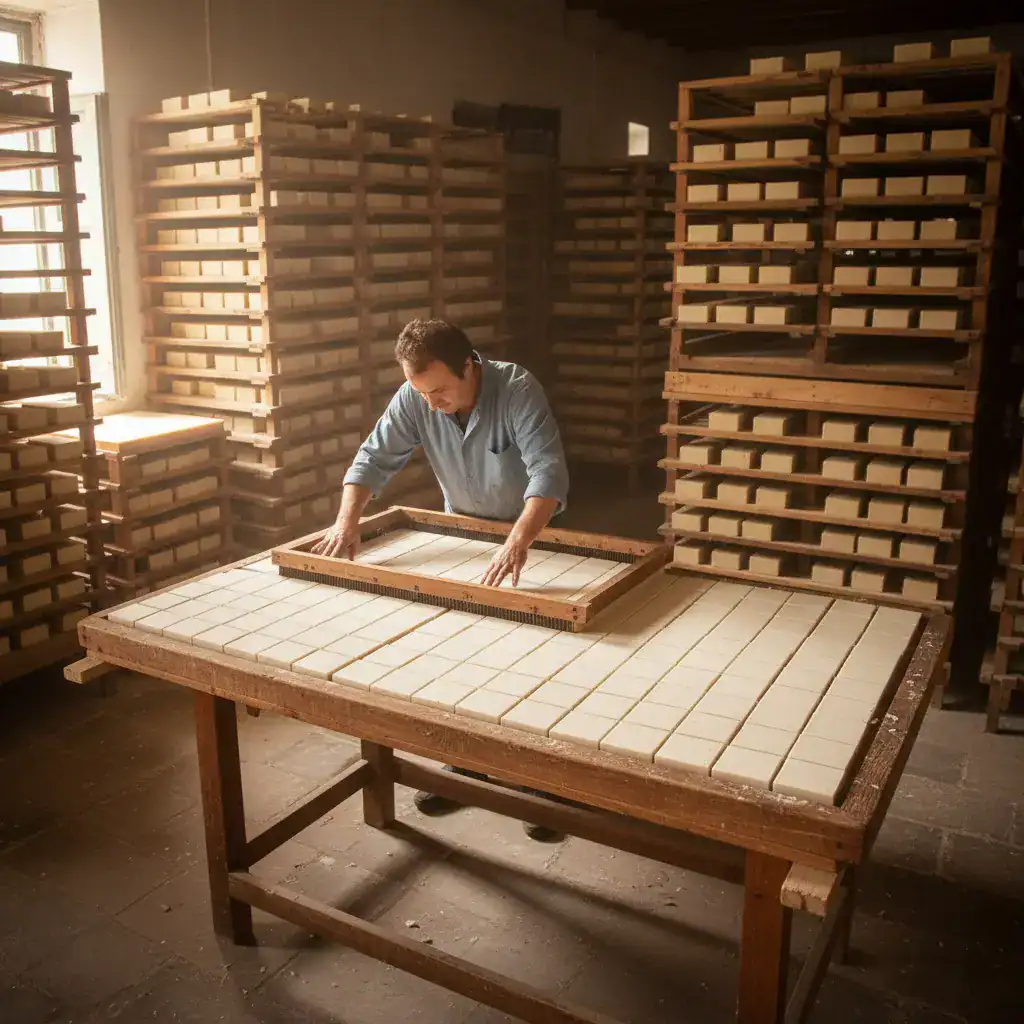
Production at the Patounis Soap Factory is based on a time-honored method, known as ‘baked saponification.’ Unlike modern cold methods, this process requires heating raw materials – primarily olive oil and olive pomace oil – in large cauldrons, where the chemical reaction that transforms oil into soap takes place.
The final product is a pure, traditional green soap, free from additives or colorants, maintaining the authenticity of its fatty components. The process demands experience and the continuous presence of the craftsman, as the success of production depends entirely on controlling the stages of ‘baking.’
Apprenticeship and Knowledge Transfer
The art of soap making is transmitted experientially within the family. The apprentice soap maker is trained alongside the experienced craftsman, observing every stage of the process, especially the critical cauldron stage. Learning is time-consuming and requires repetitive practice, which underscores the nature of the art as specialized knowledge rather than a simple productive activity.
From Prosperity to Industrial Challenge
During the 19th and early 20th centuries, soap making was a key sector of the economy in many Mediterranean regions, especially in olive-producing areas. However, with the development of synthetic detergents and the industrialization of production, traditional soap significantly declined.
Despite these changes, the Patounis Soap Factory managed to survive, maintaining its authentic production and adapting its activity to modern conditions without altering its traditional identity.
Cultural Significance and Contemporary Dimension
Today, the Patounis Soap Factory is not only a production unit but also a landmark for Corfu’s cultural heritage. The building itself, with its equipment preserved in situ, functions as a living museum, attracting visitors and researchers.
The production of soap from local raw materials connects the craft with the natural environment and the agricultural economy, while the international distribution of its products highlights the timeless value of traditional know-how.
A Tradition That Endures Through Time
The Patounis Soap Factory is a characteristic example of how a craft activity can evolve into an element of intangible cultural heritage. The preservation of techniques, family continuity, and adaptation to modern needs compose a dynamic tradition that continues to produce, educate, and inspire.
Source: https://www.dimokratia.gr/politismos/686875/kerkyra-i-saponopoiia-patoyni-os-zontani-viotechniki-paradosi-dyo-aionon/