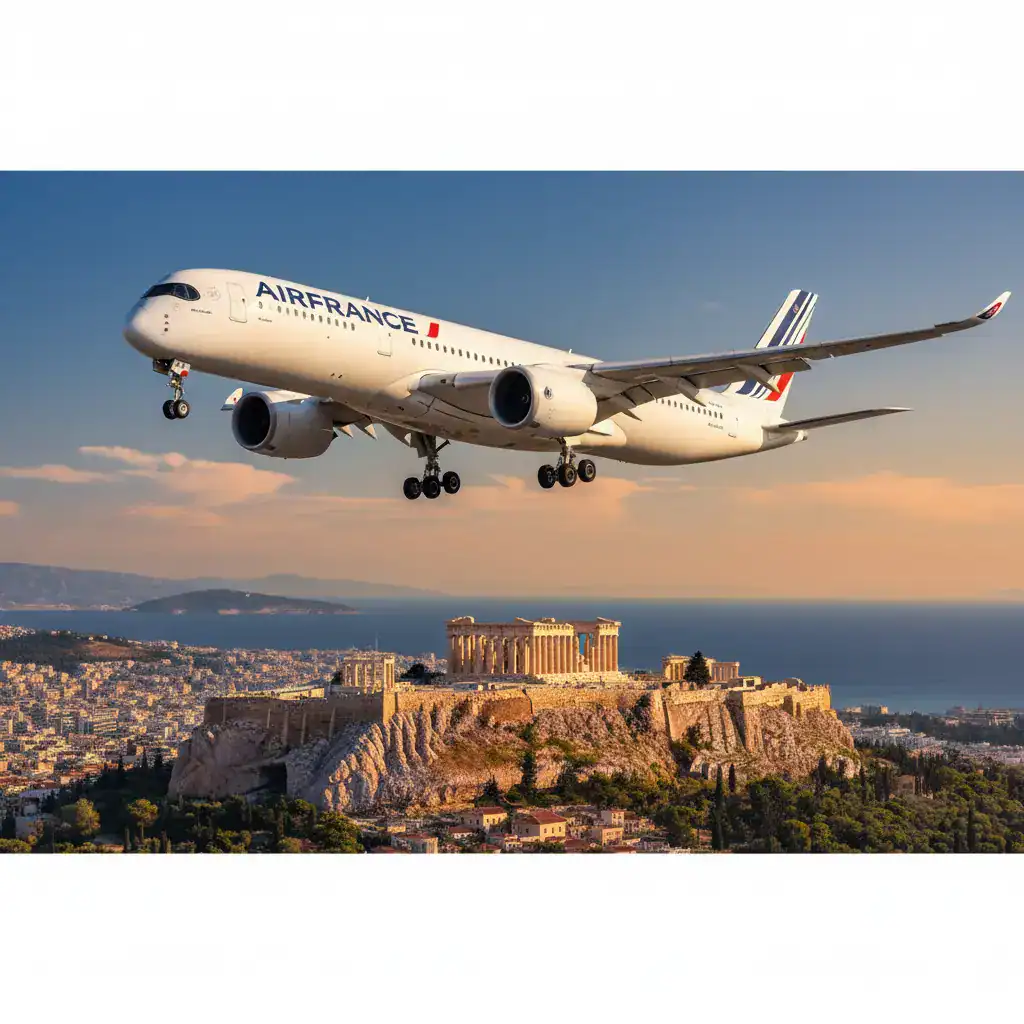
Athens, June 28, 2026 – Air France is commemorating a significant milestone: 70 years of uninterrupted flights between Athens and Paris. This enduring route, one of the longest-operating within Air France’s European network, symbolizes the strong and lasting connection between Greece and France. It has played a pivotal role in fostering tourism, facilitating business travel, supporting diplomatic relations, and aiding emigration over the past seven decades.
A Historic Air Bridge Since 1956
The direct air connection between Athens and Paris was inaugurated in the mid-1950s, with Air France launching its first non-stop service on June 20, 1956. This marked a crucial development in post-war European aviation, establishing a reliable air bridge between Southern and Western Europe. Over the years, the route has catered to a diverse range of travelers, including tourists exploring Greece’s rich heritage and islands, French visitors to Athens, business professionals, diplomats, and members of the Greek diaspora residing in France. This route has become a stable pillar of European short-haul connectivity, reflecting deep economic and cultural ties.
Evolution of Aircraft Technology
The Athens-Paris route has witnessed continuous technological advancements in aviation. Initially, Air France operated propeller-driven aircraft, with Athens serving as a strategic transit point for longer journeys towards the Middle East and Asia. With the advent of the jet age, the route transitioned to faster, higher-capacity aircraft, significantly reducing travel times and enhancing passenger comfort. Today, the service utilizes modern aircraft such as the Airbus A350, showcasing Air France’s commitment to fuel efficiency, reduced emissions, and enhanced passenger experience. This evolution underscores how legacy routes adapt to technological progress while maintaining operational continuity.
Greece: A Strategic Market for Air France
Air France’s engagement with Greece extends beyond the Athens-Paris connection. Historical aviation data indicates that the airline and its predecessors were active in the wider Eastern Mediterranean region during the early and mid-20th century, leveraging Athens as a key waypoint. The introduction of the direct Athens-Paris service in 1956 further solidified Air France’s presence in the Greek market, coinciding with the growth of international tourism to Greece. The development of Athens International Airport and the rise of Greek island tourism have significantly boosted passenger volumes on European routes, establishing Athens as a major aviation hub in Southeast Europe. Greece remains a crucial leisure and business destination within Air France’s European network, supported by consistent inbound and outbound traveler demand.
70-Year Milestone: A Testament to Stability
The 70-year continuous operation of the Athens-Paris route is a rare feat in European aviation, where routes often experience changes in operators or frequencies. This longevity is a testament to sustained demand, robust bilateral connectivity, and the strategic importance of both Athens and Paris within the European air transport system. Such long-standing routes typically connect major capitals, supporting tourism, trade, diplomacy, and the movement of diaspora communities. The Athens-Paris connection perfectly fits this model, linking two historically significant European capitals with strong cultural and economic bonds. Stable air corridors are vital for regional mobility and tourism development, particularly in destinations like Greece, where aviation plays a central role in supporting seasonal visitor flows.
Modern Fleet Enhances Passenger Experience
Today’s Athens-Paris flights are operated using Air France’s modern fleet, including the Airbus A350, which exemplifies the airline’s focus on fuel efficiency, reduced emissions, and superior passenger comfort. These aircraft feature improved cabin designs, quieter operations, and advanced in-flight systems. The deployment of modern aircraft on established European routes reflects Air France’s broader strategy of upgrading short- and medium-haul services while preserving historic connections. For passengers, this means the Athens-Paris route now seamlessly blends its historical legacy with contemporary aviation standards, offering faster, more comfortable, and more sustainable travel options.
Anniversary Promotion and Market Importance
To commemorate this 70-year milestone, Air France has launched a special promotional offer: a 70-euro discount per booking on flights departing from Athens to destinations across its global network. This initiative underscores the airline’s ongoing commitment to the Greek market and highlights Athens’ importance as a key European departure point within its route structure. Promotional pricing is a common strategy for legacy carriers to celebrate anniversaries, reinforce brand loyalty, and stimulate travel demand. This offer also reflects the competitive nature of European aviation, where targeted campaigns are regularly used to strengthen market presence in key international destinations.
Athens Airport: A Regional Gateway
The sustained operation of the Athens-Paris route also reinforces the broader significance of Athens International Airport as a regional aviation hub. Official airport statistics show substantial growth in passenger traffic over recent decades, driven by tourism, business travel, and connectivity to major European capitals. As Greece continues to bolster its tourism sector through government initiatives and infrastructure investments, Athens remains a critical gateway for both inbound international visitors and outbound Greek travelers. Routes like Athens-Paris contribute significantly to this role by ensuring consistent connectivity between Southern Europe and major Western European hubs, supporting both short-break tourism and long-term economic ties.
Seven Decades of Aviation Partnership
The 70-year milestone represents more than just a commercial route; it signifies a long-standing aviation partnership between France and Greece, built on sustained passenger demand and mutual connectivity needs. Over time, the route has evolved from a post-war air link into a modern European travel corridor, facilitating millions of passenger journeys across generations. It has adapted to shifts in tourism patterns, airline technology, airport infrastructure, and passenger expectations while maintaining uninterrupted service. This continuity highlights the resilience of core European air routes that remain relevant despite changes in the global aviation landscape.
Air France Strengthens European Identity
As Air France continues to modernize its fleet and expand its international network, the Athens-Paris route stands as a powerful symbol of the airline’s enduring European identity. It reflects a strategic balance between preserving heritage routes and implementing a future-focused aviation strategy. The airline’s ongoing investments in modern aircraft, sustainable operations, and enhanced passenger services demonstrate how legacy carriers are adapting to new market conditions while preserving historic connections. The Athens-Paris service remains a key component of this strategy, linking two major capitals and reinforcing Air France’s pivotal role in shaping European aviation connectivity.
A Landmark Anniversary for European Aviation
The 70th year of Athens-Paris flights is an impressive record for European aviation. Very few airline connections have been maintained for such an extended period, making this route a benchmark for international flight stability. This anniversary underscores that while aviation technology evolves and passenger requirements change, certain fundamental international routes, built on strong bilateral relations, remain active for many years. With this upcoming 70-year anniversary, the Athens-Paris connection will continue its mission as an important channel of contact between two of Europe’s main centers. With modern aircraft, high passenger demand, and ongoing promotional activities, this route is as relevant today as it was in 1956.
Source: https://www.travelandtourworld.com/news/article/iycac4pk5xlk/