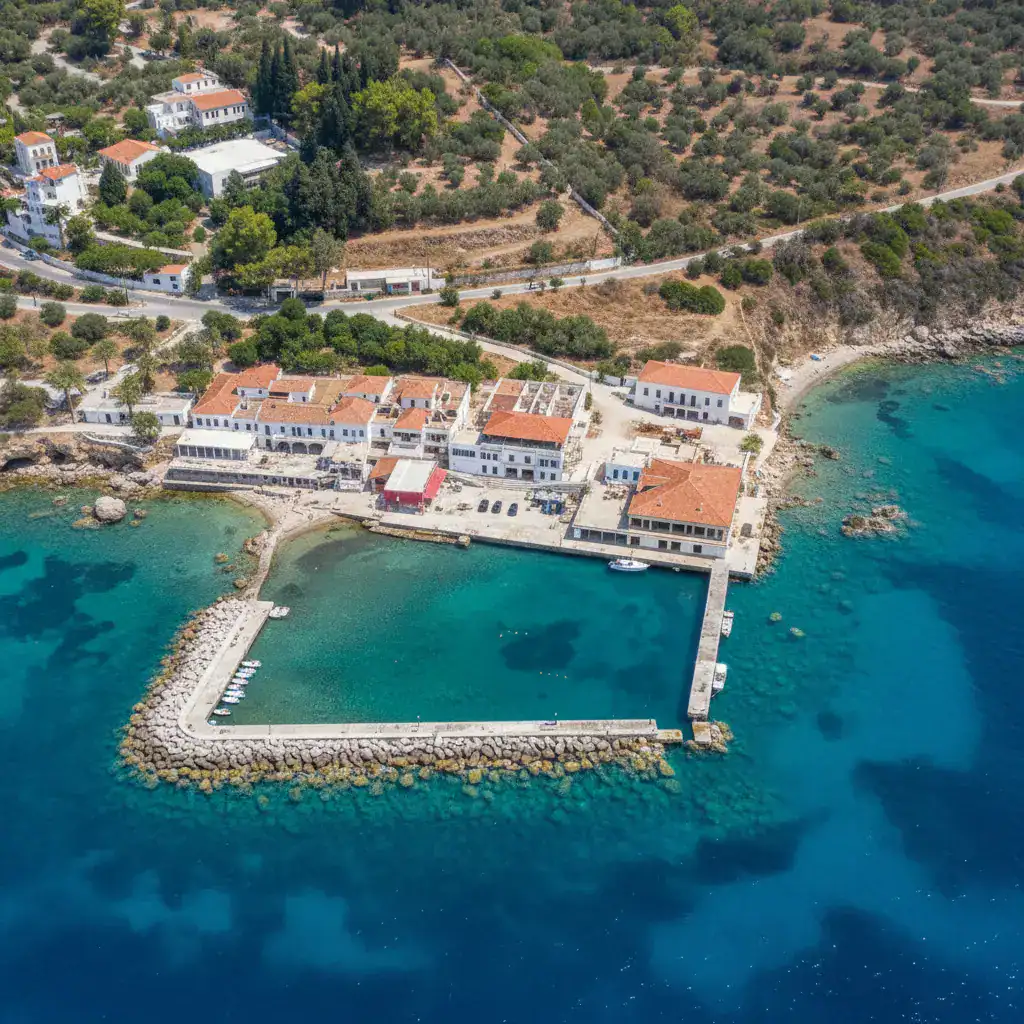
The recent decision by the Ministry of Culture concerning the facilities of the Nautical Athletic Club of Corfu (NAOK) is not the definitive conclusion to the legitimation and regularization process that it might initially appear to be. While the Ministry granted its consent for the use of the facilities and approved the relevant Environmental Commitments Study, it simultaneously imposed a series of substantial conditions and interventions that must be implemented before the process can be finalized.
The Provisional Nature of the Approval
Of particular importance is condition 6 of the decision, which stipulates that the modified architectural study, adapted to the terms set by the Ministry of Culture, must be resubmitted to the competent services of the Ministry of Culture for examination by the Central Archaeological Council (KAS). In essence, the matter is far from concluded within the Ministry of Culture. Instead, the procedure mandates a new review of the study by the KAS after all required changes have been incorporated.
The Administrative Labyrinth
The prescribed administrative route is as follows:
- NAOK (if it is a legal user) must prepare a new architectural study in accordance with the terms set by the Ministry of Culture.
- The study will be submitted to the Ephorate of Antiquities of Corfu.
- The prescribed opinions and controls will be requested from the co-competent services, including the Ephorate of Underwater Antiquities.
- The file will be forwarded to the Directorate of Byzantine and Post-Byzantine Antiquities of the Ministry of Culture, which will evaluate the study and make a recommendation.
- Subsequently, the case will return to the Central Archaeological Council for a new opinion.
Only if the KAS issues a positive opinion will the relevant ministerial decision be issued, and the Ephorate of Antiquities of Corfu will approve and certify the study. This new approval is a crucial prerequisite for the subsequent stages of the process concerning the legitimation and concession of use of the facilities in accordance with Article 14A and Article 18A of Law 2971/2001.
Unanswered Questions Plague the Process
Concurrently, the documents referenced in the Ministry of Culture’s decision raise several unanswered questions:
- Undisclosed Document: The decision explicitly refers to document No. prot. ktim. 128194 APA 2025/29.10.2025 from the Corfu Cadastral Service to the Ephorate of Antiquities of Corfu. The content of this document has not been publicized, and it remains unknown what information or findings it contains.
- Timeliness of Application: According to the circular of the General Secretariat of Public Property (190959 EX 2025), the special procedure applies to applications submitted by April 23, 2024. Therefore, the question arises whether NAOK’s relevant application was indeed submitted within the prescribed exclusive deadline. The answer to this question is critical, as it determines the application of the special legitimation regime.
- Missing Static Studies: The 2019 circular of the Ministry of Finance explicitly states that the file must mandatorily be accompanied by an approved static study of all works and facilities to be granted, as well as an approved environmental impact study. Therefore, the question arises whether the required static studies for all facilities were submitted and approved when the file was submitted.
The Role of the Cadastral Service
Furthermore, the same circular stipulates that the Cadastral Service must:
- Check the completeness of the file.
- Conduct an on-site inspection.
- Identify the works and facilities to be legalized.
- Ascertain whether there are additional unauthorized constructions not included in the application.
- Only after completing the above checks, proceed to the next stages of the procedure.
Consequently, it is of particular interest whether these prescribed checks were carried out, what their findings were, and whether additional unauthorized constructions beyond those included in the file were recorded.
Broader Implications and Ongoing Concerns
The essence is that the recent decision of the Ministry of Culture constitutes an important but intermediate step in the process. The final judgment on the modified architectural study rests once again with the Central Archaeological Council, while critical issues remain open regarding the completeness of the file, the static studies, the inspections by the Cadastral Service, and the fulfillment of all conditions set by law for the legitimation and concession of the facilities.
It should be noted that the Head of the Corfu Urban Planning Department has not responded regarding:
a) the static adequacy of the building, and
b) completely ignores (knowingly) that the ownership of these specific unauthorized constructions has not been granted.
Indeed, the entire case is pending before the Public Prosecutor of Corfu. Despite the revocation of the operating license for the catering establishment in the specific area, it continues to operate normally (in the NAOK area) with a temporary decision from the Administrative Court of First Instance of Corfu (without taking into account (?) that there are problems of static adequacy!).
The protracted nature of this case underscores a broader issue of administrative efficiency and adherence to regulatory frameworks within local government and national ministries. The lack of transparency regarding crucial documents and the apparent circumvention of established procedures raise concerns about accountability and the equitable application of the law. For Corfu, a region rich in archaeological heritage, the meticulous adherence to such regulations is not merely bureaucratic but essential for safeguarding its cultural and environmental integrity.
The ongoing saga of NAOK’s facilities serves as a stark reminder that even seemingly straightforward administrative processes can become entangled in a web of legal ambiguities and political considerations, ultimately delaying essential decisions and leaving critical questions unanswered.