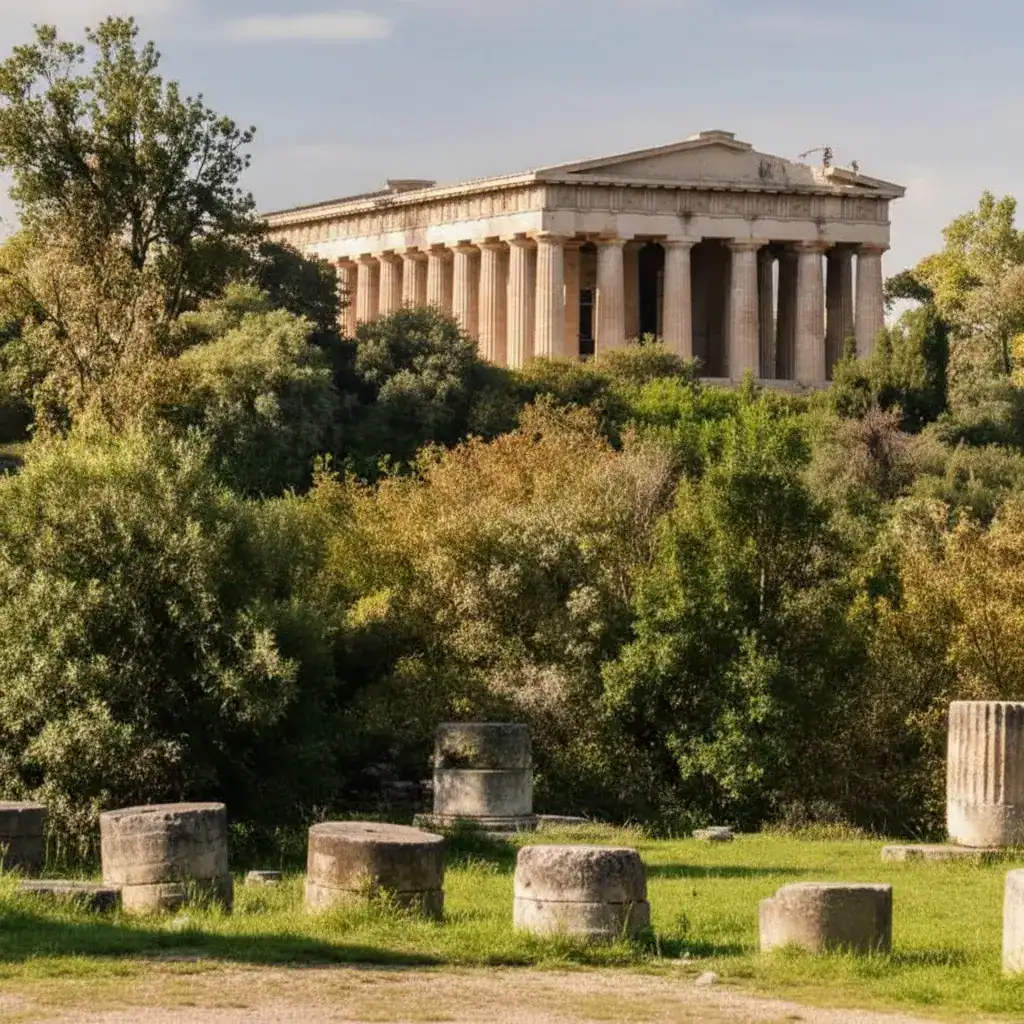
The morning light slants across the Ancient Agora, catching the honeyed stone of the Temple of Hephaestus. Tour groups hum past in a dozen languages, while a school class quietly counts Doric columns. In this city, known for being noisy and singular, a quiet detail hangs in the air like incense: its name. Athens, the guide explains, has always been plural.
If you walk the ridges of Attica, it starts to make sense. Before boulevards stitched together the plains and the metro carved its tunnels, the land was dotted with villages scattered like beads – hill towns, farms, and sanctuaries. Old stories say their union came with Theseus, who brought separate communities into one polity through synoecism, or “living together.” The name that survived wasn’t a boast but a map: Athenai (Ἀθῆναι), which literally means “the Athenses.”
A plural city before it was one
In ancient times, this plurality simply reflected the reality. The city’s center was just one part of a larger whole, which included ports at Piraeus, sacred roads leading to Eleusis, and small villages tucked into terraced hills. The name “Athenai” recognized a collective identity, more like a chorus than a solo performance. Other places showed the same grammatical pattern – such as Thebes (Θῆβαι) and Mycenae (Μυκῆναι) – but Athens was the one that carried its plural identity the furthest.
The plural that crossed languages
When the Romans began speaking of Greece, they kept the plural form – Athenae – and from there it spread. The echo can still be heard in modern languages: English Athens, French Athènes, Spanish Atenas, and Italian Atene. That “s” at the end is like a fossil, an impression of an older landscape preserved in our daily speech. When you say the word, you are unknowingly naming the collection of communities that Theseus once brought together.
From Athenai to Athina
Centuries later, as a new Greek state took shape in the 19th century, the language adapted to the modern city. Common speech adopted the singular form, Athina, to reflect a capital that was now a single entity. The change also had a nice ring to it: Athina sounds like Athena, the city’s patron goddess who won its loyalty with an olive tree, symbolizing wisdom, peace, and endurance. The grammar simplified, but the symbolism grew richer.
But language has a memory. On the stones above the Agora, the plural form lives on in the words we borrow and in the way maps label the city outside of Greece. Down in Plaka, a shop sign places “ATHENS” next to “ΑΘΗΝΑ”; on the Metro, neighborhoods introduce themselves like verses in a long poem – Thiseio, Kerameikos, Monastiraki – each one a note in an ancient harmony. The plural city is still present, hidden within the singular name, reminding us that Athens was many things before it became one.
Source: https://greekreporter.com/2025/10/30/ancient-greek-origin-athens-plural/