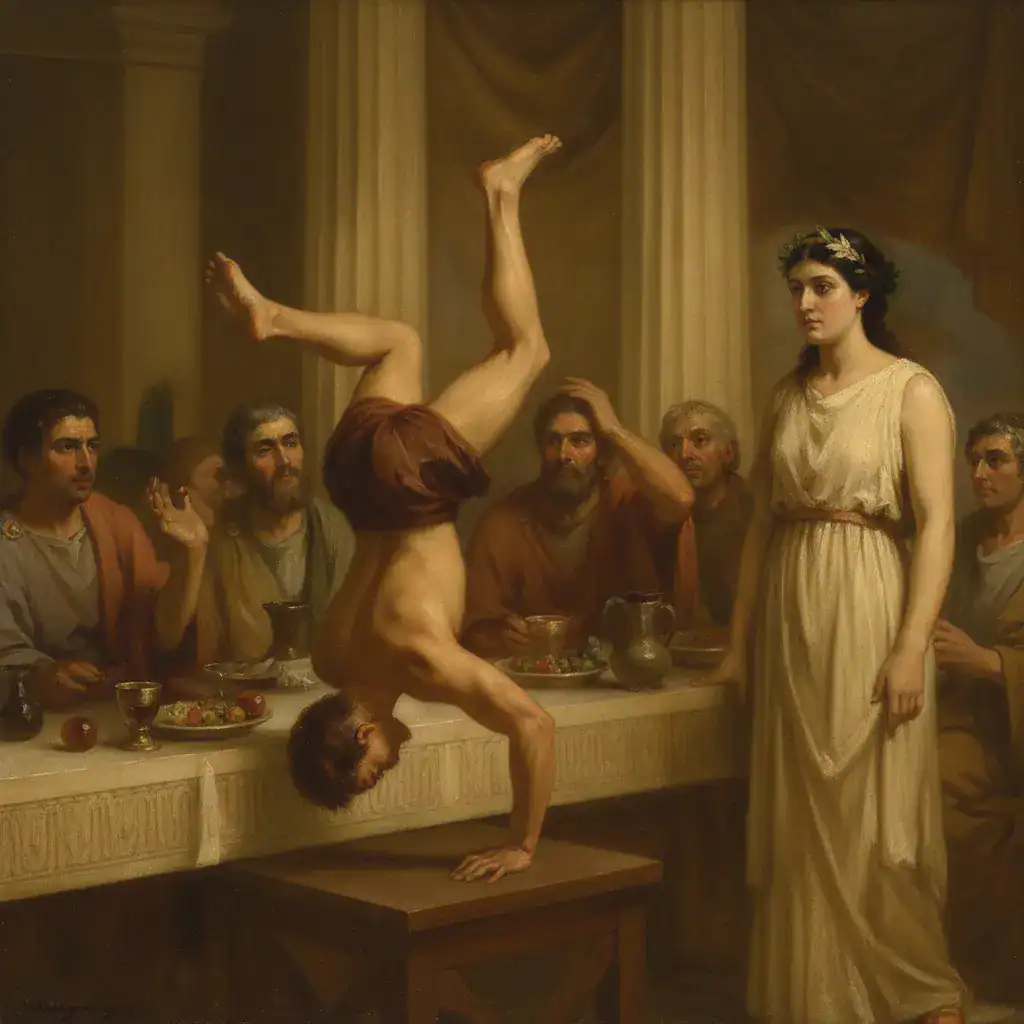
Near the end of the 6th century BC, a seemingly ordinary marriage contest on the Greek mainland unfolded into a series of unforeseen events, culminating in a legendary drunken dance that, against all odds, paved the way for the birth of Athenian democracy. No one present could have possibly grasped the profound historical significance of the spectacle they were witnessing.
A Tyrant’s Grand Vision for His Daughter
Cleisthenes, the formidable tyrant of Sicyon, a thriving city-state in the northern Peloponnese, announced his ambitious quest to find a husband for his daughter, Agariste. His declaration was clear: only the finest man in all of Greece would be deemed worthy. This grand gesture, seemingly a traditional aristocratic display of wealth and status, was destined to become far more consequential than anyone could have predicted.
Cleisthenes, a leading figure of the Orthagoras dynasty, had meticulously built his reputation through a blend of shrewd political maneuvering and military triumphs, including a pivotal role in the First Sacred War. Victorious, wealthy, and widely respected, he began to contemplate his legacy, with his daughter’s marriage at its core. By uniting his family with one of Greece’s most prestigious lineages, he aimed to elevate Sicyon’s standing and ensure Agariste’s future with a man whose influence matched his own aspirations.
The Contest Begins: A Stage Set for Destiny
Cleisthenes strategically chose one of the great Panhellenic festivals-either the Olympic or Pythian Games-to announce his contest. The news spread rapidly across the Greek world: within sixty days, any young man of noble birth and proven excellence was invited to Sicyon to vie for Agariste’s hand. The response was overwhelming. Herodotus recounts suitors flocking from far-flung cities like Sybaris and Siris in Magna Graecia, and from distant colonies such as Trapezus and Epidamnus.
Among the impressive array of candidates, two Athenians quickly captured attention: Megacles of the esteemed Alcmaeonid family and Hippocleides, both hailing from powerful and prestigious Athenian lineages. Cleisthenes, a seasoned ruler, understood that appearances could be deceptive. He was determined to select a son-in-law based on more than just looks or reputation. He transformed his city into a prolonged festival, constructing a racetrack and wrestling grounds, and spent months meticulously observing the suitors.
They raced, wrestled, trained in the gymnasium, and dined at his table, all under his watchful eye. Herodotus highlights Cleisthenes’ keen observation of their behavior during meals, their conversational skills, their handling of wine, and their interactions with others. Through this deliberate and extended competition, the field gradually narrowed, with Megacles and Hippocleides emerging as the most impressive contenders, setting the stage for the legendary drunken dance that would inadvertently shape the future of Athenian democracy.
The Feast, the Dance, and the Unraveling
The culmination of the contest was a lavish banquet hosted by Cleisthenes. He reportedly sacrificed a hundred oxen, and the tables groaned under the weight of an abundance of food and wine, creating a spectacular display of wealth and hospitality. After the feasting, two final competitions were announced: one in speaking and storytelling, and another to showcase each man’s musical taste and skill.
Hippocleides excelled in both. His eloquence, wit, and polished demeanor impressed everyone, and his easy charm and musical appreciation made him seem the ideal aristocratic son-in-law. As the evening progressed and the wine flowed freely, Cleisthenes found himself increasingly drawn to Hippocleides, envisioning him as Agariste’s future husband. But then, a moment of profound indiscretion undid it all.
Overcome by wine, music, and his own ego, Hippocleides decided to entertain the company with a dance. However, instead of remaining on the floor, he climbed onto a table and performed a series of increasingly wild and showy moves: first a Laconian style, then an Attic one, and finally a personal, improvisational routine that pushed the boundaries of propriety. The performance reached its shocking climax when Hippocleides stood on his head, legs kicking to the music, accidentally exposing himself to the assembled guests and to Cleisthenes. For a man courting a tyrant’s daughter, this was more than just bad manners; it was a stunning display of shameless carelessness. This infamous drunken dance would become legendary, not only for its audacity but also for its indirect role in shaping the future of Athenian democracy.
Cleisthenes was furious. All admiration for Hippocleides evaporated. He declared that Hippocleides would certainly not be marrying his daughter. Hippocleides, beyond shame, famously retorted with the line that echoed through Greek proverb: “Hippocleides doesn’t care” (Ού φροντίς Ιπποκελίδη – Ou frontis Hippocleidi), words that came to symbolize total indifference to disgrace or consequences.
With Hippocleides eliminated by his own recklessness, Cleisthenes turned to the other Athenian, Megacles, who had maintained his composure and dignity throughout. Megacles, from the influential Alcmaeonid clan, was already a prominent figure in Athenian affairs. Cleisthenes offered Agariste to Megacles, sent the rejected suitors home with generous silver gifts, and thus concluded the contest that had captivated the Greek world.
The Drunken Dance: An Unlikely Catalyst for Democracy
The true significance of Agariste’s marriage to Megacles can only be fully appreciated in light of the events that followed. Agariste and Megacles had a son, another Cleisthenes, who was raised in a family steeped in aristocratic tradition, political acumen, and ambition. These formative experiences shaped Cleisthenes of Athens’ understanding of power, instilling in him an acute awareness of both the perils of tyranny and the potential for a complete transformation of Athens. In a profound and unexpected way, the infamous drunken dance that determined his parents’ marriage indirectly set the stage for the rise of Athenian democracy.
By the late 6th century BC, Athens was a cauldron of simmering tension. Cleisthenes of Athens, leveraging his family’s wealth, networks, and established reputation, emerged as a spokesman for the broader populace. He skillfully outmaneuvered his aristocratic opponents and introduced a genuinely revolutionary concept: a political system that loosened the direct grip of the aristocracy and empowered the people more than ever before. Thus, Athenian democracy began to take root, its genesis traceable back to a lavish marriage contest and a fateful drunken dance.
Source: https://greekreporter.com/2025/12/07/drunken-dance-democracy-ancient-greece/