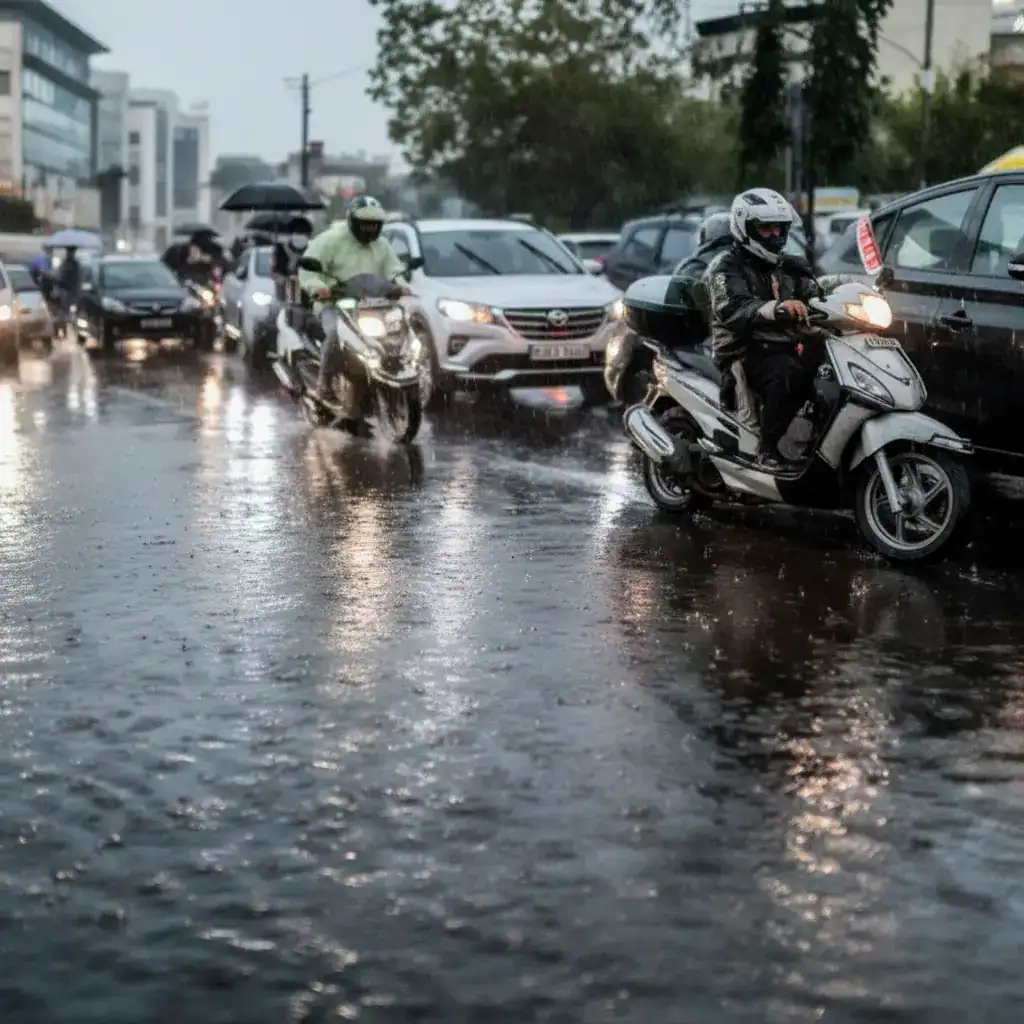
Athens, November 28 – Storm Adel has caused significant problems across Attica, with two intense storm fronts, beginning on Thursday evening and peaking in the early hours of Friday, turning roads into rivers and making travel exceptionally difficult due to water accumulation. This rapid transformation of streets into waterways occurred within a short period.
Significant Rainfall Recorded Across Attica
Considerable rainfall was recorded across Attica during Storm Adel. Data from 101 meteorological stations indicated that in many areas, from early Friday morning until 09:00 AM on November 28, over 40-50 millimetres (mm) of rain fell. This is particularly noteworthy given that the average monthly precipitation for November/December in Athens typically ranges from 70-100 mm.
According to the rainfall map, the highest amounts were recorded in Faliro with 52 mm and Alimos with 50 mm, highlighting the severe impact on the southern coastal areas of the basin. Very high values were also noted in Kifissia with 50 mm and Ekali with 48 mm, indicating that the northern suburbs were also at the core of the intense phenomena.
In the western areas, Peristeri recorded 41 mm and Haidari (Forest) 40 mm, rainfall quantities equivalent to a ‘full’ month during milder periods. To the east, Malakasa saw 34 mm, while on the island of Aegina, the station registered 49 mm, demonstrating that the Saronic Gulf was heavily affected by the storm zone.
Overall, the map depicts an extensive area of heavy rainfall over most of Attica, with a locally maximum daily rainfall reaching approximately 86 mm at an individual station.
Why Athens Flooded with Just 40 Millimetres of Rain
Meteorologist Theodoros Kolydas explained in a social media post why Attica experienced flooding with only 40 millimetres of rain.
“Since yesterday, we had mentioned the possibility of a double passage of storms over Attica. Indeed, the first wave occurred late at night, and the second followed in the early morning, bringing intense phenomena once again to the dense urban fabric of Athens.
Data from the EAA/meteo station network recorded a high amount of rain which, in the centre of Athens, reached 40 mm, while in areas such as Zografou and Goudi, it exceeded 38-39 mm. And this number alone was enough to cause local water accumulations, traffic delays, and minor floods on roads that are difficult to drain,” Kolydas initially stated.
He noted that it is not an exaggeration to say that Athens “flooded” with 40 millimetres. As the meteorologist explained, 40 millimetres in an urban environment – with dense construction, small streams, and minimal absorbency – are already capable of creating problems.
“To understand what it means for 100 or 200 millimetres to fall in an area, consider that in Epirus, within a similar timeframe, we saw precipitation reaching these values, which burden rivers, aquifers, and mountainous catchment areas – much more vulnerable to sudden flood reactions than Athens. Even if Attica struggles with 40 mm, imagine the burden in an area where quantities triple or quintuple,” Kolydas pointed out.
How Can Such Situations Be Avoided?
The meteorologist concluded his post by discussing the causes and potential solutions to avoid such difficult situations.
“Attica – and the country in general – still has areas where radar coverage is insufficient. This makes it difficult to assess rainfall intensity and provide operational warnings in a timely manner. However, today there are alternative tools that can give a 1-2 hour warning, such as satellite products and forecast models that can detect the development of storm tops and the intensity of cloud nuclei. Many of these accurately predict the location and intensity of Mediterranean storms a few hours before they occur.
Today’s bad weather once again demonstrated that even quantities of 35-40 mm can create significant impacts in Attica. At the same time, it reminded us how crucial it is to utilise every available warning tool, especially in a country where radar infrastructure has gaps, phenomena are becoming more frequent and intense, and operational response time is precious. With better utilisation of satellite products and models, a 1-2 hour warning is absolutely feasible – and in several cases, decisive,” Kolydas concluded.
Source: https://www.ertnews.gr/eidiseis/ellada/sarotiko-to-perasma-tis-adel-stin-attiki-i-athina-plimmyrise-me-molis-40-xiliosta-vroxis-giati-synevi-ayto/