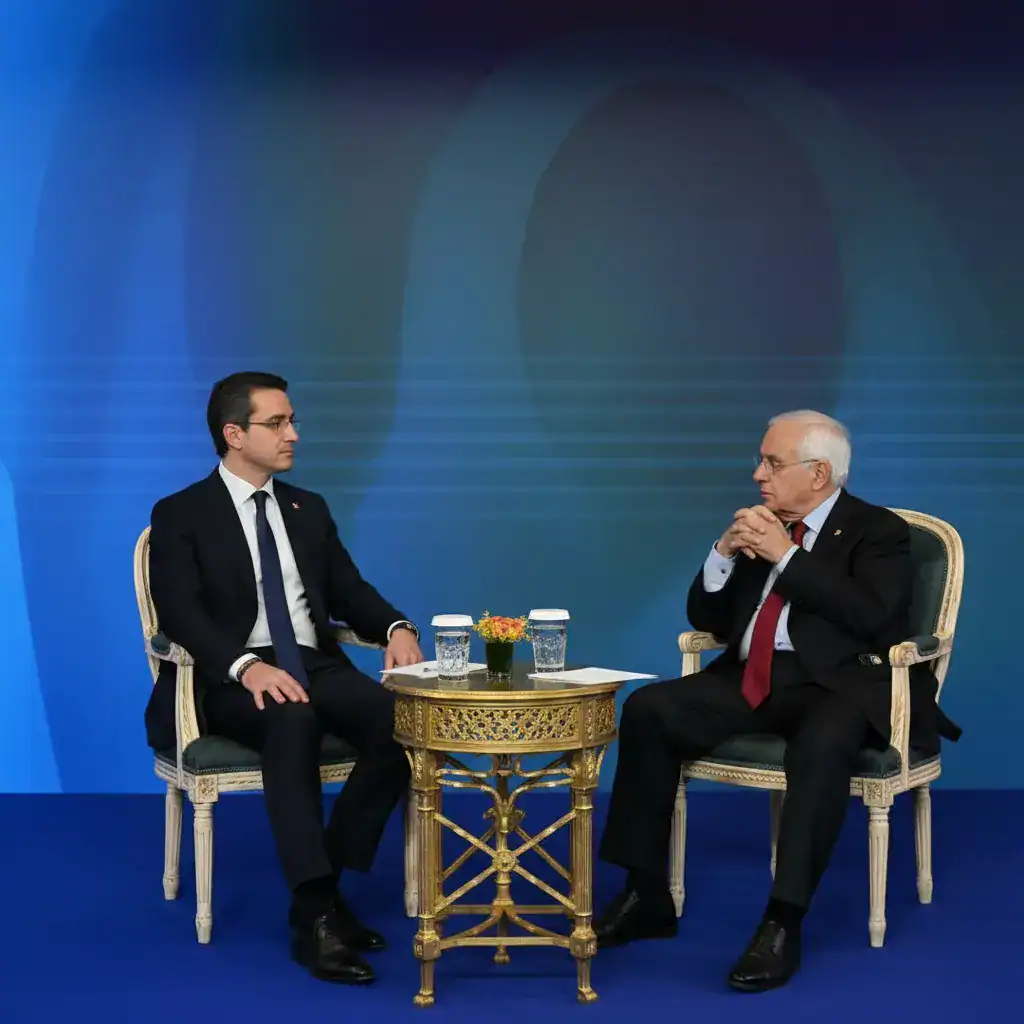
Greek Prime Minister Kyriakos Mitsotakis brought the second annual Athens Policy Dialogues event to a close on Friday, engaging in a comprehensive interview that covered foreign policy, domestic issues, and potential election scenarios. The event, themed ‘The Eastern Mediterranean in Flux’, was hosted by the Delphi Economic Forum, The Council – Greece in Global Affairs, and the historic Athens weekly “To VIMA” (Το Βήμα).
Maintaining an ‘Operational’ Relationship with Turkey
During his discussion with To Vima publisher Yiannis Pretenteris, Mitsotakis articulated his government’s primary foreign policy objective: fostering an ‘operational’ relationship with Turkey, a nation he characterized as often challenging. He asserted that Greece’s strategy is fundamentally geared towards regional stability, which includes a concerted effort to reduce tensions with Turkey. This approach, he noted, has already yielded positive results in moving towards a more functional relationship, while simultaneously consolidating national positions to ensure dialogue with Ankara does not compromise Greek interests.
Mitsotakis highlighted that conditions are now conducive for another session of the High-Level Cooperation Council (HLCC) between Greece and Turkey, anticipated in the first half of 2026. He recalled that bilateral relations were ‘alarmingly tense’ prior to the signing of the ‘Athens Declaration,’ an understanding that, according to Mitsotakis, confirmed the potential for a functional relationship between the two countries. This functionality is evidenced by successful cooperation in managing migration flows, an area where ‘tangible positive results have been achieved.’
However, Mitsotakis also drew clear lines, emphasizing that de-escalation does not equate to a retreat on matters of principle. He cited Greece’s demand for Turkey to rescind its 1995 grand assembly resolution, which declared Greece’s right to extend territorial waters in the Aegean beyond six nautical miles as a cause of war (casus belli), as a prerequisite for Turkey’s participation in European defense programs like the SAFE scheme. Conversely, he lauded the highly successful fast-track tourist visa scheme, which has allowed tens of thousands of Turkish citizens to visit 12 eastern Aegean islands by streamlining bureaucratic processes.
The Complexities of the Libya Issue
Addressing the situation in Libya, Mitsotakis acknowledged its inherent complexities. Nevertheless, he underscored a significant achievement of Greek foreign policy: maintaining a stable communication channel with ‘both sides of the Libyan reality’ – a reference to the rival governments in Tripoli and Benghazi. Libya gained prominence in Athens’ foreign policy considerations in 2019 following the internationally recognized provisional government in Tripoli’s controversial maritime delimitation agreement with Turkey. Athens, along with the EU and other regional actors, has consistently deemed this agreement baseless and illegal, noting how it effectively ‘erases’ Greek island territory, including Crete, from the map to suggest a direct border between Asia Minor and Libya’s North African coasts. Regarding illegal migration originating from Libya, Mitsotakis indicated an improved situation compared to the preceding six months, further underscoring Libya’s critical role in the East Mediterranean’s geopolitical calculus.
Greece’s Enduring Relationship with Israel
Mitsotakis also turned his attention to Greece’s strategic relationship with Israel, a partnership he described as possessing deep roots and substantial content, exemplified by the ‘3+1 format’ involving Greece, Israel, Cyprus, and the US. He reiterated Greece’s unwavering support for Israel’s right to self-defense following the October 7 Hamas attack, while also acknowledging that Israel’s military response sometimes exceeded necessary bounds.
Realism on the Cyprus Issue
On the protracted Cyprus issue, Mitsotakis stated that under the previous Turkish Cypriot leadership in the Turkish-occupied areas of the north, there was ‘no real room for progress.’ He firmly rejected Ankara’s stance on a ‘two-state solution,’ deeming it ‘unthinkable and unacceptable’ not only for Greece but for all parties involved in the process. Concluding his remarks on Cyprus, he stated, ‘I am not pessimistic about the Cyprus issue, but I am a realist.’
Source: https://www.tovima.com/politics/mitsotakis-closes-out-athens-policy-dialogues-with-wide-ranging-interview/