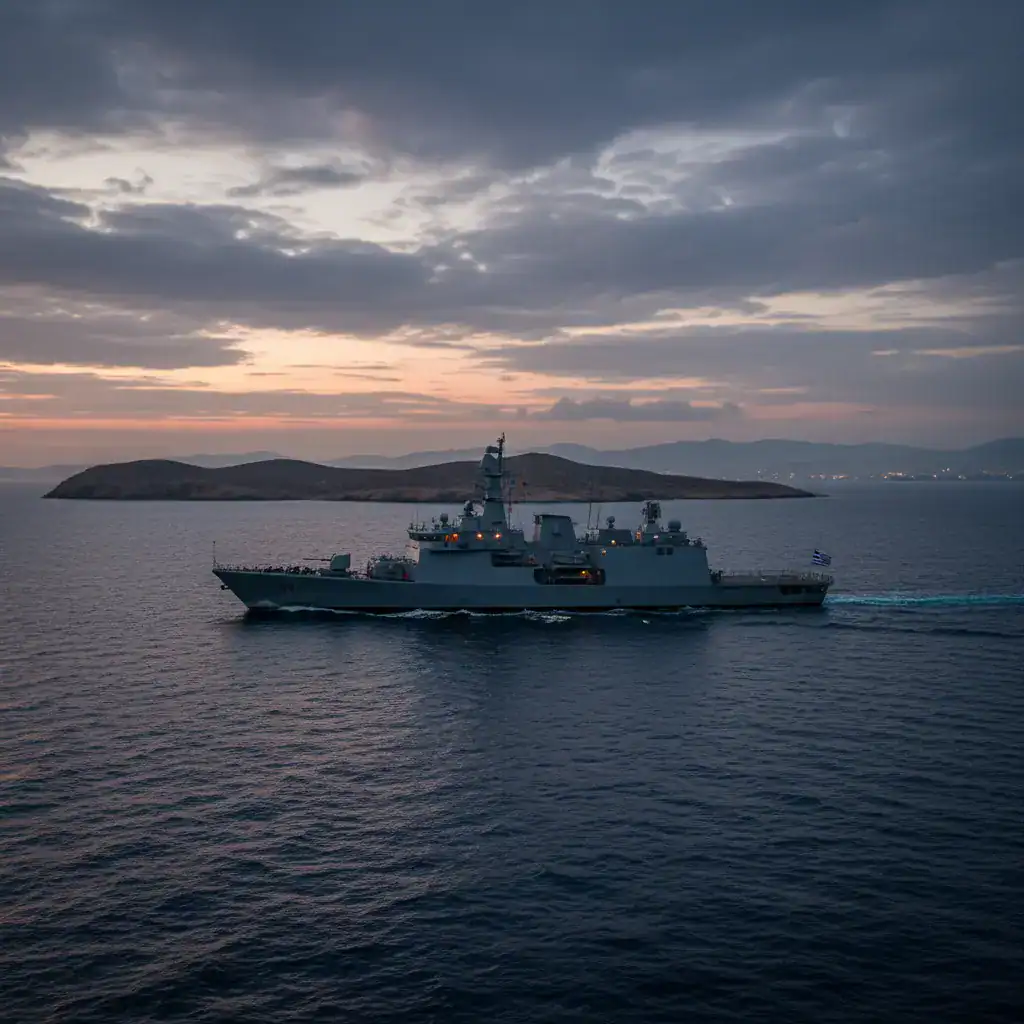
As the Middle East war continues to reshape global realities, Greece is actively recalibrating its defense posture, moving beyond immediate responses to current developments. This strategic shift, described by government officials as transforming Greece into a “security provider” for the wider region, involves a dual approach: strengthening existing alliances and forging new strategic footholds beyond the Eastern Mediterranean.
The “Cyprus Example” and a Strengthened Defense Footprint
The ongoing conflict has underscored the necessity for a robust defense strategy, with Greece already demonstrating a strengthened presence. This includes military assistance to Cyprus, the deployment of Patriot missile systems in Karpathos and Evros, and the involvement of a Greek Patriot battery in intercepting Iranian missiles over Saudi Arabia. These actions signal a clear intent to protect not only Greek territory but also the broader southern borders of the European Union, echoing the importance given to the EU’s eastern flank.
France and the Pursuit of European Defense Autonomy
A pivotal partner in Greece’s evolving defense strategy is France. Athens, under the leadership of Kyriakos Mitsotakis, is actively deepening bilateral ties with Paris, recognizing their shared strategic interests as traditional naval powers in the Eastern Mediterranean. A renewal of their defense agreement is anticipated in April, coinciding with President Emmanuel Macron’s visit to Athens. Sources indicate that both nations are exploring ways to reinforce the mutual defense clause established in their 2021 strategic partnership.
Flexible Alliances Over Grand European Plans
Recent events, particularly the defense of Cyprus, have brought a crucial realization to both Athens and Paris: smaller, more agile coalitions often yield more effective results on the ground. This was evident in the EU’s ASPIDES operation, where participating forces operated with varying degrees of commitment. The implication is clear: the vision of a fully unified European defense among all 27 EU members remains largely theoretical. Instead, Greece’s strategy now centers on pragmatic, smaller alliances, particularly for bolstering defense in the EU’s southern flank. At a recent EU summit, Mitsotakis and Nikos Christodoulides jointly advocated for an update to Article 42.7, the EU’s mutual defense clause, to clarify its activation protocols in the event of an external attack.
Turkey: A Persistent Strategic Rival
Athens and Nicosia are also proactively addressing the potential resurgence of Turkey’s revisionist agenda. Their aim is to establish an effective collective response mechanism, again relying on a “coalition of the willing.” While acknowledging that not all major EU powers, such as Germany, Spain, or the Netherlands, may actively participate, the focus remains on those prepared to offer tangible support, with France at the forefront. Greece maintains a cautious yet vigilant stance, closely monitoring Ankara’s increased activities in the Middle East. Concurrently, Greek Foreign Minister Giorgos Gerapetritis is pursuing renewed diplomatic engagement with Libya, with planned visits to Benghazi and Tripoli, as maritime boundary negotiations continue.
Turkey’s Expanding Regional Ambitions and Greece’s Gulf Strategy
Greek officials are closely observing the actions of Hakan Fidan, who has recently advanced military cooperation talks with Saudi Arabia and Pakistan, integrated Egypt into the broader regional equation, and promoted deeper defense collaboration across the Gulf. Turkey is increasingly positioning itself as a regional security guarantor, leveraging its defense industry and Iran’s weakening influence, with aspirations to lead the wider Muslim world.
However, Athens has also strengthened its ties with key Gulf players, notably Saudi Arabia and the UAE. Following the successful deployment of Greek Patriot systems, Mitsotakis engaged in talks with the Saudi Crown Prince, discussing renewed defense cooperation and the extension of the Greek Patriot battery’s deployment on Saudi territory, deemed crucial for Riyadh’s security amidst the ongoing conflict. Greek officials anticipate increased investment interest from Gulf countries and an acceleration of digital data connectivity projects.
The Trump Factor and a Delicate Balancing Act
The potential impact of Donald Trump remains a significant unknown. Following his renewed criticism of NATO, particularly after European allies rejected a US proposal to secure the Strait of Hormuz, Athens must now assess the future trajectory of transatlantic relations post-war. It is certain that the United States will recalibrate its strategy and presence in the Eastern Mediterranean once the regional balance clarifies. A senior diplomatic source, referencing comments by Matthew Whitaker, affirmed Greece’s status as a key ally on NATO’s southeastern flank, emphasizing that its relationship with Washington is not externally dictated and does not solely depend on the US president’s stance toward Europe.
The Greek government believes it has thus far maintained a careful balance between Brussels and Washington, strengthening ties through diplomatic contacts and energy agreements. However, initial fissures have emerged, particularly following Athens’ clear refusal to participate in a potential mission in the Strait of Hormuz. This has prompted Mitsotakis to call for a public debate on the crisis’s implications, especially the potential closure of the Strait. Experienced diplomats caution that Greece cannot afford to prematurely exclude itself from such initiatives, especially given the significant stakes for its powerful merchant shipping fleet. Nevertheless, any such decision carries substantial risks and potentially serious domestic political costs.
Source: https://www.tovima.com/politics/athens-redraws-defense-strategy-amid-mideast-war/