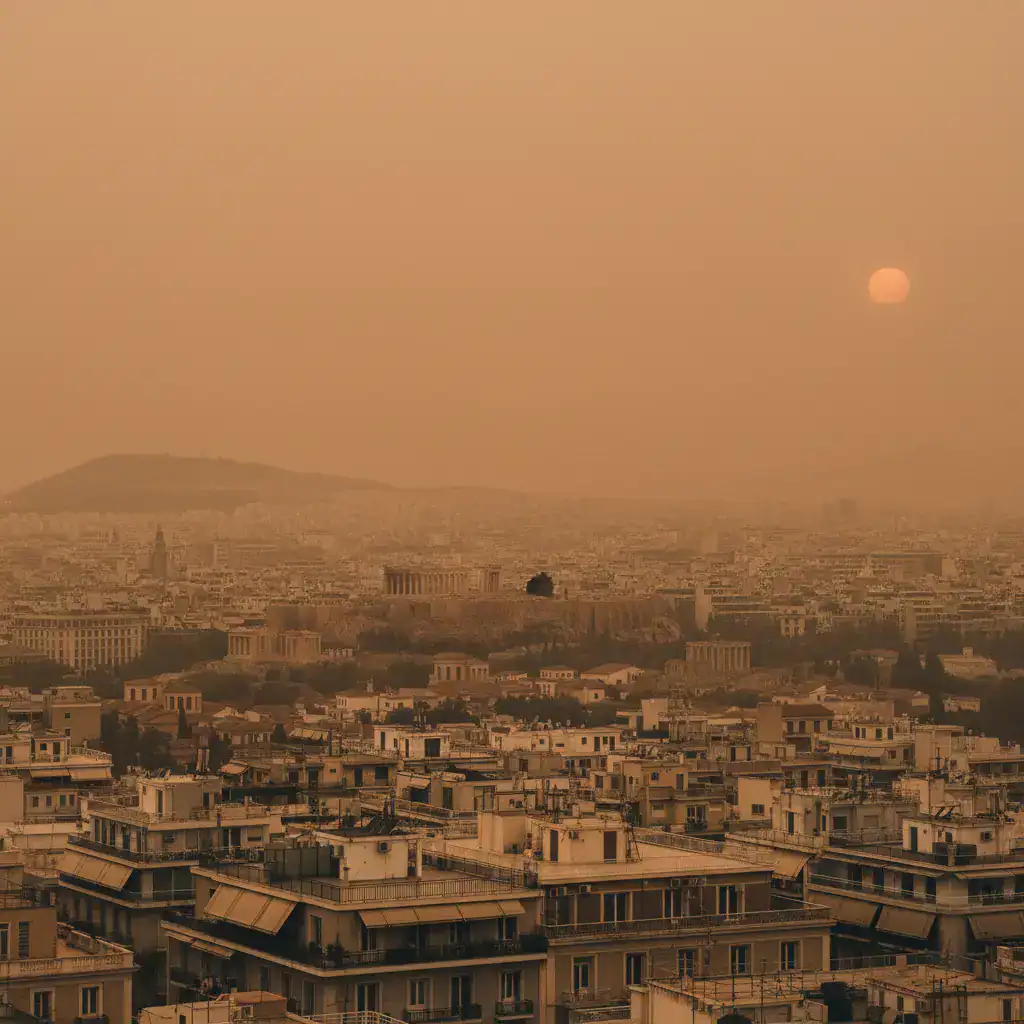
Athens and a large part of the Greek territory have been under a peculiar “orange” siege in recent hours, as the wave of African dust culminates, creating an eerie image in the Attic basin.
Saharan Dust Transforms Athenian Landscape
The phenomenon, which originated in the Sahara Desert, has covered the city’s emblematic landmarks with a thick layer of haze, affecting visibility and air quality. According to the National Observatory of Athens, concentrations of suspended particulate matter are expected to remain high until the early morning hours of tomorrow, when the shift in winds to westerly will begin to clear the atmosphere.
The photos that follow capture in the most impressive way the alteration of the Attic landscape. Below you can see Athens as we rarely see it: wrapped in the grains of sand that traveled thousands of kilometers from the Sahara to “cover” our daily lives.
Impact on Visibility and Air Quality
The dust storm has led to a significant reduction in visibility across the region. Residents and visitors have reported a noticeable change in the color of the sky, with a distinct orange hue dominating the horizon. Air quality has also been affected, with increased levels of airborne particles posing potential health concerns, particularly for individuals with respiratory issues.
Duration and Forecast
Experts from the National Observatory of Athens anticipate that the high concentrations of suspended particulate matter will persist until the early hours of Tuesday. A change in wind direction, shifting to westerly, is expected to gradually clear the atmosphere, bringing relief to the affected areas. Until then, authorities advise caution and recommend minimizing outdoor activities, especially for vulnerable groups.
Historical Context of Dust Storms
While such intense dust storms are not an everyday occurrence, Greece, due to its geographical proximity to the Sahara Desert, experiences these phenomena periodically. These events are a natural consequence of atmospheric conditions that transport dust from arid regions across vast distances. The current event, however, stands out for its intensity and widespread impact across the Attica region.
Visual Documentation of the Phenomenon
Photographs from across Athens vividly illustrate the extent of the dust storm. Images show iconic landmarks such as the Acropolis and the Parthenon shrouded in the orange haze, presenting a stark contrast to their usual appearance. These visual records underscore the dramatic impact of the natural phenomenon on the urban environment.
Public Health Advisory
In light of the elevated particulate matter concentrations, public health officials have issued advisories. Residents are encouraged to stay indoors, keep windows and doors closed, and use air purifiers if available. Those with pre-existing respiratory or cardiovascular conditions are particularly urged to take precautions and consult with their healthcare providers if they experience any symptoms.
The current African dust storm serves as a powerful reminder of the interconnectedness of global weather patterns and their potential to significantly alter local environments, even temporarily.