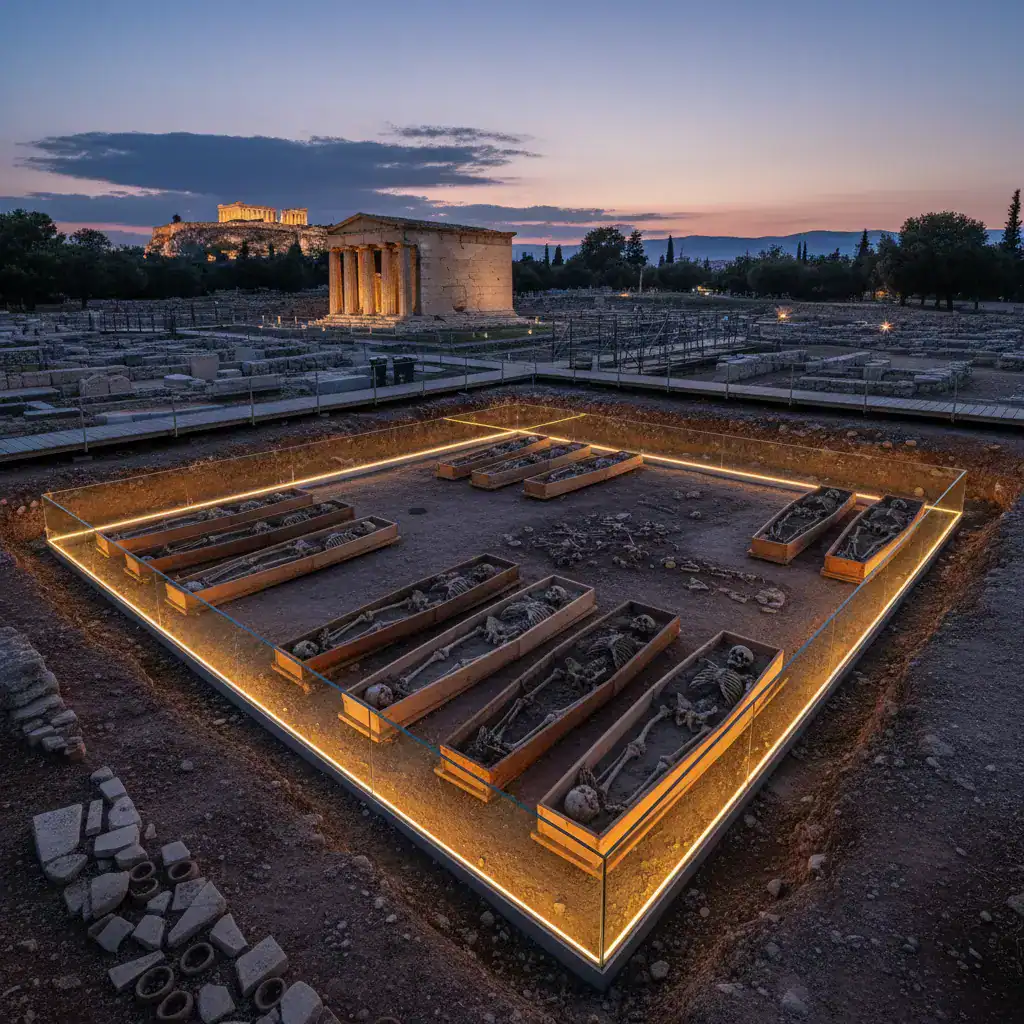
Athens, March 10 – The 2,700-year-old remains of dozens of youths, who were executed in a mass killing in ancient Athens, will be presented in a newly built display area later this year, a culture ministry official confirmed last Friday.
Discovery at Faliro Cemetery
The ancient cemetery in Faliro, located south of the Greek capital, has yielded approximately 2,000 deceased individuals of various ages, alongside several buried horses. In 2016, archaeologists uncovered 79 men arranged in three trenches, bound together in groups. Many of these individuals had corroded iron shackles around their wrists, and the majority were young adults or juveniles.
“They were in their prime and in very good physical condition,” stated Stella Chrisoulaki, the senior archaeologist overseeing the project, during a conference. She further noted that all had sustained a fatal blow to the base of the skull from a blunt instrument.
The ‘Captives of Faliro’
Dubbed the “Captives of Faliro” by the media, these skeletons were subsequently relocated for their preservation. Chrisoulaki informed AFP that the remains would be housed in a protective display area, slated for completion “at the end of summer.”
These men lived during the seventh century BC, a period characterized by significant upheaval in ancient Athens. Experts theorize that they were likely supporters of the Cylonian conspiracy, an unsuccessful attempt to seize power in the city, who were subsequently put to death.
According to the Swedish Archaeological Institute at Athens, which contributed to the investigation of these findings, this represents the earliest known mass burial of executed individuals in the broader Athens area. Archaeology Magazine recognized the “Captives” as one of the top 10 discoveries of 2016.
Further Discoveries and Ongoing Research
A significant portion of the ancient cemetery is believed to lie beneath a cultural center that was completed a decade ago. This section contains numerous other deceased individuals who were also likely subjected to torture before their deaths. Some were interred face-down, a sign of disrespect, while others were bound hand and foot, akin to livestock.
Separately, the American School of Classical Studies at Athens is currently examining 1,100 individuals from the site and is expected to release its findings in 2028, as reported by Chrisoulaki.