Athens Defence Summit: Collusion Allegations Cast Shadow Over High-Profile Event
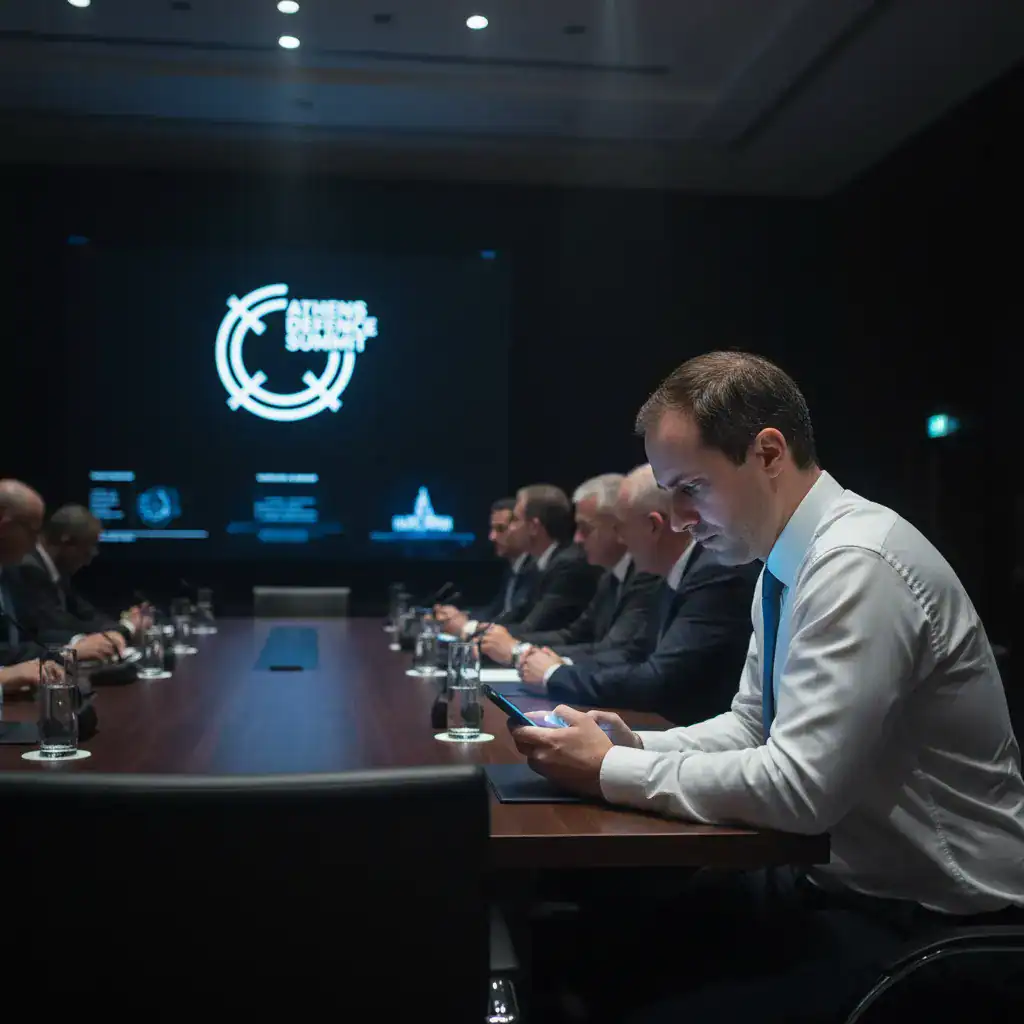
The Athens Defence Summit, a security conference held under the auspices of the national defence ministry, Hellenic Aerospace Industry (HAI), and Hellenic Defence Systems (EAS), is facing intense scrutiny. What was presented as a significant national security event has unraveled into a complex web of intertwined political and business interests, raising serious questions about transparency and ethical conduct within the Greek government’s orbit.
A Newly Formed Company at the Helm of a Major Conference
The core of the controversy lies in the organization of the summit by European Defence Summit PC, a private company established just 3.5 months prior to the event, in February 2026, with a modest share capital of 5,000 euros. Despite its nascent status, this company managed to secure the organization of a conference with sponsorships exceeding 1.5 million euros.
This decision bypasses established event management companies with proven track records, prompting an investigation into the rationale behind selecting such a new entity for a high-profile national defence event.
‘Princelings’ and Pro-Government Media: The Architects of the Summit?
Records from Greece’s General Commercial Registry (GEMI) reveal that the main shareholders of European Defence Summit PC are Filippos Avramopoulos, son of former minister and current New Democracy lawmaker Dimitris Avramopoulos, and Giorgos Karamanlis, son of pro-New Democracy publisher Nikos Karamanlis. Giorgos Karamanlis reportedly holds 37% of the company and serves as its manager, while Filippos-Lambros Avramopoulos holds 31.5%.
The rapid ascent of this company, whose principal shareholders have direct political and familial connections to the ruling party, suggests that its selection may have been predicated on its access to the government’s broader power system rather than on experience or competitive bidding. This raises concerns about cronyism and the potential for exploiting political influence for private gain.
The Flourishing of Nikos Karamanlis’ Businesses Under the Mitsotakis Government
Further deepening the entanglement is the reported operational base of European Defence Summit PC within the premises of Nikos Karamanlis’ media businesses on Syngrou Avenue. This publisher, known for his pro-government propaganda through outlets like Political, Paraskinio, and Karfitsa, has seen his businesses “flourish” during the Mitsotakis era.
Investigative reports, including one by Ta Nea newspaper, have highlighted a pattern of direct state contracts awarded to companies linked to the Karamanlis family, often for assignments nearing the 30,000-euro threshold. Furthermore, Karamanlis’ media outlets received substantial funding from the controversial “Petsas List” during the pandemic, despite their limited circulation, indicating a potential quid pro quo for their consistent pro-government narrative.
The Lingering Shadow of Grigoris Dimitriadis
The most controversial aspect of the Athens Defence Summit involved the initial inclusion, and subsequent quiet removal, of Grigoris Dimitriadis as a speaker. Dimitriadis, former secretary-general to Prime Minister Kyriakos Mitsotakis, was embroiled in a wiretapping scandal (“Predatorgate”) involving threats to national security. His planned participation, particularly on a panel with former Israeli Prime Minister Ehud Olmert (whose company Intellexa marketed the Predator spyware), sparked outrage.
Critics questioned the appropriateness of Dimitriadis, a figure with no current public office and a controversial past, speaking on national security. His removal from the program, without official explanation, suggests an attempt by the government to mitigate public backlash. However, it also underscores the deep-seated connections between the event’s organizers and the very individuals implicated in past scandals, raising questions about who truly benefits from such conferences.
Unanswered Questions and Systemic Failures
The Athens Defence Summit exposes a broader political issue concerning the ethics and style of government power in Greece. Key questions remain unanswered:
- By what procedure and based on what criteria was an unknown, newly established private company entrusted with managing millions of euros in sponsorships linked to the defense industry?
- Who facilitated the partnerships and opened doors to ministries, banks, and public organizations for this company?
- Why do the same circles, surnames, and “insiders” consistently appear when public money or strategic sectors are involved, accumulating the bulk of available business opportunities?
The article suggests that the term “Maximos” (referring to the Maximos Mansion, the seat of the Prime Minister) acts as a “magic key” that grants privileged access to public funds, from the Recovery and Resilience Facility to state advertising, in exchange for “gratitude” expressed through a pro-government media ecosystem.
This situation paints a picture of a state where the lines between public interest and private gain are blurred, and where political connections appear to supersede merit and transparency. The systematic disregard for journalistic investigations and complaints by the judiciary, as highlighted in the article, further compounds the issue, contributing to a decline in institutional trust and democratic integrity.
The Athens Defence Summit, presented as a matter of national importance, ultimately reveals a familiar narrative of “Greece 2.0” – a system where relatives of politicians, figures close to the ruling elite, opaque financial flows, and business activities emerge from obscurity to occupy central positions of power. While the government speaks of “reforms,” public opinion witnesses a system that appears to have transformed the state into a closed, family-like club.
Source: https://www.tovima.com/politics/athens-defence-summit-allegations-of-govt-business-collusion-involving-organizers-linked-to-political-families-shadow-of-grigoris-dimitriadis/