Athens Tourism Soars to New Heights, But Challenges Loom
The year 2025 marked a significant milestone for Greek tourism, particularly for Athens, which has been on an impressive upward trajectory in recent years. The Athens International Airport ‘Eleftherios Venizelos’ recorded a historic high of 34 million passenger movements, surpassing 2024 figures by two million. This remarkable growth, however, casts a spotlight on the city’s persistent shortcomings in urban experience and infrastructure, especially when juxtaposed with a leading European destination like Barcelona.
A Tale of Two Cities: Athens vs. Barcelona
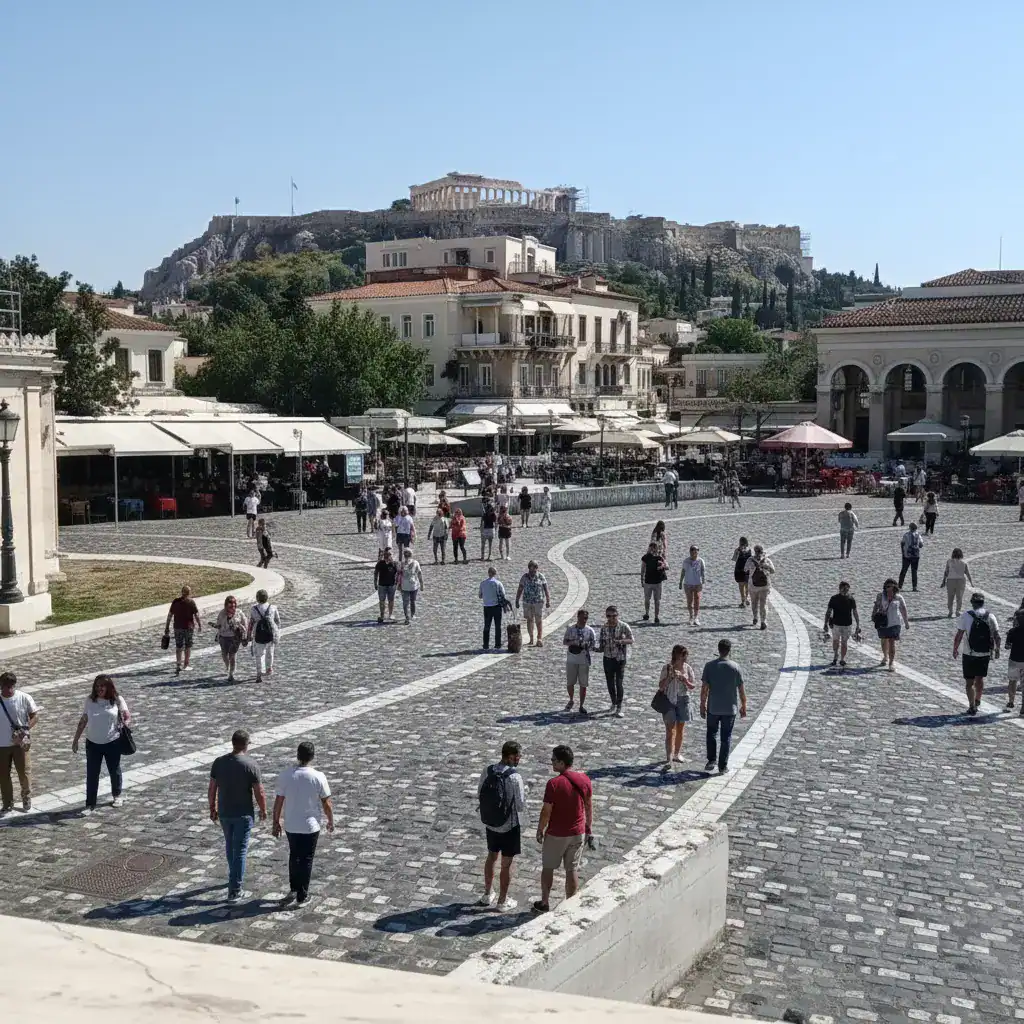
Despite this spectacular growth, Athens still lags considerably behind Barcelona in terms of its overall tourist and metropolitan character. This disparity is meticulously detailed in a study by GBR Consulting and the Athens International Airport. The study underscores that Barcelona functions as a unified metropolitan tourist destination, encompassing not just the city but its broader metropolitan area, with a population of 5.87 million and an area of 7,726 square kilometers. In contrast, the Attica region, with 3.81 million residents and 3,808 square kilometers, sees its visitors largely concentrated around the historical triangle of the Acropolis, Syntagma, and Monastiraki, with only a limited coastal zone.
In 2024, Barcelona’s destination recorded 13.1 million hotel arrivals and 34.6 million overnight stays, translating to 2,222 arrivals per 1,000 inhabitants. Attica, meanwhile, registered 5.7 million arrivals and 12.7 million overnight stays, roughly 1,500 arrivals per 1,000 inhabitants. Barcelona also boasts a daily average of 95,000 overnight stays, compared to Athens’ 35,000. These figures become even more pronounced during peak summer months, with Barcelona seeing 112,000 daily foreign visitor overnight stays in August 2024, versus Attica’s 42,000.
Infrastructure and the Airbnb Conundrum
A critical area where Athens falls short is its tourist infrastructure. Barcelona’s hotel capacity is more than double that of Athens, with 909 hotels and 147,516 rooms in its broader destination, and 456 hotels with 76,689 rooms within the city itself. Attica, on the other hand, has 716 hotels with only 36,016 rooms, and central Athens features 306 hotels with 18,888 rooms. This translates to an average of 162 rooms per hotel in Barcelona, compared to a mere 50 in Attica, indicating a prevalence of smaller, less integrated accommodation options in the Greek capital.
Moreover, Athens exhibits an alarming over-concentration in short-term rentals. The Central Sector of Athens has an estimated 16,000-18,000 Airbnb units, a figure surpassing even Barcelona city’s 10,600 units. The wider Attica region hosts 32,000-35,000 short-term rental units, compared to Barcelona’s 24,000. This suggests that Athens’ tourism growth is heavily reliant on a small-scale, dispersed tourist economy rather than organized metropolitan tourism investments, potentially leading to a ‘tourism monoculture’ that displaces long-term residents and impacts urban fabric.
The Urban Experience: A Major Hurdle
Despite the overall positive trend, Athens continues to struggle with fundamental aspects of quality of life and urban functionality. The overall visitor satisfaction score for Athens stands at 8.4/10, trailing Barcelona’s 8.7/10. The most significant deficiencies in Athens are identified in:
- Public transport (7.4 vs. 8.5)
- Public cleanliness (6.6 vs. 8.0)
- Event information (6.8 vs. 8.1)
- Noise levels (6.4 vs. 7.3)
- City safety (7.9 vs. 8.2)
These factors collectively detract from the overall urban experience, making Athens less appealing for extended stays and diverse tourist activities. The study also highlights that a significant portion of visitors (71%) do not explore the islands of the Saronic Gulf, citing lack of time, insufficient information, difficult access, and preference for other islands. Yet, 38% of visitors would opt for a nearby island if they had an extra day, indicating a vast untapped potential for integrated coastal tourism.
A Cultural Gateway, But Not Yet a Destination
Athens primarily functions as a cultural destination, with 53% of visitors drawn by its archaeological sites and cultural heritage, which garners a satisfaction score of 9.2/10. A substantial 61% of visitors are first-timers, and 71% plan to continue their journey to other parts of Greece. This indicates that Athens largely serves as a ‘gateway’ to island destinations, with an average stay of only three days, compared to a total of 10 days in Greece. The major challenge for Athens, therefore, is to transform from a mere ‘stopover’ into a comprehensive, multi-day metropolitan destination.
The city’s rapid tourism growth, while economically beneficial, exposes underlying weaknesses in urban planning, infrastructure development, and the regulation of short-term rentals. To truly compete with established metropolitan destinations like Barcelona, Athens must address these systemic issues, investing in public services, improving urban cleanliness, and developing a more integrated and sustainable tourism strategy that balances economic gains with the quality of life for both residents and visitors.
Source: OT.gr