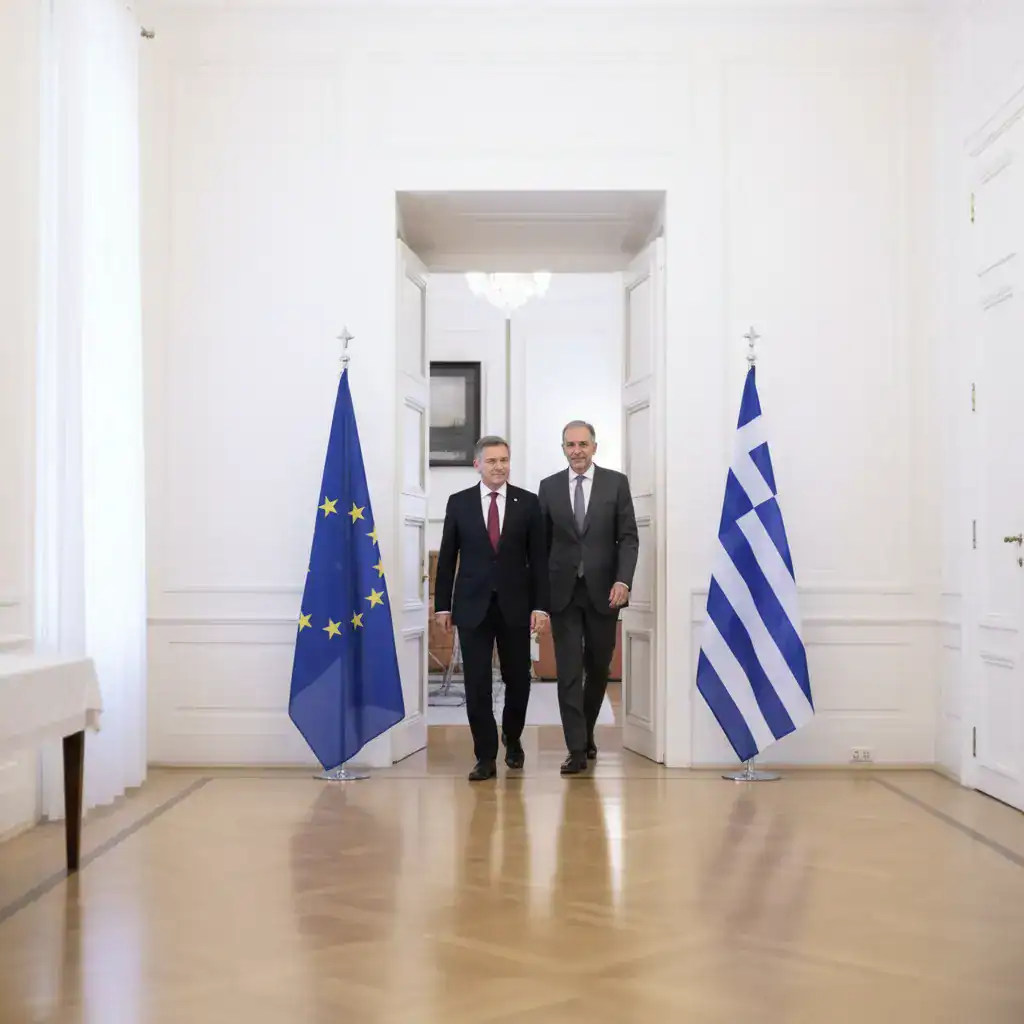
Athens, May 5 – German Foreign Minister Johann Wadephul declared on Monday that arms sold to Turkey must not be deployed against Greece, during his visit to Athens for talks overshadowed by a growing rift between the United States and Germany. Speaking after meetings in the Greek capital, Wadephul asserted that it was a “prerequisite” for any weapons supplied to Turkey to be directed at “external enemies,” not an ally. He also underscored that while Turkey is a NATO partner, the EU remains Germany’s “closest family,” assuring that Berlin would safeguard its members.
Widening Rift Between Washington and Berlin Impacts Aegean Dynamics
The German foreign minister’s visit coincides with heightened tensions between the United States and Germany, which are now spilling over into the Aegean region, further complicating already delicate Greek-German relations. Historically, Greek-German ties have been uneasy, deteriorating sharply during the eurozone crisis before gradually stabilizing, only to face renewed strain recently.
Adding to the complexity, US President Donald Trump has adopted a tougher stance towards Berlin while expressing increasingly warm rhetoric towards Athens. Recently, Trump criticized German Chancellor Friedrich Merz for suggesting the US had been “humiliated” in Iran, threatening to withdraw over 5,000 US troops from Germany. Conversely, Trump has lauded Greek Prime Minister Kyriakos Mitsotakis as a “terrific guy” and commended Greece’s support in the conflict against Tehran. Reports in The Wall Street Journal in April indicated that Greece could benefit from an alleged US plan to reallocate troops to more supportive nations during the Iran conflict.
Germany’s Delicate Balancing Act in the Aegean
Local media reported that during his meetings with Greek Foreign Minister Giorgos Gerapetritis and Prime Minister Kyriakos Mitsotakis, Wadephul deliberately avoided the highly sensitive issue of Turkey. “Greece is, for us, a strategic anchor in southeastern Europe, a close friend, and a partner country within the EU and NATO,” Wadephul stated prior to his visit.
Greece and Turkey have been locked in a decades-long arms race in the Aegean, fueled by deep-seated maritime disputes. Germany has historically maintained a policy of equal distance in its relations with both Greece and Turkey, both of whom are NATO allies. Furthermore, Turkey is considered a significant export market and a crucial partner in managing migration flows.
Despite Greek officials privately urging Germany to demonstrate “solidarity” with Athens in the eastern Mediterranean, Berlin has found it challenging to strike a balance between Athens and Ankara.
Incidents in the Aegean Raise Concerns for Greece
Euractiv has learned that Greece’s foreign ministry recently issued a démarche to the German ambassador in Athens following two alleged incidents in the Aegean involving Turkey and a German-led patrol. The first incident reportedly involved NATO’s Maritime Group 2 (SNMG2), which monitors migrant smuggling routes along the Greek-Turkish maritime boundary. The mission alerts Greek and Turkish coastguard authorities to suspicious movements without intercepting vessels.
During one patrol under German operational leadership, maps defining areas of responsibility extending to Cyprus were required. However, the Turkish side insisted on omitting island names, according to sources familiar with the incident. Turkey does not recognize Cyprus, having occupied the northern third of the island since 1974, and disputes the sovereignty of several Greek islands near its coastline. Following Turkey’s request, the mission reportedly issued official maps using only coordinates, an omission that offended Greece.
In the second instance, a German coastguard vessel operating under Frontex allegedly followed instructions from the Turkish coastguard while in an area under Greek responsibility. For Greece, these episodes are politically sensitive and legally concerning, given ongoing maritime boundary disputes with Turkey. “These incidents may set dangerous legal precedents and create grey zones,” a Greek diplomatic source stated. The German foreign ministry declined to comment on these specific incidents.
Discussions on Defence Procurement and Submarine Sales
The discussions surrounding German patrols occur amidst broader tensions between Berlin and Athens concerning defence procurement and arms sales to Turkey. Berlin has advocated for Turkey’s full inclusion in the EU’s €150 billion SAFE procurement program. However, Athens vetoed Turkey’s full participation, ensuring that EU rules incorporated conditionality for third countries, such as a requirement not to pose a security threat to individual EU member states.
Athens has also expressed dissatisfaction with Berlin’s decision to supply both Greece and Turkey with advanced Type 214 submarines. Local media reported in February that Greece was considering incorporating clauses into future defence contracts to prevent Turkey from acquiring identical weapons systems.
Gerapetritis stated on Monday that Athens cannot dictate to any country how it manages defence procurements. “However, what we consider to be the bare minimum requirement is that it is ensured that such systems, when supplied to third countries, are not used against an allied country. This is of crucial importance for our common European defence,” he emphasized.
When questioned during a press conference about how German-Greek defence cooperation aligns with Germany’s collaboration with Turkey, Wadephul declined to answer directly. Nevertheless, in an interview with the public broadcaster ERT, he reiterated that it is a “prerequisite” that arms sold to Turkey not be used against Greece, but rather against “external enemies.”
German submarine manufacturer Thyssenkrupp Marine Systems (TKMS) has signed an agreement with Greek shipyards for a mid-life upgrade of Greece’s four Type 214 submarines. A German government official commented that this was a positive signal for Greece’s potential procurement of the new Type 212 CD submarines, also produced by TKMS. The company is reportedly seeking to maximize production in Greece if awarded the contract.
However, it remains uncertain whether Greece will ultimately choose the German submarines. Following French President Emmanuel Macron’s visit to Athens in April, government sources informed local media that Greece was considering the purchase of four French Blacksword Barracuda submarines for a minimum of €5 billion.
Source: https://www.euractiv.com/news/berlin-draws-red-line-on-turkey-arms-use-during-fraught-athens-talks/