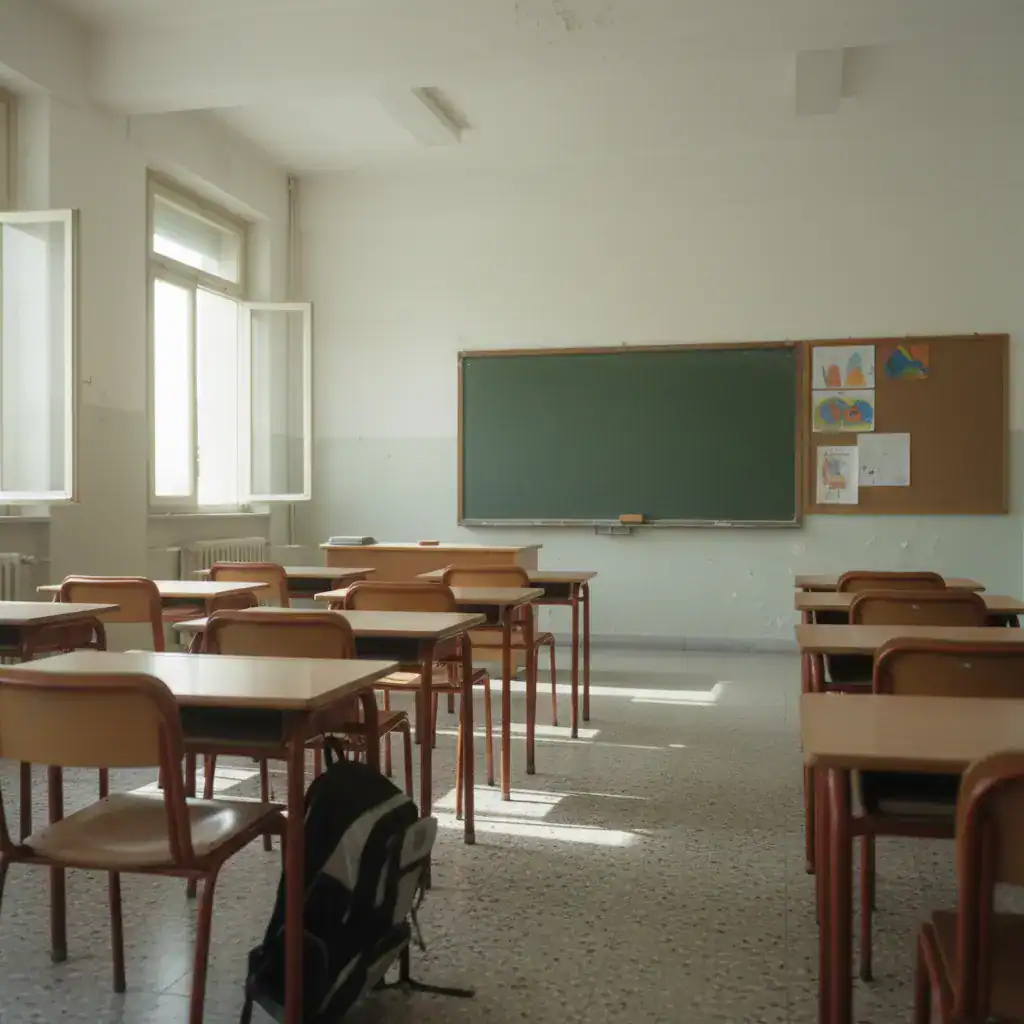
The Corfu Primary Education Teachers’ Association (SEPE Corfu) has voiced profound concern over the significant decline in student enrollments across the island’s kindergartens and primary schools. This alarming trend, approaching a 35% overall reduction, unequivocally highlights the rapid deterioration of Greece’s demographic landscape.
The Alarming Numbers: A Quarter Century Decline in Enrollments
The latest data paints a grim picture. In Corfu’s kindergartens, registrations have plummeted from 898 last year to just 694 this year, representing a 25% decrease. Similarly, primary schools have seen a drop from 900 to approximately 760 students, marking the lowest enrollment figures in years. When considering the total number of children, the reduction reaches a staggering 35%, confirming that schools are indeed beginning to empty.
This is not a fleeting aberration but rather part of a widespread and continuously worsening national trend. Greece has consistently recorded a decline in birth rates in recent years, placing it among the lowest in Europe. Over the past fifteen years, first-grade primary school enrollments have decreased by tens of thousands, with a reduction exceeding 40% compared to 2010. Low birth rates, an aging population, and the ongoing emigration of young people combine to form a volatile mix that threatens not only education but also the very sustainability of society.
Historical Parallels and a Critical Difference
Historically, such intense and prolonged reductions in student populations have primarily been associated with periods of war, major catastrophes, or mass migration, such as post-World War II and the Greek Civil War, when the country’s population suffered heavy losses and displacements. However, the current situation presents a critical difference: it is not a temporary decline due to extraordinary circumstances, but a long-term, structural, and continuously worsening trend in peacetime. In this sense, the data we are experiencing today are largely unprecedented, as the demographic downturn unfolds quietly but steadily, without the ‘shocks’ of war, but with equally severe consequences.
The Socio-Political Roots of the Crisis
The demographic problem is no longer a future challenge; it is a present, acute crisis. Its causes are deeply social and political. Persistent economic pressure, rising costs of living, precarious employment, high housing costs, and the absence of meaningful support for young couples act as deterrents to family formation. Concurrently, the lack of a cohesive and long-term demographic policy, combined with the degradation of public social services-from healthcare to education and childcare-exacerbates the situation. Government policies, often characterized by austerity, privatization, and the shifting of costs onto families, objectively reinforce the demographic decline rather than curbing it.
The Empty Desk: A Warning for Society’s Future
The consequences of this development are already evident and are expected to intensify in the coming years. The reduction in student numbers is not being addressed in pedagogical terms, nor is it being leveraged to create smaller class sizes for the benefit of the educational process. Instead, it is clear that the direction and political choice are towards mergers and closures of school units, particularly in rural and island areas, with the decrease in students being used as a pretext for their implementation. This entails a further degradation of the educational process, an increase in inequalities, the weakening of local communities, and the reinforcement of the trend of depopulation in remote areas. At the same time, pressure is mounting to reduce permanent teaching positions, intensifying job insecurity. The empty desk is not just an image; it is a resounding warning signal for the future of our society!
A Call for Comprehensive Action
In the face of this situation, the state must assume its responsibilities. To date, the demographic issue has been addressed piecemeal, without a comprehensive plan and without taking into account the real needs of families and education. Instead of substantial support, ‘rationalization’ policies are being promoted, leading to mergers and cuts, exacerbating the problem.
SEPE Corfu emphasizes that addressing the demographic crisis requires immediate measures at multiple levels. Substantial financial support for young families is essential, with generous allowances, tax breaks, and housing policies that make family creation feasible. Universal and free access to quality early childhood education and care facilities is required, as well as measures that truly support the reconciliation of professional and family life. Simultaneously, there must be meaningful incentives for young couples to remain and settle in the periphery and on the islands.
Regarding education, it is imperative to ensure that there will be no mergers or closures of school units due to the decrease in students. On the contrary, this situation can and should be utilized to reduce the number of students per class, for the benefit of the educational process. It is necessary to strengthen schools with permanent staff-teachers, psychologists, social workers-as well as the overall upgrading of public education and care infrastructures. Small schools, especially in local communities, should not be considered a burden for the state, but vital nuclei of social cohesion and must be supported.
Demographics: A Political Choice, Not a Natural Phenomenon
Demographics are not a ‘natural phenomenon’ that evolves independently of social conditions. They are the result of specific political choices! Reversing the trend requires a comprehensive plan that prioritizes the needs of society, youth, and public education.
SEPE Corfu will continue to highlight the issue and intervene dynamically, advocating for vibrant schools, with children, teachers, and prospects. Because without children, there is no school. And without school, there is no future!
Source: https://www.startmediacorfu.gr/sepe-kerkyras-dramatiki-meiosi-engrafon-sta-nipiagogeia-kai-dimotika-scholeia-tis-kerkyras-pou-prosengizei-to-35/