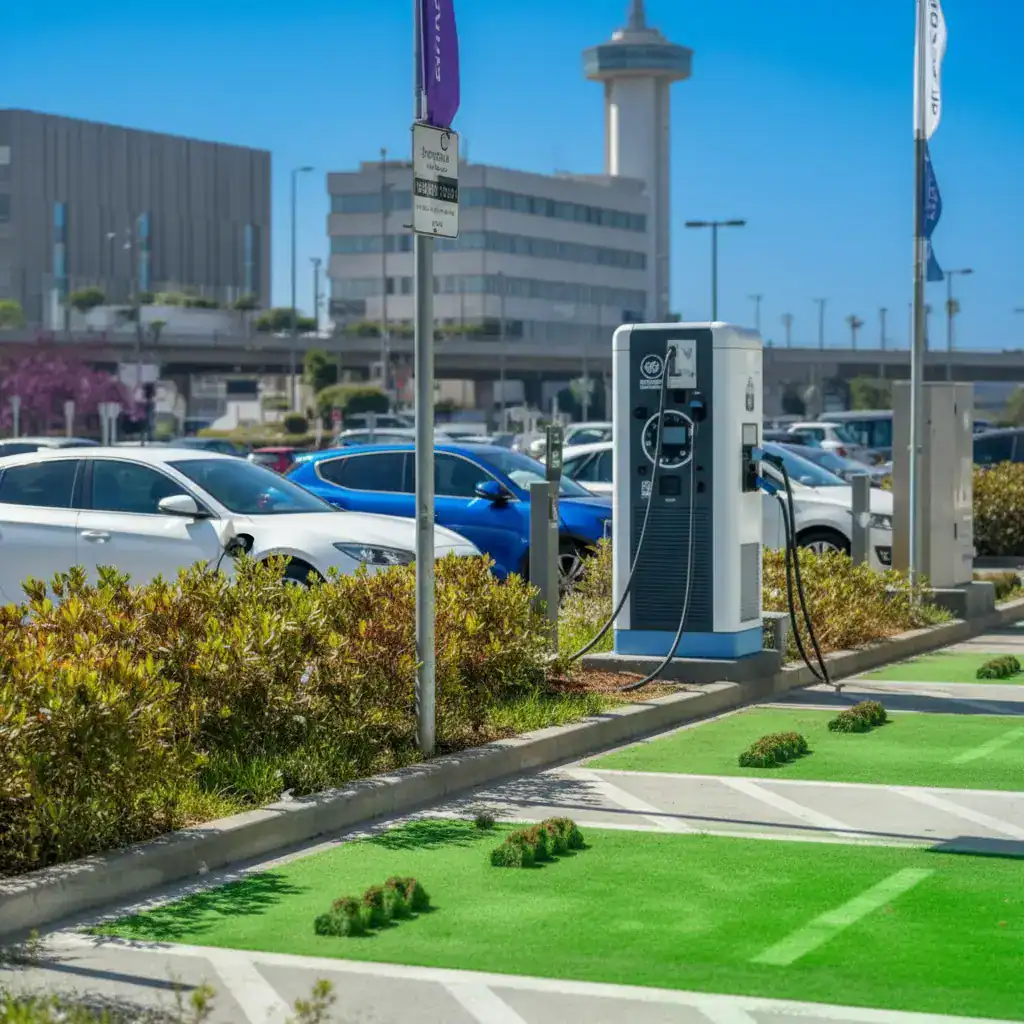
Athens Becomes the Epicenter for EV Charging Station Development
Recent market insights highlight a significant concentration of electric vehicle (EV) charging infrastructure development in Athens, with other regions of Greece currently remaining underserved. Industry stakeholders point to several factors contributing to this disparity, primarily the existing EV fleet size and the substantial investment costs involved.
Companies are strategically prioritizing the Attica region, focusing on locations such as hotels and supermarkets. This approach is based on the assumption that these venues are frequented by potential EV owners, thus maximizing the utilization of charging services. Furthermore, business plans include investments along the national road network and in select tourist-heavy islands, where demand is expected to be higher.
Challenges in Market Maturity and Profitability
Despite these efforts, the EV charging sector in Greece is still in its nascent stages. Companies are currently more focused on securing market share rather than achieving immediate profitability, which is largely influenced by the relatively low number of electric vehicles on Greek roads. As of early 2026, purely electric vehicles (BEVs) exceeded 32,000, a notable increase from 8,708 registrations in 2024. EVs now account for a significant portion of new car sales (6.2% in 2025), with plug-in hybrids further boosting the total.
However, the current fleet of 32,000 vehicles does not yet justify an extensive expansion of the charging network across the entire country. Investment costs remain high, especially for hybrid charging stations that combine chargers, batteries, and photovoltaic systems.
This strategy reflects the perception of EVs primarily as ‘city vehicles’ rather than primary family cars for long-distance travel. This perspective is expected to shift as charging infrastructure becomes more widespread, enabling greater adoption of EVs for various travel needs.
DEDDIE’s Role and Infrastructure Limitations
The Hellenic Electricity Distribution Network Operator (DEDDIE) plays a crucial role in the future of electric mobility. Market players identify DEDDIE’s network infrastructure and its capacity to support fast chargers as a major hurdle. Challenges include both access to the network and the overall ‘ecosystem,’ such as substations, which are often insufficient to accommodate fast chargers.
Currently, Greece has approximately 8,500 AC charging points (11KW) but only 170 DC fast-charging points with capacities exceeding 120 kW. DEDDIE’s five-year development program, outlined in the revised National Energy and Climate Plan (ESEK) issued in 2024, aims to promote alternative fuels in transport. It sets ambitious targets for developing charging infrastructure, envisioning 40,000 to 100,000 publicly accessible EV charging points by 2030.
Impact of Recent EU Decisions and Future Outlook
A recent decision by the European Commission in December 2025 to extend the lifespan of internal combustion engines has somewhat slowed the penetration of electromobility. Nevertheless, experts agree that electric vehicles represent the future of transportation.
The current market trend indicates a strategic, phased approach to EV charging infrastructure development, starting with high-demand urban centers like Athens. As the EV fleet grows and DEDDIE’s infrastructure improves, a more comprehensive national charging network is expected to emerge, facilitating broader EV adoption across Greece.
Source: energypress.gr