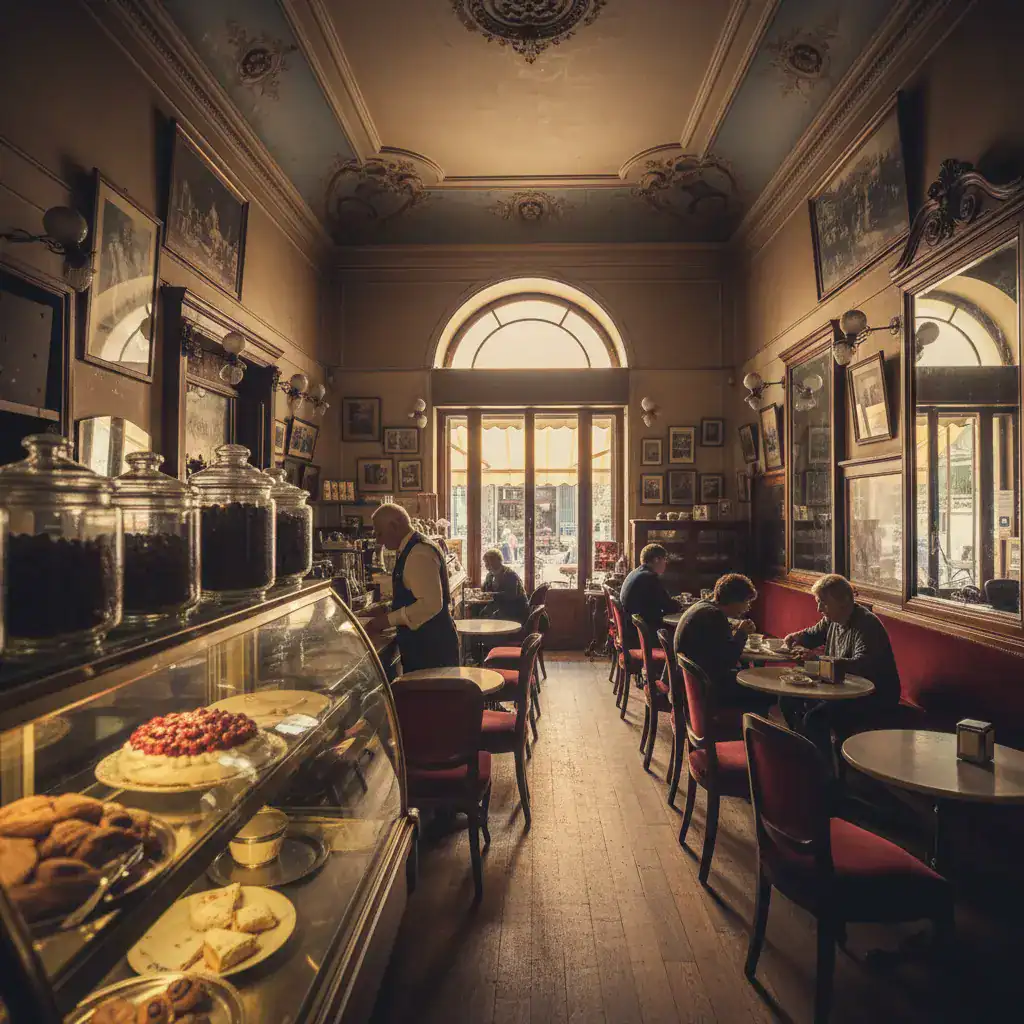
The aroma of freshly brewed coffee, the clinking of porcelain, and the murmur of conversations once filled the air in Athens’ legendary cafe-patisseries. These weren’t just establishments; they were living museums, vibrant epicenters where the pulse of modern Greek history beat strongest. From the regal “Flokas” to the intellectual “Brazilian” and the community-defining “Sonia,” these twelve iconic hangouts shaped the city’s cosmopolitan rhythm for decades, leaving an indelible mark on its cultural and social fabric.
Flokas: A Royal and Political Stage
Opened in 1938 at 9 Panepistimiou Street, where the Attica Center now stands, “Flokas” was more than a patisserie; it was a chronicle of Athens’ evolution. For five decades, until its closure in 1987, it hosted an eclectic clientele ranging from the royal family – who commissioned its magnificent 3.20-meter wedding cake for King Constantine and Anne-Marie – to political titans like Constantine Karamanlis and Sofoklis Venizelos. Literary giants such as Giorgos Seferis and Odysseas Elytis, alongside artists like Melina Mercouri and Manos Hadjidakis, found solace and inspiration within its elegant walls.
Imagine sitting at a table, overhearing a waiter announce, “Mr. Manos’s coffee” or “Mrs. Melina’s.” The atmosphere was one of understated luxury, where elegance permeated every detail, from the furniture to the lighting. Hadjidakis and Nikos Gatsos even had their dedicated upstairs table, where their final collaboration, “Athanassia,” was conceived. The story of a newly hired law student, Giorgos Mitropoulos, and a crime of honor he witnessed, inspired Gatsos to pen the lyrics for “Giannis the Murderer,” later immortalized by Manolis Mitsias.
Another “Flokas” on Fokionos Negri became a haven for artists like Vangelis Papathanassiou and the Forminx, as well as actors such as Aliki Vougiouklaki and the Kazakos-Karezi couple. Their preference for “Flokas’s” divine desserts, especially the profiterole, became legendary. The profound impact of these patisseries on Athenians is beautifully encapsulated in Maria Varvoglis’s book, “Rendezvous at Flokas.”
Brazilian: The Intellectual’s Sanctuary
In the friendly rivalry between “Flokas” and “Zonar’s,” a third contender, the “Brazilian” in the Kalligas Arcade on Voukourestiou Street, carved its own niche. Founded in the 1930s by Evangelos Saravanos, its mission was to introduce Athenians to the sophisticated world of Brazilian coffee. Though small, with customers often standing shoulder-to-shoulder, its flavors and intellectual aura attracted the city’s cultural elite. Elytis, Moralis, Fassianos, Mercouri, Hadjidakis, and many other luminaries were devoted patrons.
After Saravanos’s passing in 1975, the “Brazilian” faced a period of decline, eventually closing in 2002. However, it later resurfaced on Valaoritou Street, under new management, continuing its legacy of fine coffee and exquisite desserts, striving to connect its storied past with the demands of the present.
Sonia: A Neighborhood’s Identity
“Sonia,” located on Alexandras Avenue near Argentina Square, transcended its role as a mere cafe. It became such a beloved landmark that the entire neighborhood adopted its name. Beginning as a traditional coffeehouse in the 1930s, founded by businessman Poubouras, its spacious and discreet setting attracted a diverse clientele, from intellectuals and artists to politicians and everyday Athenians.
Significantly, “Sonia” played a pivotal role in the early days of PASOK, serving as a hub for political planning and discourse. Although it ceased operations after 2017, its name continues to resonate, a testament to its profound impact on the community.
Floral: The Blue Apartment Building’s Cultural Heart
With an 80-year history, “Floral,” situated on the ground floor of the iconic Blue Apartment Building in Exarchia, began as a patisserie in the 1930s. Over the decades, it evolved, changing ownership and identity, yet always remaining a cherished meeting place for Exarchia’s residents and visitors alike. Writers, artists, scientists, and students gathered within its walls, where countless book presentations, film screenings, and musical events unfolded.
The Blue Apartment Building itself, a masterpiece constructed in 1933 by architect Koulis Panagiotakos, housed notable figures like Renos Apostolidis and Leonidas Kyrkos. “Floral’s” regulars included theatrical legends like Voula Zouboulaki and Dimitris Myrat. It was a place where books were written, scripts were rehearsed, and songs were composed. Renowned for its exquisite desserts, “Floral” closed in the mid-1990s, only to reopen in 2009 as a multi-purpose cultural space. Despite its cultural significance, it ultimately succumbed in 2016, not to financial woes, but to an increasingly challenging environment.
Galaxy and Adonis: Nea Smyrni’s Rival Icons
Nea Smyrni’s impressive square was home to two fiercely competitive cafe-patisseries: “Adonis” and “Galaxy.” “Adonis,” owned by the Fragoulis family, was immortalized in a popular song by Kraounakis in 1986, sung by Alkistis Protopsalti. It was a place where “kids and freaks went and athletes hung out,” frequented by the crème de la crème of Nea Smyrni, including artists like Jenny Vanou and Aleka Kanellidou.
Across the square stood its formidable rival, “Galaxy.” This legendary establishment, with its distinctive architecture, served as a nucleus of leisure for all of Nea Smyrni’s “tribes.” Its specialty was frappé served in a glass with a holder, and its most beloved desserts included chocolatina, cassata ice cream, and “fire ice cream.” While athletes gravitated towards “Adonis,” “Galaxy” was the haunt of Panionios supporters, where the hardcore fan group, the “Panthers,” was founded one winter night in 1983. It also hosted a historic meeting of First Division footballers for their first major strike action in 1979-80.
“Galaxy” closed its doors in 2001, marking the end of a beautiful era. “Adonis” continues its journey, albeit in a renovated space on the mezzanine, striving to bridge its nostalgic past with the multifaceted present.
Of these legendary cafes and patisseries, very few have survived in their original form. Some have relocated, adapted, and continue under new identities. The rest, however, live on as cherished memories, evoking a profound sense of nostalgia for a bygone era that, despite its disappearance, left an indelible imprint on the shaping of modern Athens.
Their stories are not just about coffee and desserts; they are about the people who gathered there, the ideas that were born, the history that unfolded, and the enduring spirit of a city that continues to evolve, carrying echoes of its past in every corner.