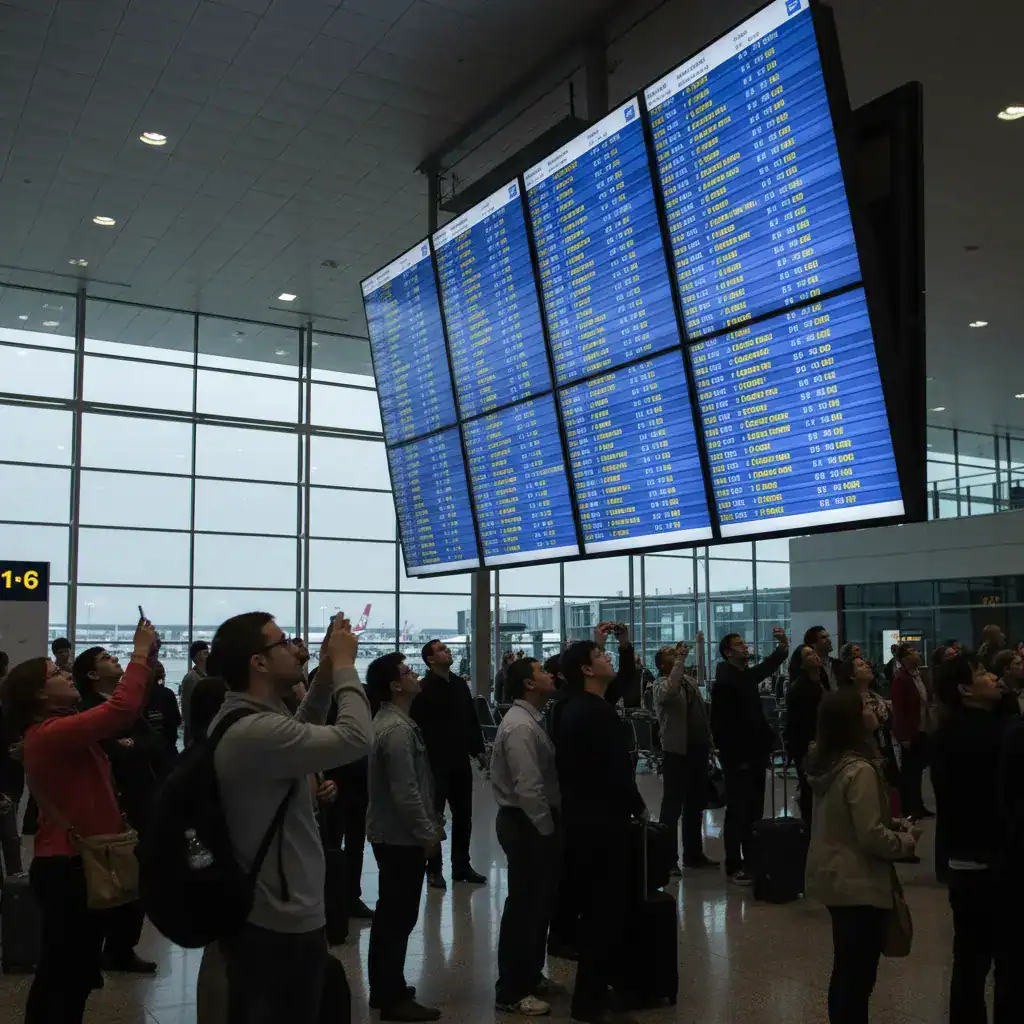
Athens, January 8 – The recent blackout at the Athens Flight Information Region (FIR) was the result of a widespread telecommunications system failure and not external interference or malicious activity, confirmed Michalis Bletsas, Commander of the National Cyber Security Authority and MIT Media Lab researcher. The incident, which occurred last Sunday, led to significant flight disruptions but posed no risk to flight safety.
Technical Failure Identified as Cause
Speaking to ERTnews, Bletsas stated, “We know very well what happened. What we don’t know yet is how it happened.” He emphasized that there was no interference and that an investigation is ongoing to prevent similar incidents in the future. The problem was specifically linked to remote control transmitters in broadcast centers used for ground-to-air voice communication.
“To a large extent, many transmitters were left on, some without sound and some emitting bomb or broadband noise,” Bletsas explained. This led to a takeover of frequencies, causing a “denial of service.” He elaborated that when multiple transmitters continuously transmit on the same frequency, it becomes unusable, and backup systems cannot function when the spectrum is occupied. “Parallel spectrum, unfortunately, does not exist,” he noted.
No Risk to Flight Safety, Investigation Continues
Bletsas firmly dismissed concerns about flight safety, stating, “There was a question of great inconvenience to passengers, with flight cancellations, but in no case was there a safety problem.” He refuted reports of “blind flights” as unsubstantiated. He was unequivocal that the system’s own transmitters took over the spectrum, and there was no external interference or sabotage.
Regarding scenarios of sabotage or foreign involvement, Bletsas clarified, “as far as we can see, it is not the result of malicious action.” While possibilities remain open, he indicated that such scenarios are diminishing as the investigation progresses. He suggested that a human technical error could be a potential cause.
Members of the National Cyber Security Authority are actively gathering more evidence as part of the ongoing investigation. Bletsas explained that a new committee was convened for this purpose to ensure speed and completeness, involving various relevant agencies.
Global Perspective on System Failures
Bletsas highlighted that such incidents are not unique to Greece, citing similar failures that have led to the closure of larger FIRs internationally. “All systems fail at some point. The point is that the failures should not have a major impact and the systems should be resilient,” he remarked.
He concluded by noting that even modern, increasingly complex systems are susceptible to failures, emphasizing that “never having failures is impossible.”
Source: https://en.protothema.gr/2026/01/08/commander-of-the-national-cyber-security-authority-no-interference-in-athens-fir-transmitters-caused-the-blackout/