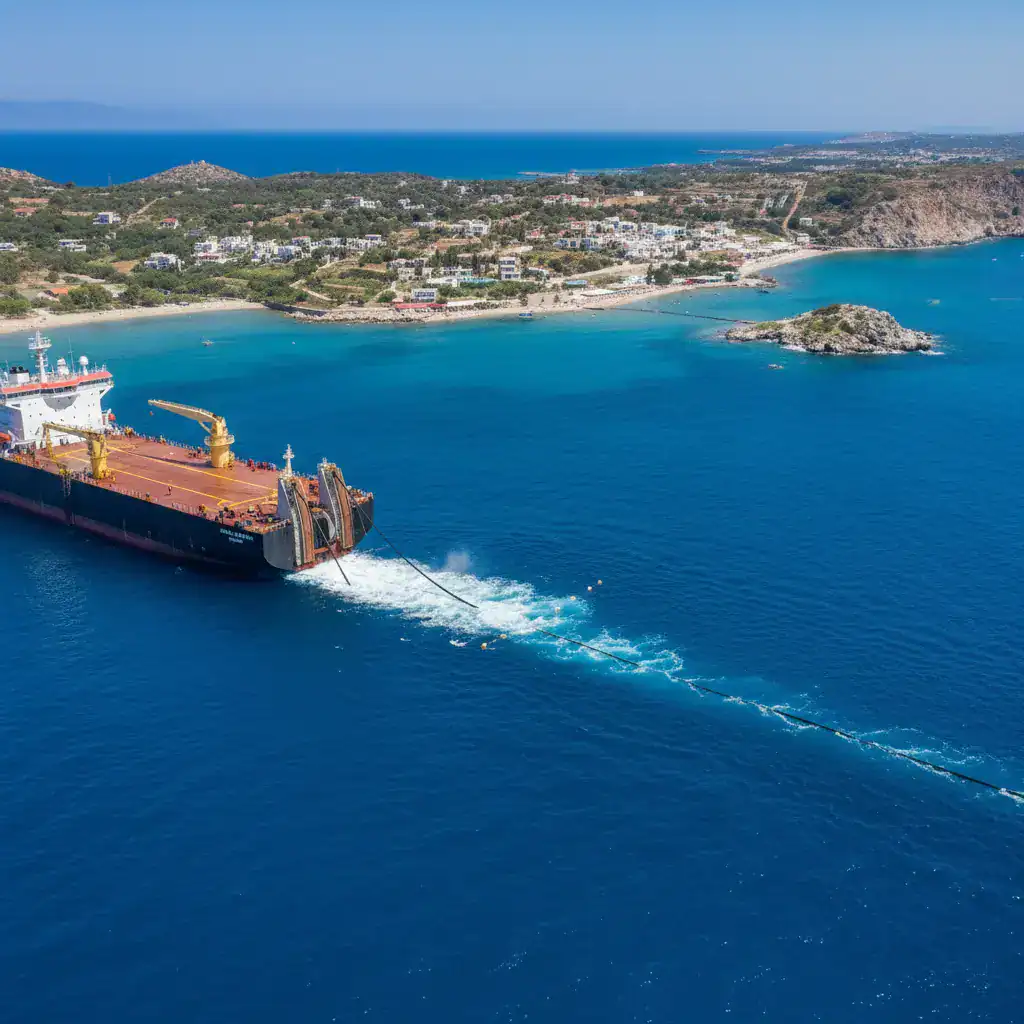
Athens Continues Laying Cable Between Greek Isles Despite Turkish Annoyance
Athens, January 9, 2026 – Greece is pressing ahead with its project to lay fiber optic cables between several Greek islands in the central and southeast Aegean Sea, a move that has reportedly drawn annoyance from Turkish foreign ministry sources. Reports in local media on Thursday, January 8, cited these sources as Ankara continues to assert its claim of ‘jurisdiction in maritime zones between clusters of Greek islands.’
The operation, carried out by the Panamanian-flagged vessel ‘Ocean Link’, involves connecting various Greek islands with undersea fiber optic cables. This initiative is part of Greece’s broader strategy to enhance connectivity and infrastructure in its island regions.
Turkish Objections and Maritime Claims
Official Turkey maintains a revisionist stance, arguing that Aegean islands do not possess a continental shelf or influence the delimitation of any future exclusive economic zone (EEZ). Furthermore, Ankara has historically contended that Greece lacks the right to extend its territorial waters in the Aegean beyond six nautical miles, a position that is not in line with the UN Convention on the Law of the Sea (UNCLOS).
Turkey’s perspective appears to be that the Aegean Sea, east of the 25th meridian and excluding areas where Greek islands have six nautical miles of territorial waters, either belongs to Turkey or constitutes a future Turkish continental shelf/EEZ.
Alleged Harassment and Denials
Last Saturday, a Turkish frigate, identified as the “Gediz,” reportedly hailed the ‘Ocean Link’, calling on it to cease activities in what it claimed were areas of Turkish “jurisdiction.” This incident allegedly occurred in a location between the Greek islands of Amorgos and Astypalea, a distance of approximately 28.5 nautical miles apart, and dozens of nautical miles from the nearest Turkish territory on the west Asia Minor coast.
However, reports on Thursday indicated that Turkish sources have denied any harassment of the vessel. These sources, while referring to “unilateral activities” by Greece in the Aegean, stated that such actions ignore the “rights and interests of our country (Turkey), which emanate from the maritime regions under its jurisdiction.” They added that “these efforts are rendered ineffective by the framework of international law and our country’s initiatives.”
The Turkish sources concluded by stating, “Contrary to the claims in the Greek press, there has been no harassment of the ship by Turkey.”
Greek Response and International Law
The Hellenic Navy’s hydrological service has issued a NAVTEX (Navigational Telex) for the wider maritime region, effective until January 26, 2026, to facilitate the ‘Ocean Link’s’ activities. To date, the vessel’s operations have proceeded without impediment. The ‘Ocean Link’ was observed docked off the eastern Aegean island of Kos on Thursday, January 8, 2026, after reportedly completing the cable laying between Astypalea and Kos.
Greece maintains that its activities are fully compliant with international law, including UNCLOS, which grants islands their own continental shelf and EEZ rights. The ongoing cable laying project is considered by Athens to be a legitimate exercise of its sovereign rights within its territorial waters and exclusive economic zone.
Broader Context of Greece-Turkey Relations
This incident occurs within a broader context of ongoing tensions and disagreements between Greece and Turkey over maritime boundaries, airspace, and resource exploration in the Aegean and Eastern Mediterranean. Both nations are key NATO allies, yet their bilateral relations are frequently strained by historical disputes and differing interpretations of international law.
The laying of undersea cables is a critical component of modern infrastructure, essential for communication and data transfer. Greece’s continued efforts to connect its islands reflect its commitment to developing its digital infrastructure and ensuring robust communication networks across its territory.
The international community largely recognizes Greece’s sovereign rights in the Aegean, as enshrined in international treaties and conventions. The current situation underscores the persistent challenges in resolving long-standing maritime disputes in the region, despite ongoing diplomatic efforts.
Source: https://www.tovima.com/politics/athens-continues-laying-cable-between-greek-isles-despite-turkish-annoyance/