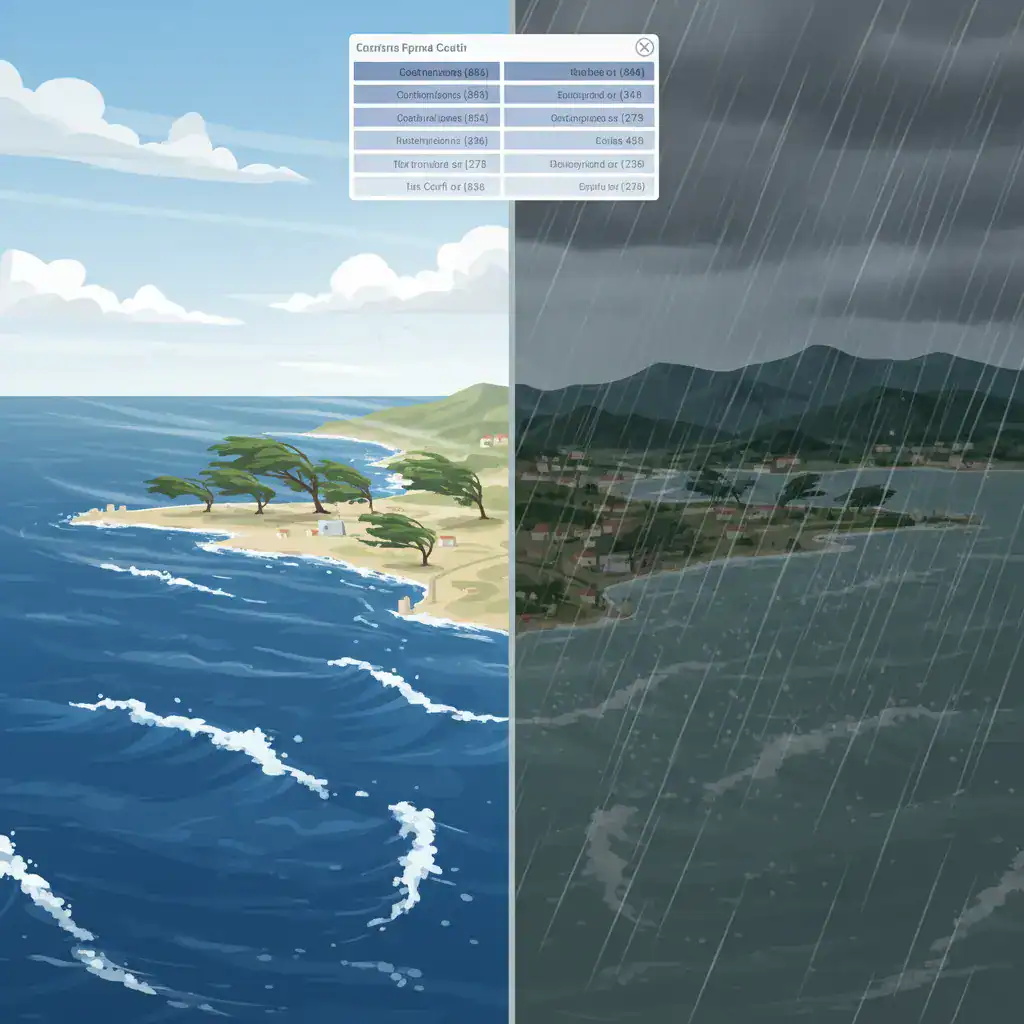
Corfu, Greece – While Epirus has been deluged with heavy rainfall, Corfu is experiencing a peculiar weather phenomenon: strong winds but no rain. This meteorological paradox has been analyzed by amateur meteorologist and forecaster Nikolaos Vlachos of MeteoCorfu, who attributes the disparity to atmospheric conditions.
Significant Rainfall in Epirus
On January 6, 2026, mountainous areas of Epirus, particularly those with enhanced orographic lift, recorded significant rainfall. Theodoria, Arta, measured 131 mm of precipitation, while Lepiana, Arta, and Terovo, Ioannina, registered 111 mm and 107 mm, respectively, by 19:25 on Tuesday. This persistent rainfall was due to strong moisture transport and a steady supply of rain-bearing clouds, leading to prolonged precipitation.
Corfu’s Dry Spell Amidst Gale-Force Winds
In stark contrast, Corfu, despite experiencing gale-force winds of 7-8 Bft, has remained largely dry. According to Vlachos, this is due to strong horizontal and vertical shear within the lower and middle troposphere. This shear causes ‘boundary layer decoupling,’ preventing upward air movements from organizing into cohesive cloud columns. The intense mechanical turbulence increases the entrainment of drier air from lower layers, reducing relative humidity and increasing Convective Inhibition (CIN). Consequently, even with available moisture, the atmosphere cannot support the development of deeper cloud formations.
Furthermore, the high wind speeds lead to rapid horizontal movement of clouds, which do not have enough time to develop vertically. The vertical growth is ‘cut off’ by the shear, resulting in shallow stratocumulus or altostratus clouds that are incapable of producing rain.
The Contrast Explained
The difference in weather patterns between Corfu and Epirus can be summarized as follows:
- Corfu: Strong shear leads to decoupling, entrainment, high CIN, and shallow cloud formation, resulting in a lack of precipitation.
- Epirus: Weaker winds and orography (mountainous terrain) allow for organized upward air currents and deep cloud formation, leading to significant rainfall. The Pindus mountain range enhances upward movements through orographic lifting, locally increasing Convective Available Potential Energy (CAPE) and enabling clouds to reach heights where condensation and microphysical processes result in precipitation.
The Civil Protection of the Central Corfu Municipality issued a warning on January 5, 2026, for intense weather phenomena, including sporadic thunderstorms, particularly in the northern Ionian from the afternoon, with winds of 5 to 7, locally 8 Beaufort. Citizens were advised against unnecessary travel during the intense weather events. [ertnews.gr](https://www.ertnews.gr/perifereiakoi-stathmoi/kerkira/kerkyra-proeidopoiisi-gia-entona-kairika-fainomena/)
Previously, on December 3, 2025, the National Meteorological Service (EMY) issued an emergency weather deterioration bulletin, forecasting increased cloudiness with rain and sporadic thunderstorms in marine and coastal areas, with strong phenomena in the Ionian islands and Peloponnese. South-easterly winds of 5 to 6, locally 7 to 8 Beaufort in the Ionian, were expected to gradually weaken by midday. [corfutvnews.gr](https://corfutvnews.gr/kerkyra-anakousi-tis-politikis-prostasias-kerkyras-gia-ta-entona-kairika-fainomena/)
The region has experienced significant weather-related issues in recent months. On November 27, 2025, ‘Bad Weather Adel’ caused severe problems in central Corfu, including overflowing streams and rivers, impassable roads, and trapped drivers. Houses and basements were flooded in areas like Spyrou Peroulaki Street, Kallithea, and Kanali. Landslides also occurred in Glyfada and Agios Dekas, leading to road closures and school closures in South and Central Corfu. [corfutvnews.gr](https://corfutvnews.gr/kerkyra-pnigike-i-mesi-kerkyra-oloi-stous-dromous-gia-parochi-voitheias/)
On November 21, 2025, extensive damage was reported at the First Municipal Cemetery of Corfu due to a local tornado that uprooted or snapped seven ancient cypress trees, causing damage to over 100 graves. [corfutvnews.gr](https://corfutvnews.gr/ektetamenes-zimies-sto-a%CE%84-dimotiko-koimitirio-kerkyras-logo-entonon-kairikon-fainomenon/) The Municipality of North Corfu had previously urged citizens to exercise increased caution on November 26, 2025, due to adverse weather conditions, with continuous mobilization of crews for road network restoration and cleanup. [corfutvnews.gr](https://corfutvnews.gr/voreia-kerkyra-ekklisi-stous-polites-gia-afksimeni-prosochi-se-diarki-kinitopoiisi-ta-synergeia/)
Citizens can stay informed about the evolution of extreme weather phenomena through EMY’s regular weather bulletins and website at [www.emy.gr](http://www.emy.gr/). For information on road network conditions, the Hellenic Police website [www.astynomia.gr](http://www.astynomia.gr/) is available. General instructions for severe weather phenomena are also provided on the General Secretariat for Civil Protection website at [www.civilprotection.gr](http://www.civilprotection.gr/). The ‘Laertes’ information system ([https://hazardspro.eu/](https://hazardspro.eu/)) also offers a comprehensive crisis management tool for Civil Protection, providing information for citizens before, during, and after natural disasters through a dynamic GIS map and a mobile application.