The silver casket gleamed under the November sun. Inside it lay the body of a fourth-century shepherd-bishop who became the patron saint of an island-and the reason why, on this particular Sunday morning, an entire city stopped breathing.
It was 11:47 a.m., November 2nd, 2025. The bells of the Church of Saint Spyridon had been ringing since dawn. Maria Papadopoulos stood at the corner of Nikiforos Theotoki Street, her grandmother’s black lace mantilla draped over her silver hair. She had been standing there since nine in the morning. She was seventy-three years old, and she had not missed a Protokyriako procession in sixty-one years.
“My mother brought me here when I was twelve,” she said, her voice barely audible over the approaching music. “She told me: ‘You must see this. You must remember. Because one day, you’ll bring your children. And they’ll bring theirs.'”
Maria’s daughter stood beside her. Her granddaughter-eight years old, restless, clutching a small Greek flag-stood on tiptoes, trying to see over the crowd.
“When will he come, yiayia?” the girl asked.
“Soon,” Maria whispered. “Soon.”
The Miracle That Never Ended
Protokyriako-the First Sunday of November-is not just a date on the Corfu calendar. It is memory made flesh. It is 1673, when plague ravaged the island, when bodies piled in the streets, when mothers wept over children who would not wake. And it is the moment when the people of Corfu, desperate and dying, carried the relics of their saint through the city-and the plague vanished.
Three hundred and fifty-two years later, they still carry him. Not because they fear plague. But because some rituals are stronger than reason. Some stories refuse to die.
“This is not folklore,” said Father Dimitrios, a young priest standing near the church entrance, his black robes fluttering in the wind. “This is living faith. Every year, we walk the same streets our ancestors walked. We sing the same hymns. We ask the same saint for the same thing: protection. Mercy. Hope.”
He paused, looking at the crowd gathering in the square.
“And every year, he listens.”
Five Bands, One Heartbeat
At noon, the procession began. First came the municipal police, in crisp uniforms, clearing the way. Then the scouts-boys and girls in khaki, flags held high. Then the schoolchildren, hundreds of them, their white shirts bright against the gray stone buildings.
And then the music.
Five philharmonic bands. The Old Philharmonic Society of Corfu. The Mantzaros Philharmonic. The Kapodistrias. The Philharmonic of the Holy Temple. The Municipal Band. Each with its own history, its own pride, its own sound. But today, they played as one.
The first notes of the funeral march echoed through the narrow streets. Slow. Solemn. Heavy as stone.
Maria Papadopoulos closed her eyes. She knew this melody. It was the sound of her childhood. The sound of her mother’s voice. The sound of every Sunday she had ever loved.
“I used to march with the band,” said Nikos Vlachos, standing a few feet away. He was sixty-eight, a retired trumpet player from the Mantzaros Philharmonic. His hands, gnarled with arthritis, trembled slightly as he spoke.
“I played for forty-two years. Every Protokyriako, every Easter, every saint’s day. My father played before me. His father before him. It’s in our blood.”
He watched the young musicians pass, their instruments gleaming.
“I can’t play anymore,” he said quietly. “But I can still listen. And I can still remember.”
The Saint Who Walks Among Us
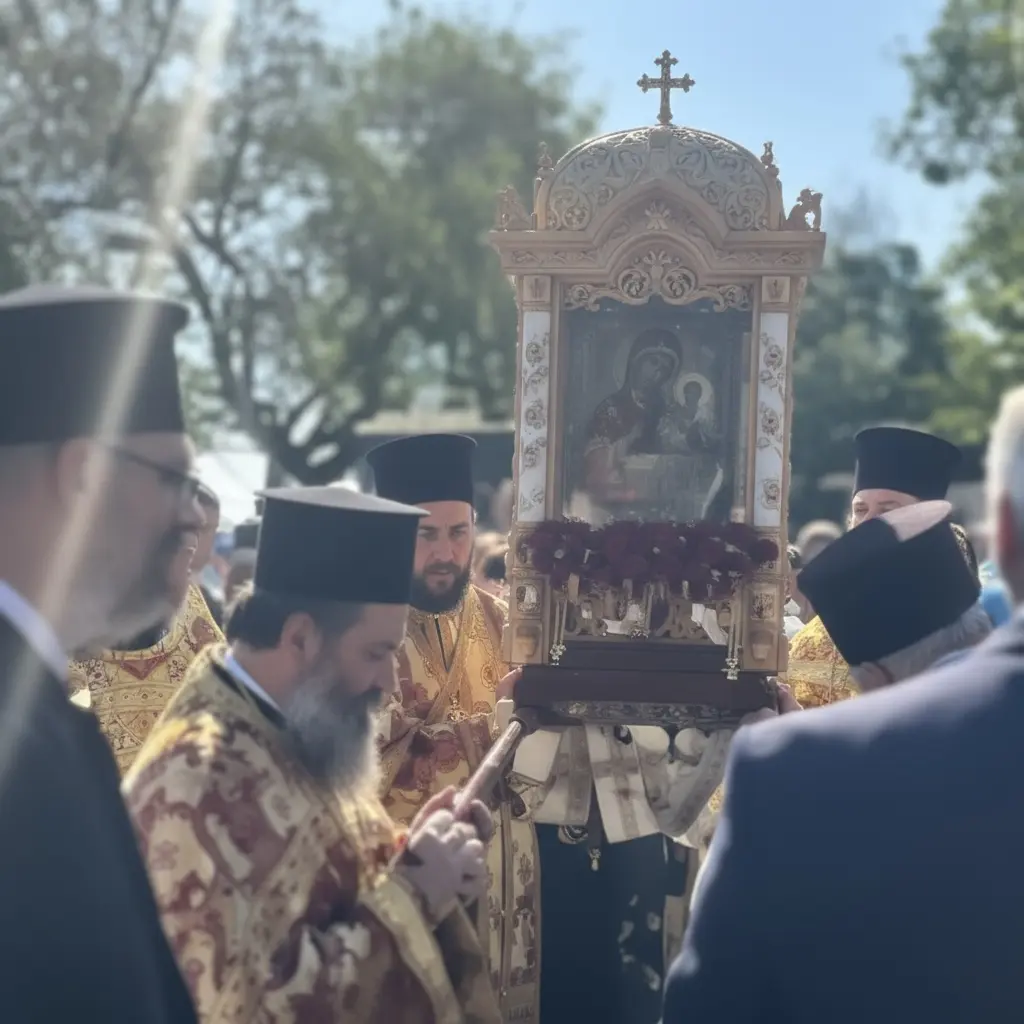
Then came the clergy. Dozens of priests in gold-embroidered vestments. Deacons swinging censers, clouds of incense rising like prayers. And at the center, carried on the shoulders of six men, the sacred relics of Saint Spyridon.
The crowd fell silent. Hats came off. Heads bowed. Hands made the sign of the cross-once, twice, three times.
“He’s here,” whispered Maria’s granddaughter, her eyes wide.
“Yes,” Maria said, tears streaming down her face. “He’s here.”
Metropolitan Nektarios of Corfu walked beside the casket, his white beard flowing, his staff tapping the cobblestones. Beside him walked three visiting bishops: Metropolitan Theofanis of Bukovina and Moldavia from the Romanian Orthodox Church, Metropolitan Kyriakos of Nazareth from the Patriarchate of Jerusalem, and Metropolitan Serapion of Paramythia.
But the crowd’s eyes were not on the bishops. They were on the casket. On the saint who, according to tradition, still watches over them. Still protects them. Still performs miracles.
“My son was sick,” said Eleni Kostopoulou, a forty-year-old mother standing near the Old Fortress. “Cancer. Stage four. The doctors said six months. I came here last year. I prayed to Saint Spyridon. I begged him.”
She paused, wiping her eyes.
“My son is in remission. The doctors can’t explain it. But I can.”
The Prayer at the Fortress
The procession wound through the city. Down Nikiforos Theotoki Street. Past the Liston, where tourists sat at cafes, cameras raised. Along the Esplanade, where the crowd thickened, where people pressed against the barriers, reaching out as if to touch the casket.
At the entrance to the Old Fortress, the procession stopped. This was the moment everyone waited for. The gonyklisia-the kneeling.
Metropolitan Nektarios raised his hand. The crowd fell to their knees. Thousands of people, all at once, on the cold stone pavement.
The Metropolitan’s voice rang out, clear and strong:
“Saint Spyridon, protector of our island, hear our prayer. We live in times of spiritual plague. Violence in our schools. Division in our families. War in our world. We have turned away from love, from unity, from God. We have submitted to a global system that replaces human wisdom with artificial intelligence, that makes us slaves to our own creations. Help us, Saint Spyridon. Open our eyes. Bring us back to the path of love.”
Silence. Not a breath. Not a whisper.
Then, slowly, the crowd rose. The procession continued.
The Faces in the Crowd
Among the dignitaries walking behind the casket: Stefanos Gikas, Deputy Minister of Maritime Affairs and Island Policy. Dimitris Biagis and Alexandros Avlonitis, members of Parliament. Ioannis Trepeklis, Regional Governor of the Ionian Islands. Stefanos Poulimenos, Mayor of Central Corfu. Archbishop George of the Roman Catholics of Corfu.
But the procession was not theirs. It belonged to the people. To the old women in black. To the children waving flags. To the fishermen and shopkeepers and teachers who lined the streets.
“This is our identity,” said Spyros Makris, a taxi driver who had closed his cab for the day. “You can take away our jobs, our money, our politicians. But you can’t take away this. This is who we are.”
When the Music Stopped
By one-thirty in the afternoon, the procession returned to the church. The casket was carried inside. The doors closed. The bands played their final notes.
And then, silence.
The crowd began to disperse. Slowly. Reluctantly. As if leaving a dream.
Maria Papadopoulos stood still for a moment, watching the empty street. Her granddaughter tugged at her sleeve.
“Can we come back next year, yiayia?”
Maria smiled. She took the girl’s hand.
“Yes,” she said. “We’ll come back. We always do.”
As they walked away, the bells of Saint Spyridon began to ring again. Slow. Steady. Eternal.
Because some things never end. Some saints never leave. And some islands never forget.
Source: https://corfutvnews.gr/kerkyra-me-lamprotita-kai-katanyksi-i-litaneia-tou-protokyriakou-fot-vinteo/