Athens, Greece’s sprawling capital and the cradle of Western civilization, carries in its very name a linguistic clue to its ancient past. Unlike most city names, Athens is plural – a detail that hints at the city’s origins as a cluster of separate communities rather than a single settlement.
The plural form preserved across millennia
In Ancient Greek, the city was called Athenai (Ἀθῆναι), which literally translates as “the Athenses.” While that sounds awkward in English, the plural form made perfect sense in antiquity. Before Athens became the intellectual and political heart of ancient Greece, the region of Attica was made up of numerous small villages scattered across its hills and valleys.
According to Greek mythology, the legendary hero Theseus united these separate settlements under a single government – a process the ancient Greeks called synoecism, meaning “living together.” Despite this unification, the plural name persisted, acting as a lasting reminder that Athens began not as one city, but as a community of many.
Athens was not the only city with a plural name. Other major Greek cities shared this linguistic pattern, including Thebes (Θῆβαι) and Mycenae (Μυκῆναι). Yet Athens outlasted and outshone them all, and when the Romans adopted the Greek name as “Athenae,” the plural form went with it into most European languages, where it remains to this day.
A linguistic fossil preserved in modern languages
The old plural form acts as a kind of linguistic fossil, preserved in languages across Europe and beyond. English speakers say Athens, the French say Athènes, Spanish speakers use Atenas, and Italians say Atene – all keeping the plural ending that points back to an ancient time when Athens was more of a neighborhood network than a unified capital.
As the centuries passed, those scattered villages blended into one great city that would become a powerhouse of democracy, art, and philosophy. The name didn’t change, but its meaning quietly evolved. What once literally meant “the multiple settlements” came to refer to a single, unified metropolis.
Modern Greek adopts the singular form
Modern Greek eventually reflected this evolution. By the 1800s, when Greece gained independence and began reshaping its national identity – balancing its Eastern Roman past with its Ancient Greek heritage – Greeks started using Athina instead, a singular form. This change suited the times, since modern Athens had become a united capital that needed a name to match its unified status. The singular form also sounded more natural in the evolving rhythm of Modern Greek.
Interestingly, “Athina” closely resembles “Athena,” the city’s patron goddess. According to legend, Athena won the city’s favor by offering the gift of an olive tree, symbolizing wisdom and peace – values that Athens would uphold throughout its history. So, even as the grammar changed, the spirit of the name came full circle. Athens and Athena became bound together again, singular and inseparable.
The myth of Theseus and the unification of Attica
The story of Theseus uniting the villages of Attica occupies a central place in Athenian mythology and identity. Before this legendary synoecism, Attica was divided into numerous small communities, each with its own local government and customs. Theseus, celebrated as one of Athens’ greatest heroes, is often credited with bringing these disparate groups under a single political system centered in Athens.
This unification wasn’t merely political – it was cultural and religious as well. The establishment of common festivals and the centralization of worship helped forge a shared Athenian identity. The Panathenaic Festival, one of ancient Athens’ most important celebrations honoring the goddess Athena, symbolized this unity.
While modern historians debate the historical accuracy of Theseus as an individual figure, the process of synoecism itself is well documented. Archaeological evidence suggests that the consolidation of settlements in Attica took place gradually over several centuries during the late Bronze Age and early Iron Age, eventually resulting in Athens’ emergence as the dominant city-state of the region.
Other Greek cities with plural names
Athens was not unique among ancient Greek cities in bearing a plural name. Thebes, another major city-state and Athens’ frequent rival, was known in Greek as Thebai (Θῆβαι). Mycenae, the legendary kingdom of Agamemnon and a major center of Bronze Age civilization, was called Mykenai (Μυκῆναι).
These plural forms likely indicated similar origins – cities that grew from the merger of multiple settlements. However, Athens stands out because its plural name survived most robustly in modern European languages, while Thebes and Mycenae often appear in singular or modified forms in various languages today.
Language as a preserver of historical memory
The persistence of Athens’ plural form in most Western languages shows language’s remarkable ability to preserve echoes of the past. It holds onto old meanings long after the stories behind them have faded from common knowledge. The plural “Athens” that English, French, Spanish, and Italian speakers still use is not an error or quirk, but a trace of historical memory – a faint echo of the small communities that Theseus once united.
This linguistic preservation offers a window into ancient social organization and the processes by which early cities formed. It reminds us that the great cities of antiquity often began as loose confederations of villages that gradually coalesced into unified political entities.
For visitors walking through modern Athens, from the ancient Agora to the Acropolis, from Plaka to Monastiraki, the plural name serves as an invisible thread connecting the present to a distant past when these neighborhoods were truly separate communities. The sprawling metropolis of today, home to nearly four million people, still carries in its name the memory of those ancient villages on the hills of Attica.
The enduring legacy of ancient Athens
Athens’ influence on Western civilization cannot be overstated. As the birthplace of democracy, philosophy, theater, and countless other cultural innovations, the city shaped the intellectual foundations of the Western world. Figures like Socrates, Plato, Aristotle, Pericles, and Sophocles walked its streets and debated in its public spaces.
The fact that Athens’ ancient plural name has survived in so many modern languages speaks to the city’s enduring importance. While countless ancient cities have been forgotten or reduced to archaeological sites, Athens remains a living, thriving capital – one that has continuously been inhabited for over 3,000 years.
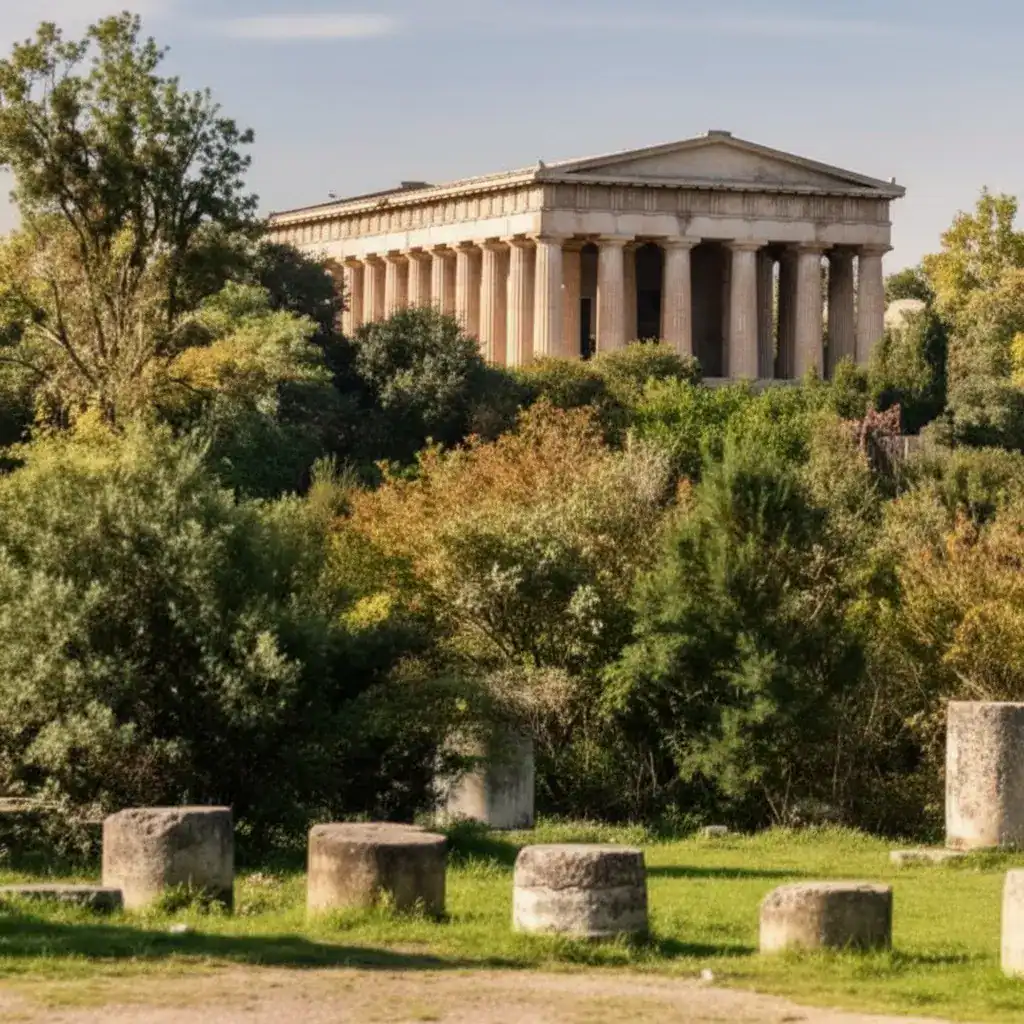
The temple of Hephaestus, standing proudly above the Ancient Agora, and the Parthenon, crowning the Acropolis, serve as physical monuments to Athens’ glorious past. But the city’s plural name serves as a different kind of monument – a linguistic one that every speaker of English, French, Spanish, or Italian unconsciously honors each time they mention the city.
In an age when cities constantly reinvent themselves and ancient traditions often give way to modern convenience, Athens’ plural name stands as a testament to the power of language to preserve memory. It reminds us that even the mightiest cities began as humble collections of villages, and that unity – whether political, cultural, or linguistic – is often an achievement built over generations.
The next time someone mentions Athens, that small -s at the end carries with it three thousand years of history, mythology, and the memory of Theseus bringing together the scattered communities of Attica under the watchful eye of the goddess Athena. It’s a small detail, easily overlooked, but one that connects us directly to the ancient world and the origins of one of humanity’s greatest cities.
Source: https://greekreporter.com/2025/10/30/ancient-greek-origin-athens-plural/