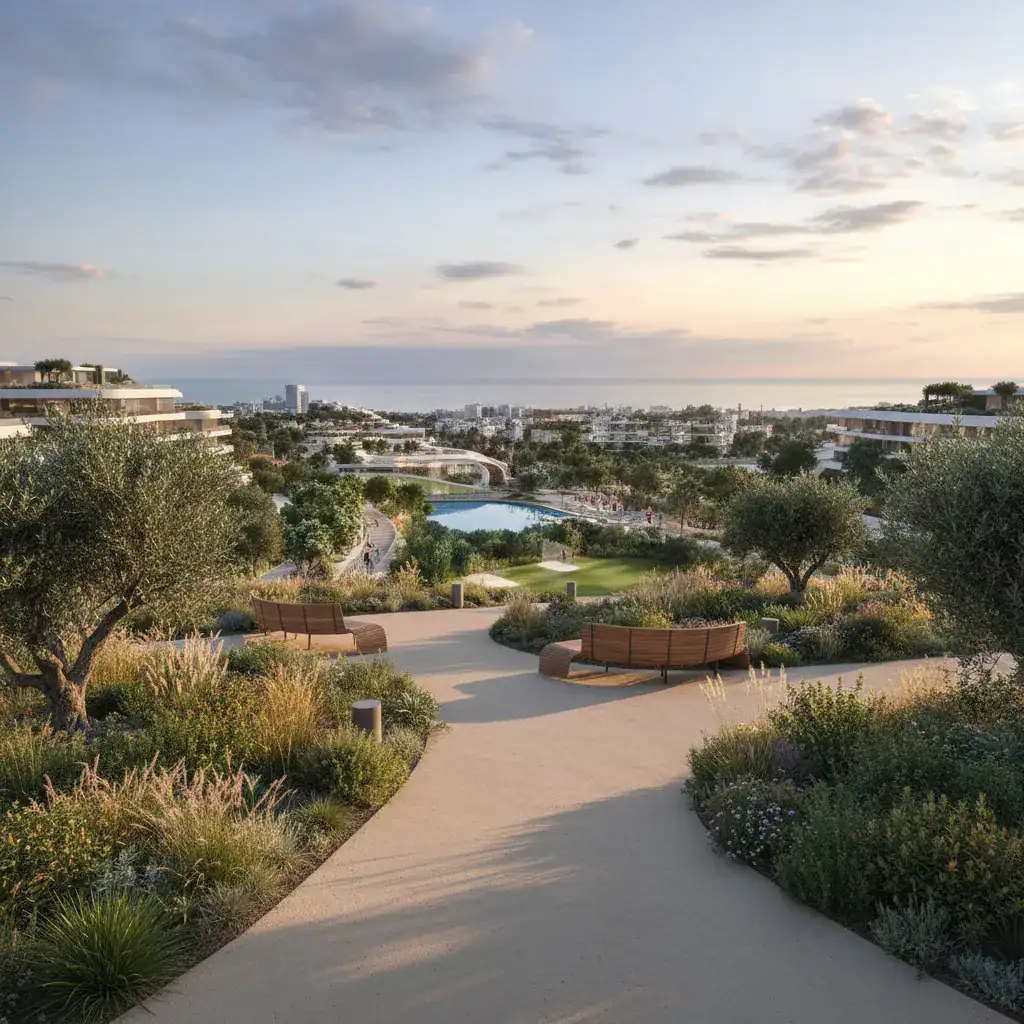
The Metropolitan Park at The Ellinikon, one of the largest components of the broader redevelopment project currently underway at the site of the former airport, is rapidly taking shape. A new study by 1830 Lab, commissioned by LAMDA Development and titled “How Difficult Can It Be?”, provides a detailed insight into the project’s immense scale and key features through a series of compelling facts.
A Green Oasis for Athens: Unprecedented Scale and Vision
The study highlights ten crucial facts that offer a clearer picture of the project’s overall scope, from its vast size and extensive landscaping to its numerous entrances, significant environmental interventions, and the planned artificial lake. This ambitious undertaking is not merely a new green space but a long-term urban infrastructure project with a planning horizon extending up to 1,000 years.
Vast Green Spaces: Larger Than Iconic Parks
According to the 1830 Lab study, the Metropolitan Park will encompass an impressive 2,000 acres (approximately 200 hectares). When including the neighboring green areas also being developed as part of The Ellinikon project, the total green space will expand to a remarkable 2,600 acres. This makes it significantly larger than many well-known parks both in Athens and internationally.
For comparison, the Stavros Niarchos Foundation Cultural Center covers 210 acres, Pedion tou Areos 277 acres, the National Garden of Athens combined with Zappeion totals 285 acres, Mount Lycabettus spans 416 acres, and Philopappos Hill reaches 700 acres. Even London’s iconic Hyde Park, at 1,376 acres, is smaller than The Ellinikon Metropolitan Park.
Extensive Flora: Thousands of Trees and Millions of Plants
The commitment to greening is evident in the sheer volume of planned vegetation. The first phase of development alone includes the planting of 16,520 trees. Upon full completion of the project, the total number of trees is projected to exceed 32,000.
This figure positions The Ellinikon to surpass even some of the world’s most famous green spaces. The National Garden of Athens contains approximately 7,000 trees, while New York’s Central Park has around 18,000. Beyond trees, the study anticipates the planting of approximately 2.65 million aromatic shrubs, contributing to a grand total of around 3.3 million plants across the entire site.
Sustainable Design: Limited Irrigation for 70% of Vegetation
A significant aspect of the park’s design is its focus on sustainability. The study reveals that mainly Mediterranean plant species have been selected, with the strategic aim that approximately 70% of the vegetation will be able to thrive with limited systematic watering. This approach underscores a commitment to ecological responsibility and resource conservation.
Environmental Remediation: Cleaning Up the Past
Before the extensive planting could begin, significant environmental remediation efforts were undertaken. The research indicates that, by the time the study was completed, over 60,000 tons of contaminated soil and approximately 65,000 cubic meters of groundwater had already been cleaned. Furthermore, 31 fuel tanks and underground pipelines stretching roughly 5.5 kilometers were removed from the former airport site, demonstrating a thorough commitment to environmental restoration.
Preserving Existing Greenery: Transplanting and Reintegrating Trees
The project also prioritizes the preservation of existing natural elements. Approximately 3,000 large trees were identified across the former airport site and the coastal area of Agios Kosmas. A portion of these trees is being carefully preserved or transplanted to be reintegrated into the new park’s landscape, ensuring continuity and respecting the existing ecosystem.
Accessibility and Connectivity: 21 Entrances and a Central Boulevard
The Metropolitan Park is designed to be highly accessible and integrated with its surroundings. The study notes that the park will feature 21 entrances, strategically connecting it with the adjacent municipalities. At its heart, a major 2.7-kilometer pedestrian boulevard will be developed, incorporating a cycling lane, a tram line, and expansive green spaces, fostering connectivity and promoting sustainable transportation within the area.
A Central Feature: The 21-Acre Artificial Lake
A striking centerpiece of the project will be the creation of an artificial lake spanning 21 acres, with a depth of up to 3.5 meters. This impressive water feature will include small islands, scenic walking routes, an observation point, and various recreational areas, offering visitors diverse opportunities for leisure and enjoyment.
Beyond its sheer scale, the research conducted by 1830 Lab for LAMDA Development emphasizes that The Ellinikon Metropolitan Park is conceived as a long-term urban infrastructure project, rather than simply a new green space. This visionary approach aims to create a sustainable and enduring asset for Athens, enhancing the quality of life for its residents and establishing a new landmark for the city for centuries to come.
Source: ypodomes.com