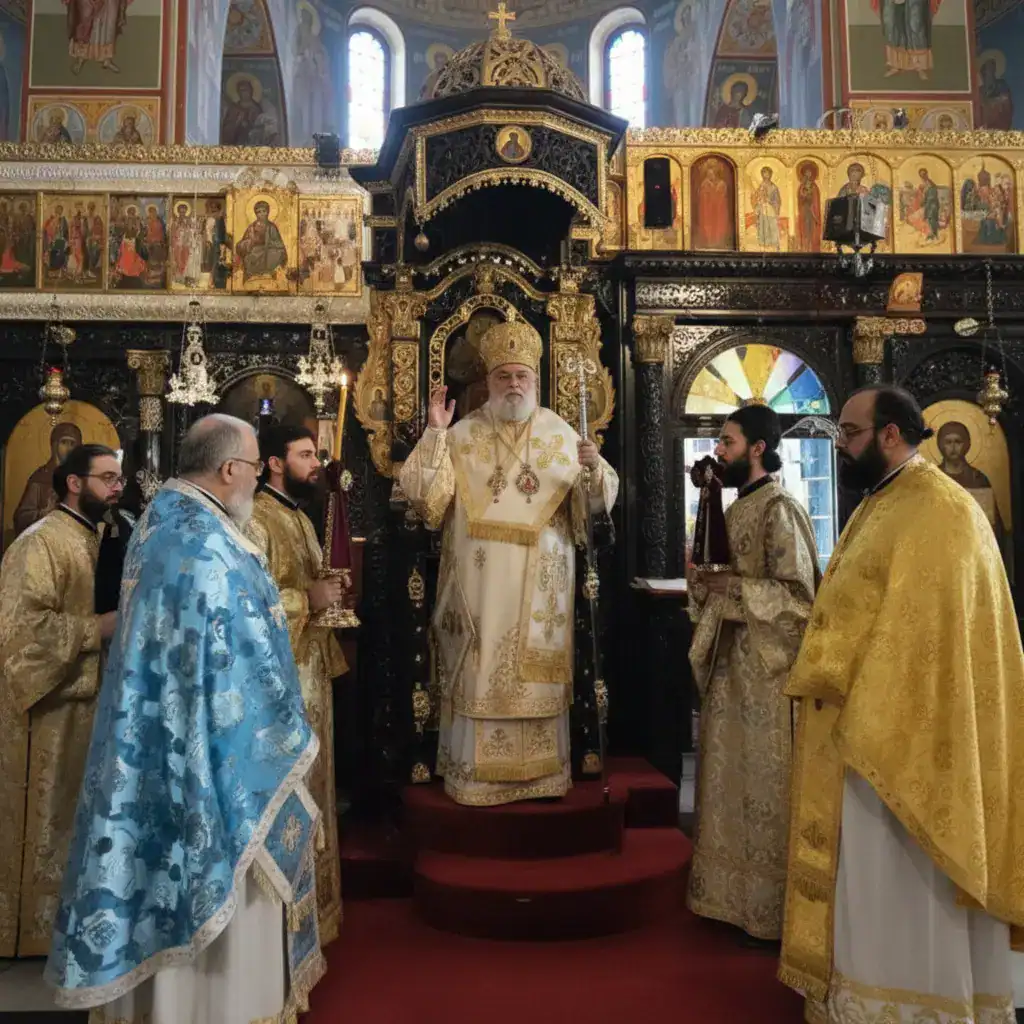
Corfu, March 8, 2026 – On the Second Sunday of Great Lent, dedicated to Saint Gregory Palamas, His Eminence Metropolitan Nektarios of Corfu, Paxoi and Diapontia Islands, led the Divine Liturgy and delivered a sermon at the Holy Church of Panagia Faneromeni, also known as “Panagia ton Xenon” (Our Lady of Foreigners), in the historic center of Corfu Town.
Sermon Focuses on Pauline Epistle and St. Gregory Palamas
During the Divine Liturgy, a Byzantine choir, directed by Mr. Nikolaos Makropoulos, head of the Holy Metropolis’ School of Byzantine Music, chanted devoutly. Among the attendees were the Deputy Minister of Shipping and Island Policy, Mr. Stefanos Gikas, and the leader of the main opposition in the Central Corfu Municipality, Ms. Meropi Ydraiou.
In his homily to the large congregation, Metropolitan Nektarios focused on three key points from the Apostolic reading, the Epistle to the Hebrews by Apostle Paul. He connected this message with the theological teachings of Saint Gregory Palamas, a great Father of the Church, to whom the Second Sunday of Great Lent is dedicated. The Metropolitan highlighted the significance of St. Gregory’s teachings for the life of the Church and the spiritual journey of the faithful.
The Unchanging Nature of God and the Incarnation of Christ
Referring to the Sunday’s Apostolic reading, His Eminence stressed that Apostle Paul reminds the Hebrews that the God of their fathers, whom they received from Abraham, is the same and unchangeable throughout the ages. While creation is subject to decay and change, as the Apostle notes, “they will all grow old like a garment,” the Creator remains eternal and uncreated. Creation, wounded by human sin and the Fall, bears the element of decay. Thus, humanity is called to realize the distinction between the unchangeable uncreated God and the created, perishable creation.
Continuing, he pointed out that Apostle Paul refers to the person of Jesus Christ, the incarnate Word of God, whom some accepted and others rejected. Christ is the One to whom God Himself said, “Sit at my right hand until I make your enemies a footstool for your feet.” Every power that opposes God, whether from the immaterial creation, such as demons, or from humanity, will be subjected to Christ. This passage, Metropolitan Nektarios emphasized, does not refer to angels, because they are created beings, while Christ is the uncreated and pre-eternal Word of God.
Human Responsibility and Communion with God
As a third point, His Eminence underscored human responsibility for salvation. Apostle Paul warns against confusing the divine persons or being led astray by delusions, such as equating angels with the Lord Jesus Christ. If humanity deviates from the Truth, it risks losing its salvation, as the purpose of our existence is communion with God.
Metropolitan Nektarios then spoke about Saint Gregory Palamas, the great Father of the Church, whom the Church presents on the Second Sunday of Great Lent for the spiritual edification of the faithful. Saint Gregory, Archbishop of Thessaloniki in the 14th century, relied on the theological teachings of the great Cappadocian Fathers, Basil the Great, Gregory the Theologian, and other Fathers of the Church. This teaching emphasizes that humanity, as a created being, can commune with God, not, however, in His divine essence, which remains inaccessible and unapproachable, but through His uncreated energies. The uncreated God is revealed and acts in the world through His divine energies, thus making possible humanity’s communion with God and participation in the divine life.
Connecting the teachings of Saint Gregory Palamas with the Apostolic reading, His Eminence emphasized that a Christian life requires discernment, faith, and trust in God. Humanity is called to surrender itself to God, “ourselves and one another,” as the Church confesses in the Divine Liturgy. Then God Himself is revealed to humanity through His uncreated and unsetting light, which Saint Gregory Palamas experienced through prayer and asceticism. The same light was seen by the disciples of the Lord on Mount Tabor, marveling at His divine glory. As the Church journeys towards Pascha and the light of the Resurrection, which is not material but uncreated and divine, the faithful are called to strive spiritually through repentance, prayer, purification, and participation in the Divine Eucharist, to experience the presence of God and to understand more deeply the teachings of the Holy Fathers.
In conclusion, His Eminence thanked the congregation for their participation in the Divine Liturgy and the Byzantine choir under Mr. Makropoulos, wishing everyone strength in the spiritual struggle of Holy and Great Lent.
Source: Ekklisia Online