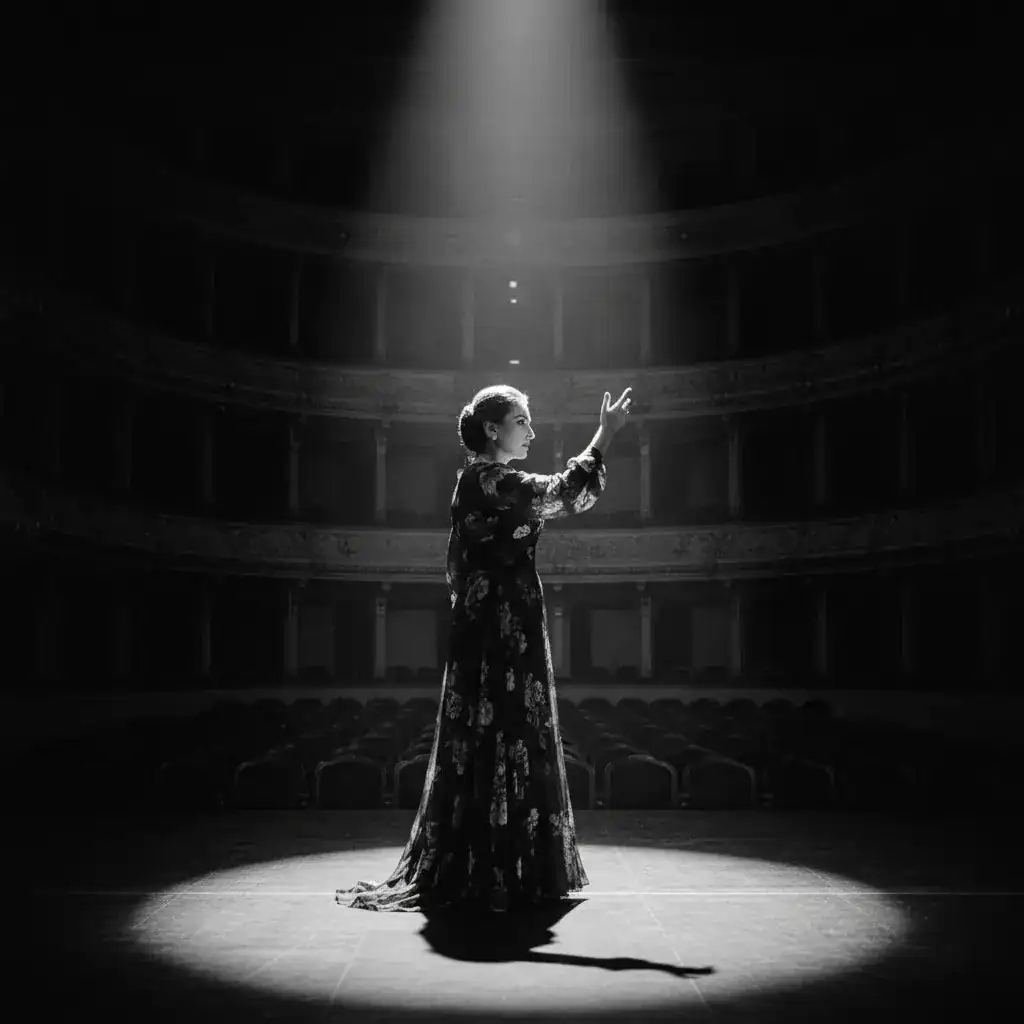
The air in Athens in the summer of 1957 was thick with anticipation, but for Maria Callas, it was also heavy with unspoken tension. The world-renowned Greek opera diva, returning to her homeland after eleven years as an international star, was about to experience a comeback unlike any other – a tumultuous blend of artistic brilliance, political intrigue, and profound personal heartbreak.
The Return of a Prodigal Daughter
Callas arrived at Athens International Airport on July 29th, 1957, accompanied by her husband, Giovanni Battista Meneghini. The city she had left as an unknown soprano now welcomed her as a legend. Her exuberance at being back in Greece was palpable, yet she was unaware of the storm brewing on the local political scene. The conservative government of Constantine Karamanlis had invited her to perform two recitals at the ancient Theater of Herod Atticus on August 1st and 5th, as part of the third Athens Festival.
A Political Storm Brews: The ‘Scandalous’ Fee
However, the opposition, led by Georgios Papandreou and Sophocles Venizelos, seized upon Callas’s visit as an opportunity to score political points against the government. Their primary weapon? Callas’s fee of $9,000 for the two recitals, deemed “scandalous” by the opposition press. Newspapers like Ta Nea and To Vima, owned by publisher Dimitris Lambrakis, launched a relentless attack, inciting readers to boycott the performances.
Dimitris Psathas, a chronicler and future playwright, penned a scathing article in Ta Nea, declaring, “This column must honestly confess that it feels ashamed because it has been repeatedly preoccupied with this repulsive prominent lady, who came to grab the dollars of our poverty.” The Athens Summer Festival, still in its nascent stages, desperately needed the tourism and prestige that Callas’s concerts would bring, but the political machinations threatened to derail everything.
Besieged in the Grande Bretagne: A Diva’s Tears
Callas’s stay at the Grande Bretagne hotel in Syntagma Square became a siege. A mob of Greek and foreign press, opera singers, musicians, and fans surrounded the hotel, joined by a heavy police presence due to bomb threats. Overwhelmed by the sheer number of people and the escalating hostility, Callas retreated to her suite, crying, “Send them all away,” and refusing to appear at the festival opening. On the evening of August 1st, just hours before her scheduled performance, the Athens Festival Committee announced that “because of a sudden illness, Mme. Callas’ performance would be postponed.”
The attacks continued unabated. Pavlos Palaiologou of To Vima went so far as to write that Callas was “unworthy” of her nation and family, dredging up vulgar gossip about her strained relationship with her mother. “My God!” he exclaimed, “My national pride has been insulted.” He concluded his hateful tirade with, “Only one road is now available for Callas, and it leads straight to the airport.”
A Voice from the Radio: Callas’s Plea
In an attempt at damage control, Maria Callas sent an audio recording to the Greek National Radio station (EIR) the following day. Her voice, filled with emotion, apologized for her missed performance, attributing it to the dry Athens weather and her unaccustomed vocal cords after decades abroad. “I wanted to appeal to the Greek people, with whom we have spent hard times together (during the Nazi occupation of 1941 to 1944),” she stated. “I want to be at my best when I sing for you, Athens crowd, because you love me so much and I love you too.”
She then addressed the political attacks directly: “I came here just to sing for you, but I was disheartened by the way some people have involved my name with politics. I have nothing to do with politics-all artists shouldn’t meddle with politics…artists belong to the whole world.” With profound emotion, she declared, “I belong to [all of the] Greek people… my blood is Greek and nobody can deny that.” She concluded by thanking her family and colleagues who stood by her during the ordeal, promising to sing with all her heart at her second scheduled concert.
Triumph in Epidaurus: A Second Coming
Despite the inauspicious reception of 1957, Callas bravely returned to Athens in August 1960 for three performances of Bellini’s opera “Norma” at the ancient theater of Epidaurus. These performances were an absolute triumph, erasing the bitter memories of her previous visit. Learning from the past, Callas agreed to donate her $15,000 fee for these performances to a scholarship fund, aimed at financing the education and training of Greek singers abroad. The National Opera later augmented this fund with an additional sum.
The story of Maria Callas’s 1957 Athens comeback is a testament to her resilience and unwavering dedication to her art. It was a period marked by uncalled-for drama and heightened emotions, mirroring the very life of the great diva herself. Yet, through it all, Callas’s voice, her passion, and her undeniable Greek spirit ultimately triumphed, leaving an indelible mark on the history of opera and on the hearts of her countrymen.
Source: https://greekreporter.com/2026/04/14/maria-callas-speaking-in-greek-athens-comeback/