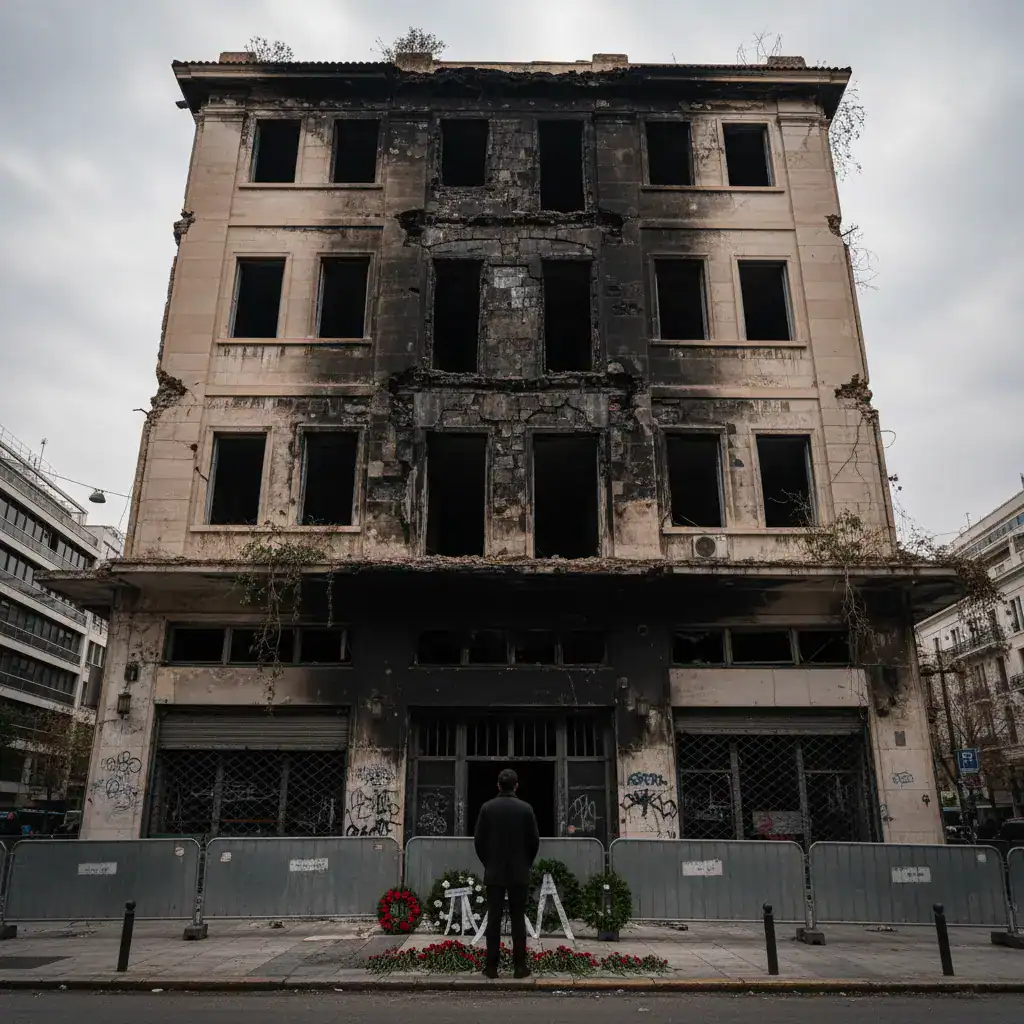
Sixteen years have passed since the tragic fire at Marfin Bank on Stadiou Street, yet Greece continues to bear the weight not only of an abhorrent crime but also of a profound unresolved issue. Three young individuals – Paraskevi Zoulia, Epaminondas Tsakalis, and the pregnant Angeliki Papathanasopoulou – were murdered in the heart of Athens. Despite the gravity and symbolism of the case, the state has failed to deliver justice. This is not merely an open wound; it is a fracture in the credibility of democracy.
The Weight of Silence, Compromise, and Impunity
Let it be stated clearly: the Marfin incident was not a “moment of deviation” within a period of social tension. It was the extreme manifestation of a political culture that for years flirted with violence, relativised it, or justified it. When the rhetoric of “righteous anger” becomes an alibi, and denunciation replaces political responsibility, then the transition from ideology to action is not an accident. It is a predictable, horrific outcome.
Yet, in the face of this reality, a segment of the political system chose silence or compromise. Instead of clear condemnation, we saw caveats. Instead of taking responsibility, we saw insinuation. This stance was not neutral; it legitimised – albeit indirectly – a dangerous notion: that violence can be “explained” when framed within an ideological context.
Herein lies the first major failure: the failure to establish a universal, non-negotiable boundary against violence. This boundary became negotiable – depending on the perpetrator, the narrative, and the political conjuncture.
The second failure is even more severe: impunity. Sixteen years later, the perpetrators have not been held accountable. In a country that mobilises mechanisms for cases of far lesser gravity, this is not merely an oversight. It is a failure of the state. Because justice is judged not only by its decisions but also by its omissions. And when the omission concerns three murders in the heart of the capital, the problem is not technical; it is deeply political.
Selective Memory: A Society’s Struggle with Contradictions
The third dimension is perhaps the most alarming: selective memory. The Marfin tragedy was never fully integrated into the collective narrative as what it was – a crime of political violence without caveats. It was often treated as a “difficult case,” awkward for prevailing narratives. And this awkwardness is not accidental; it is a symptom of a society that struggles to confront its own contradictions.
Democracies are not tested in easy times. They are tested when called upon to defend principles that are not politically convenient. When they must reject violence even when it originates from “familiar” circles. When they must insist on legality, even in the face of waves of social tension.
Marfin is precisely this test – and to this day, we have not passed it. And this does not concern the past. It concerns how we perceive the limits of democracy today. Because the real question is not only who started the fire. It is also who allowed the demand for answers to fade. Who tolerated the relativisation. Who became comfortable with silence.
Sixteen years later, the stakes are not merely the vindication of the past but the safeguarding of the future. A democracy that cannot deliver justice for such a crime risks becoming accustomed to the idea that some boundaries are negotiable. And then the defeat is not only institutional; it is profoundly political.
This open wound will not heal with time. It will heal only when memory is transformed into a consistent political stance. Without exceptions. Without caveats. Without silences.
If Marfin remains merely an anniversary, we will have failed. But if it becomes a point of zero tolerance against all forms of violence and all forms of silence, then perhaps – albeit belatedly – it will acquire true meaning for democracy.