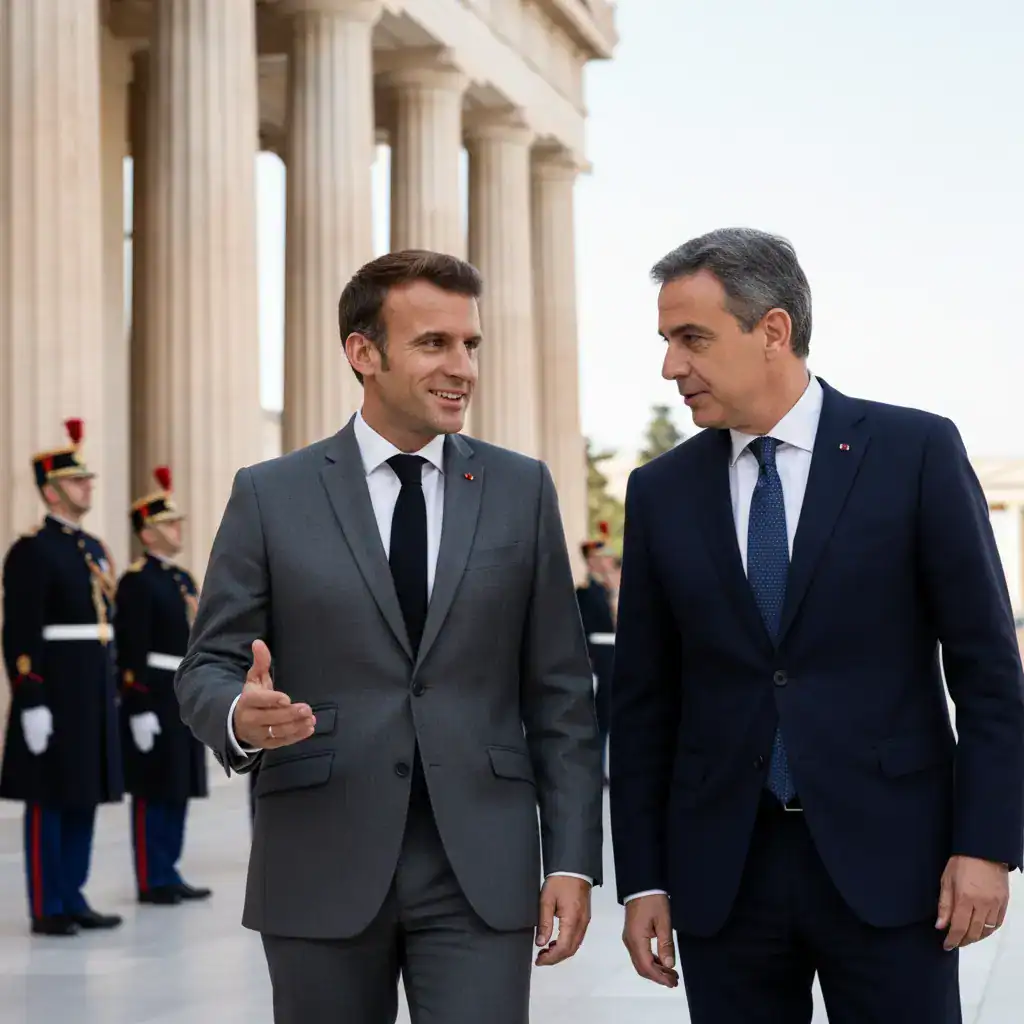
French President Emmanuel Macron’s upcoming visit to Athens on April 24-25 is poised to be more than a routine diplomatic engagement. While the renewal of the Greek-French Strategic Partnership Agreement for another five years is the official agenda, the broader context of ongoing conflicts in the Middle East and Ukraine, coupled with challenges to NATO’s unity, elevates this visit to a pivotal moment for European strategic autonomy and defense.
A Renewed Alliance and a Nuclear Umbrella
The Greek-French Strategic Partnership, which has been a cornerstone of stability in the Eastern Mediterranean, will be formally extended during Macron’s visit. This agreement, as Elysée officials have noted, is not merely an arms procurement deal but a pillar of stability for Europe, underscored by ongoing programs for Belharra frigates and Rafale fighter jets. This reinforces the shared stance of Athens and Paris in a sensitive region and across Europe.
However, the visit’s most significant aspect lies in the concurrent discussion of France’s new ‘nuclear deterrence’ doctrine, which is taking on a European dimension. This initiative is expected to involve six countries, including Greece, in exploring cooperation and joint nuclear deterrence exercises. Greek Prime Minister Kyriakos Mitsotakis recently alluded to these preliminary discussions in a CNN interview, highlighting France’s unique position as the only EU member with nuclear deterrent capabilities.
Beyond Greece, other nations expected to join this ‘nuclear umbrella’ include Germany, Poland, the Netherlands, Belgium, Sweden, and Denmark. This development signals a potential shift towards greater European defense autonomy, reducing reliance on NATO and the United States, especially given the current challenges to transatlantic cohesion.
The Geopolitical Chessboard: NATO’s Challenges and EU’s Ambitions
Macron’s visit comes at a time when Brussels is actively debating the creation of a ‘European NATO.’ The North Atlantic Alliance is grappling with significant internal cohesion issues, directly threatening its long-term existence, particularly with the unpredictable stance of figures like Donald Trump towards allies. In this environment, the reinforcement of bilateral defense ties and the exploration of a European nuclear deterrent underscore a growing urgency for the EU to forge its own robust security architecture.
The strong bonds between Greece and France are evident in their shared strategic interests in the Eastern Mediterranean, a region that continues to be a focal point of geopolitical tensions. The discussions in Athens are expected to reaffirm the high level of strategic alliance built by both sides over recent years, solidifying a common front in this critical area.
Implications for European Defense Autonomy
The prospect of a European nuclear deterrence doctrine, spearheaded by France and embracing key EU members, marks a significant step towards a more self-reliant European defense. This initiative, if successfully implemented, could fundamentally alter the security landscape of the continent, providing a credible deterrent independent of external powers.
For Greece, participation in such a framework would not only enhance its national security but also elevate its strategic importance within the EU. It signifies a move away from purely national defense considerations towards a more integrated and collective European security strategy.
Looking Ahead: A New Era for European Security?
The Athens visit by President Macron is more than a diplomatic formality; it is a strategic maneuver that could redefine European security. The discussions on a renewed bilateral defense agreement and, more importantly, the nascent European nuclear deterrence doctrine, point towards a future where the EU takes greater control of its own defense destiny. The coming months will reveal the extent to which these ambitious plans translate into concrete actions, but the direction is clear: a more robust, autonomous, and strategically unified Europe.
Source: https://www.parapolitika.gr/politiki/article/1708109/o-makron-fernei-doro-tin-puriniki-oprela-stin-athina-24-25-apriliou-o-gallos-proedros-gia-ti-stratiotiki-sufonia/