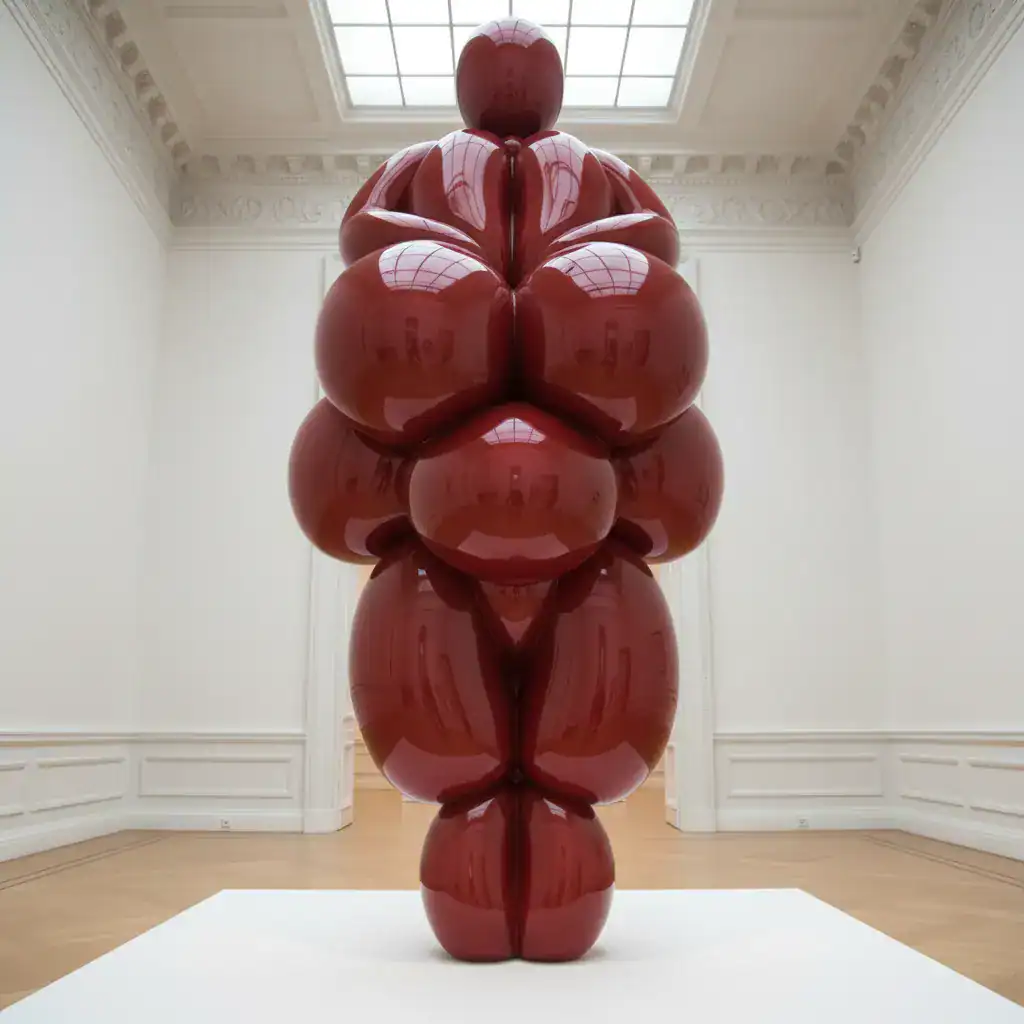
Athens, March 24 – Lessons in optimism, kindness, and acceptance are currently unfolding in Athens as renowned American artist Jeff Koons presents his work, “Balloon Venus Lespugue,” at the Museum of Cycladic Art. The exhibition strategically places Koons’ gleaming sculpture in conversation with museum casts of prehistoric Paleolithic Venus figurines, effectively bridging contemporary art with humanity’s earliest creative expressions.
Koons’ Vision: Reflective Surfaces and the Optimism of Life
Koons, celebrated for his monumental, playful, and highly polished stainless-steel works that often resemble inflatable toys, spoke to journalists about his artistic intent. He emphasized his desire to create reflective surfaces within his art, allowing viewers to encounter their own image. This self-reflection, he explained, fosters a sense of acceptance, both of oneself and of others.
His “Balloon Venus Lespugue,” Koons elaborated, evokes the human skin as a boundary between the external world and the body’s interior. “As we inhale and the body expands to receive air, it becomes a symbol of optimism and the energy of life. With exhalation, the body contracts and empties, symbolizing death. The Balloon Venus exists in a constant state of expansion, expressing the optimism of life’s energy,” Koons stated.
A Dialogue Across Millennia: Ancient and Modern Venus
Dominating the central hall of the Stathatos Mansion, Koons’ sculpture engages in a striking dialogue with the prehistoric Venus of Lespugue-an enigmatic and primal form that has deeply captivated the artist. This ancient figure is presented within a cave-like installation, rotating on a vertical axis to emphasize its ambiguity and invite viewers to experience it from all angles. This curatorial approach highlights not only its physical presence but also its timeless mystery.
Koons repeatedly expressed his awe for these early artifacts, describing them as the first signs of human artistic expression, containing “the know-how of our shared ancestors.” His own Venus, on loan from collector Phokion Potamianos, integrates the technologies of our era. Created through photogrammetry, CT scanning, and advanced imaging techniques, the sculpture reveals both external contours and a complex internal structure. “It is an attempt,” Koons noted, “to locate our bond with nature, our connection to human history, and our place in the world.”
Koons’ Enduring Connection to Greece and the Challenge of Time
A long-time admirer of Greece since the 1980s, partly through his friendship with collector Dakis Ioannou, Koons has also left his mark on the country with the public sculpture “Apollo Wind Spinner” on Hydra. Installed in 2022, this reflective wind spinner, inspired by Apollo as the sun god, greets visitors approaching the island’s harbor.
However, the inevitable impact of time on such radiant works is a recognized challenge. Koons acknowledged this tension. “Apollo is currently undergoing conservation,” he said. “If it can regain its shine, that would be ideal. But time inevitably leaves its mark. Everything is affected by light and time.” He further noted that even materials chosen for their immediacy, like plaster, eventually develop a patina from air and dust. While cleaning can restore surfaces, the passage of time cannot be halted.
Relevance Over Permanence: Koons’ Philosophy on Art’s Enduring Value
Ultimately, Koons places his faith not in permanence but in relevance. He suggests that the enduring beauty of an artwork depends on whether future generations continue to find meaning in it. If not, new forms will emerge, ready to give shape and significance to the human experience once again.
The exhibition offers a profound reflection on humanity’s artistic journey, from its earliest manifestations to contemporary expressions, all through the unique lens of Jeff Koons’ artistic philosophy.
Source: https://www.tovima.com/culture/jeff-koons-in-athens-a-shimmering-dialogue-with-humanitys-origins/