Italy is moving ahead with the construction of a massive floating offshore wind farm in the Strait of Otranto, located only 28 kilometers off the Italian coast and about 45-50 kilometers from the Greek coastline of Epirus and Corfu. The project is the Mediterranean’s first floating offshore wind installation and stands among the largest clean energy investments in the region.
Messapia: A floating giant in Greek-Italian waters
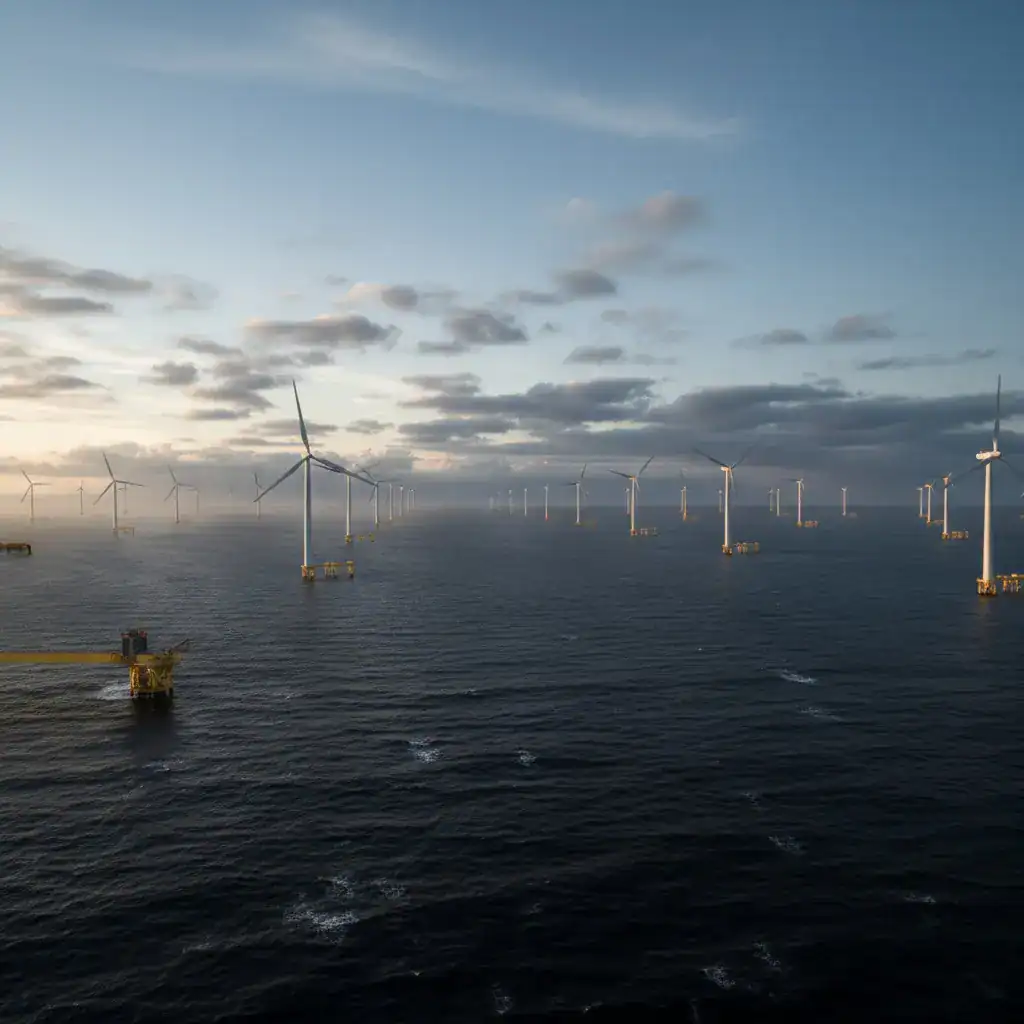
Messapia Floating Wind S.r.l., a subsidiary of Eni Plenitude, is developing a floating offshore wind farm comprising 73 wind turbines, each rated at 18 MW, for a total installed capacity of 1.3 GW. The project area spans 476 square kilometers in the Ionian Sea, roughly 28 kilometers off the Apulian coast, with depths up to 850 meters.
The wind turbines will sit on semi-submersible floating platforms, anchored with advanced systems designed to limit disturbance to the seabed. Power will be carried via 220 kV submarine cables to two floating substations, and from there, through four export cables, will come ashore near Porto Badisco, south of Otranto.
Based on technical and economic estimates, the investment is valued at about €4.5 to €5 billion. The project is expected to generate 11.5 TWh a year – enough to cover more than 10 percent of Apulia’s electricity demand.
Cross-border project triggers Greek consultation
Although an Italian project, Messapia directly concerns Greece. The installation area lies very close to the demarcated Greek-Italian Exclusive Economic Zone (EEZ), within the Strait of Otranto, the natural channel linking the Ionian and the Adriatic.
Under the Espoo Convention (1991) on projects with possible cross-border environmental impacts, Italy had to notify neighboring countries. As a result, the Environmental Impact Assessment (EIA) was recently submitted for Greek public consultation via the Ministry of Environment and Energy.
Put simply, Greece is now consulting on an Italian floating wind farm because it may affect Greek waters, navigation, or migratory birds. At the same time, though, no Greek offshore project has even reached this stage.
Greek offshore program remains stalled
The Greek offshore wind program is “in the midst of a peculiar environment,” with market interest having fallen because of inflation and geopolitical pressures. This was acknowledged in recent days at the 7th Renewable Storage Forum by Flora Karathanasi, who heads the program at EDEYEP (Hellenic Hydrocarbon and Energy Resources Management Company S.A.).
She emphasized that Greece has completed legal procedures, public consultation, and the strategic environmental impact assessment, but now “the program is in the hands of the political leadership” for issuance of the Joint Ministerial Decision (KYA) that will activate it. She voiced concerns about how planning for Greek plots is evolving, stating that the offshore wind market has frozen.
Nevertheless, EDEYEP, she noted, continues the technical and scientific preparations for the next steps.
Technical preparations continue despite political delay
The state company has moved ahead with activating the “special purpose vehicle” (SPV) that will conduct wind, geophysical, and environmental studies in areas of interest. However, the SPV has not yet been established.
Karathanasi noted that EDEYEP has created a geological database for the seabed, is preparing the strategic study for geophysical surveys, and is designing the next environmental studies. At the same time, it has developed a strategy for data collection and mapping technological needs for each area, while this study undergoes certification to ensure project viability.
EDEYEP, she added, actively supports building a local supply chain, has analyzed the ports and services that will be needed, and is preparing to give investors a clear framework for action. Activating the SPV, she said, will “rekindle enthusiasm and unlock investor interest”.
Multi-billion euro investment with 2030 target
Returning to the Italian project, construction is scheduled to begin in 2027, with operation around 2030, a lifespan of 25-30 years, and full decommissioning at the end of the cycle.
This project is part of the broader portfolio of Eni Plenitude, a subsidiary of Italy’s ENI, which includes more than 3 GW of floating wind in Italy, Calabria, Sardinia, and Tuscany.
The study does not explicitly mention the budget; however, technical and economic estimates put the investment at €4.5 to €5 billion. It is among the largest clean energy projects in the Mediterranean, with an estimated lifespan of 25-30 years and expected annual output of 11.5 TWh – enough to cover more than 10 percent of Apulia’s electricity demand.
Strategic location in the Strait of Otranto
The choice of location in the Strait of Otranto is no accident: in Italian plans, the area provides strong, stable winds, great sea depth suited to floating bases, and minimal visual disturbance.
On the Greek side of the same strait (from Corfu to Parga), the meteorological and oceanographic conditions are seen as extremely favorable. However, Greece still remains at the stage of “priority zones” without any mature floating wind project.
Timeline and environmental considerations
The wind turbines will be placed on semi-submersible floating platforms, anchored with advanced systems designed to keep seabed disturbance low. Power will be transferred through 220 kV submarine cables to two floating substations and from there, with four export cables, will reach land near Porto Badisco, south of Otranto.
According to an EDEYEP spokesperson, the value of equipment and buildings that were destroyed amounts to roughly €1.2 million in total, which, together with lost goods, brings losses to €4 million. The company has property insurance, but policy details have not been disclosed.
The Messapia project marks a major step forward in Mediterranean renewable energy development, while also highlighting the contrast between Italian progress and Greek delays in rolling out offshore wind.
Source: https://www.startmediacorfu.gr/i-italia-chtizei-ena-ploto-giga-sta-45-50-chiliometra-apo-ta-paralia-tis-kerkyras/