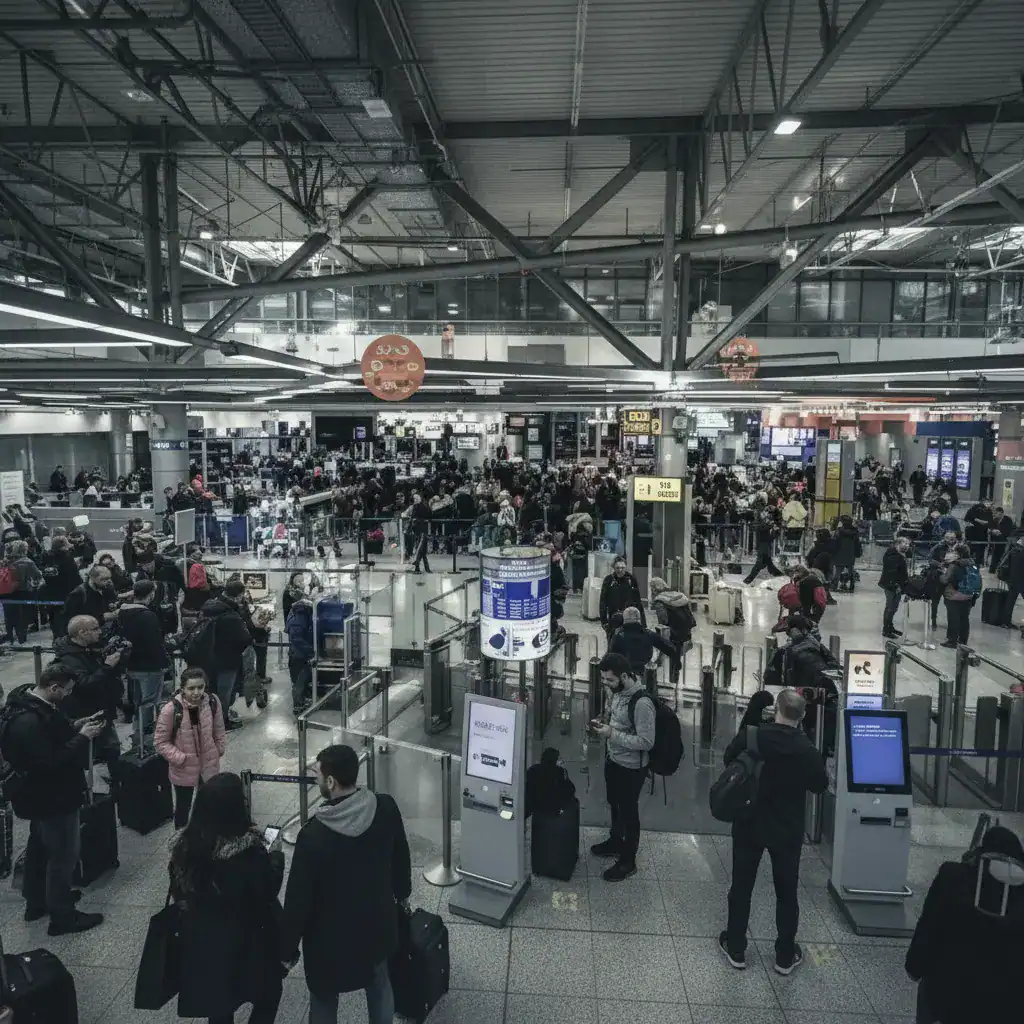
Air traffic across Greece was paralyzed for hours, leaving the Greek airspace almost empty, as a technical problem at the central radio communication systems of the Athens Flight Information Region (FIR) caused widespread disruption. Thousands of travelers found themselves stranded at airports across the country, including Athens and Thessaloniki, on January 4, 2026.
The Blackout: A ‘Nightmare’ for Air Traffic Controllers
The exact cause of the malfunction remained unclear for some time, with Panagiotis Psarros, president of the Air Traffic Controllers Union, stating that contact with aircraft in the air was lost instantaneously. He emphasized, “The only certainty is that our systems are outdated, something we have highlighted many times in the past.”
According to aviation expert Heinrich Grossbongardt, speaking to SPIEGEL, such a situation is a “nightmare for controllers.” He added, “They have no way to coordinate the many aircraft and prevent dangerous situations.” This incident occurred during a period when the eastern sector of Greek airspace, bordering Bulgaria and Turkey, is particularly strained due to the war in Ukraine, leading to increased air traffic over Greece.
German Media Points to Corruption and Underinvestment
While the Greek intelligence service ruled out sabotage, attributing the incident to a technical problem, German media outlets are delving deeper. Handelsblatt reported on the widespread disruptions, and SPIEGEL Online attempted to investigate the root causes. Oliver Wessolek, another expert, noted that “there have long been reports of a serious investment backlog in Greece.” He hinted that “it is very likely that something went wrong,” implying a potential factor of corruption, though not explicitly stating it.
The Union of Air Traffic Controllers (EEEKE) has repeatedly warned about the antiquated and poorly maintained communication systems, stating that the current situation is not a sudden occurrence but a “foreseeable” outcome of chronic inaction and mismanagement by the Hellenic Civil Aviation Authority (HCAA). They accuse the HCAA of systematically ignoring their warnings and operating with outdated, vulnerable, and inadequately maintained communication systems that have repeatedly caused serious problems. [cnn.gr](https://www.cnn.gr/ellada/story/513006/fir-athinon-giati-synevi-to-blak-aout-to-provlima-me-tis-epikoinonies-kai-oi-ypodomes-tis-ypa) and [newsit.gr](https://www.newsit.gr/ellada/fir-athinon-to-aparxaiomeno-systima-ton-30-eton-kai-to-efedriko-pou-den-leitourgise-pote/4566444/) also reported on these concerns, highlighting that the system in question is over 30 years old and that a backup system never functioned. [ethnos.gr](https://www.ethnos.gr/greece/article/393663/aerodromiataanapanthtaerothmatagiathnplhrhkatarreyshkaioiproeidopoihseispoydeneisakoysthkan) further detailed that Greece has faced repeated warnings and referrals to the European Court of Justice for non-compliance with aviation regulations due to these deficiencies.
Unanswered Questions and Future Implications
The incident has brought to light critical questions about the safety and reliability of Greece’s air traffic control infrastructure. The Ministry of Infrastructure and Transport and the HCAA maintain that no safety issues arose for flights, yet the lack of transparency surrounding the causes of such a widespread malfunction raises serious concerns. The investigation into the exact events of January 4, 2026, is ongoing, with authorities expected to determine the full extent of the problem and any potential misconduct. The Greek authorities are convinced that this is an internal problem.
The long-standing issues, coupled with the recent blackout and the criticisms from air traffic controllers and European bodies, underscore the urgent need for comprehensive modernization and transparent management within the HCAA. The current situation, described by experts as a “systemic pathology,” could lead to further disruptions and erode public trust if not addressed effectively and ethically.