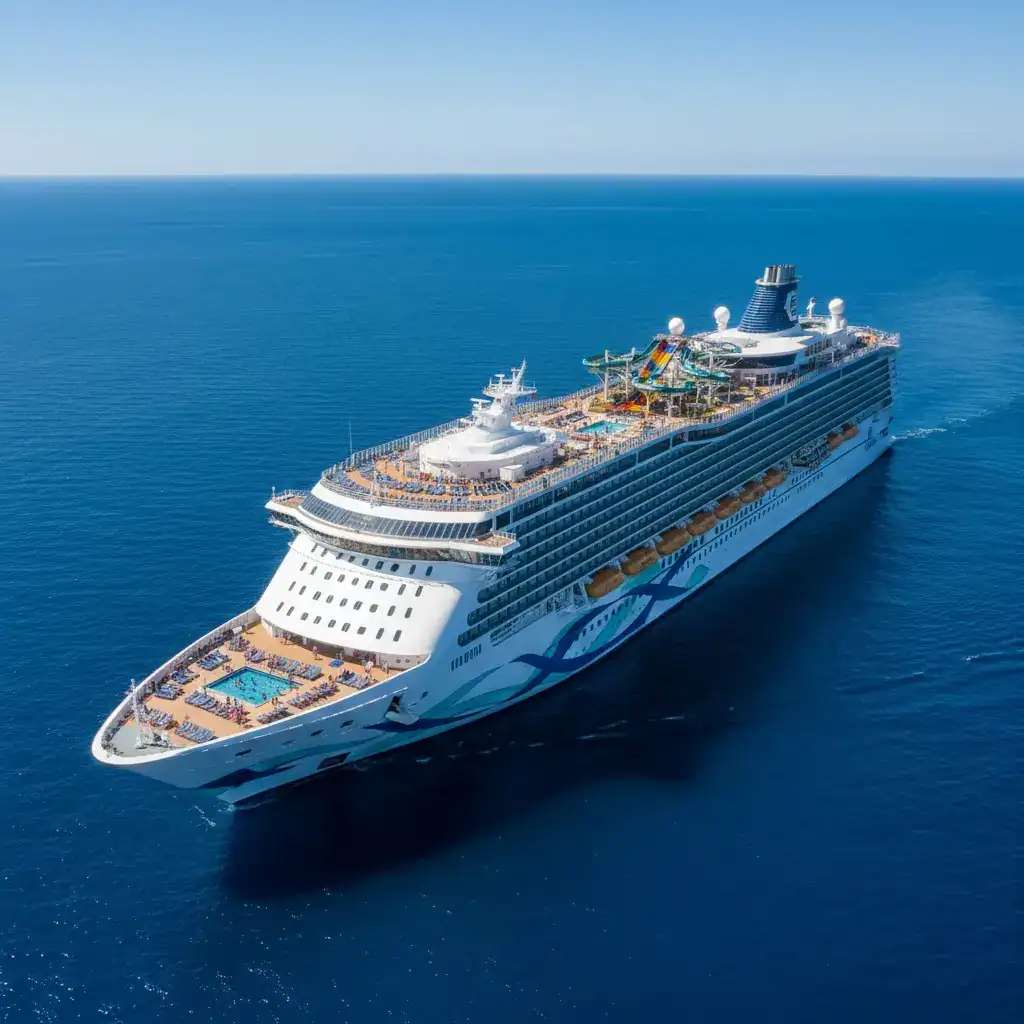
When does tourism become a moral issue? When should economic benefit give way to political conscience? These are the uneasy questions facing Corfu as the island gets ready to welcome the cruise ship Crown Iris – a vessel that has become the center of an intense debate about values, solidarity, and the cost of silence.
A Statement of Outrage
On October 29, 2025, SYRIZA-Progressive Alliance Corfu issued a scathing announcement about the upcoming arrival of the Crown Iris cruise ship. The statement, published just one day before the vessel’s scheduled docking, conveys what the party calls “anger” at the circumstances surrounding the visit.
The timing could scarcely be more provocative. According to the statement, the ship arrives “just one day after the ceasefire violation, violently perpetrated by the Israeli state, with the blessings of the West.” This reference frames the entire visit against the backdrop of the ongoing Palestinian crisis – a conflict that continues to polarize international opinion and test the limits of diplomatic neutrality.
But this isn’t just a statement about geopolitics. It’s a challenge to the very notion of “business as usual” at a time when global conflicts increasingly intrude upon local decisions.
The Uncomfortable Juxtaposition
The SYRIZA statement draws a stark contrast: while Palestine remains “under occupation, divided, plunged into humanitarian crisis, with daily deaths from hunger and violence,” Israeli tourists claim “their right to vacation and undisturbed rest.”
This juxtaposition, suffering on one side, leisure on the other, is cast as morally untenable. The party’s rhetoric is deliberately provocative, meant to push residents and officials alike to confront an uncomfortable reality: can an island accept tourism revenue while remaining silent about the policies of the tourists’ home government?
Dr. Maria Konstantinou, a political analyst at the Ionian University, adds context: “What we’re witnessing is the collision of two worldviews. One sees tourism as an apolitical economic activity – people are people, regardless of their passport. The other sees every transaction as inherently political, especially when it involves citizens of states engaged in controversial military actions.”
The question becomes: which worldview should prevail in Corfu?
Local Disruption for High-Value Tourists
Beyond the geopolitical dimension, SYRIZA’s statement takes up a more immediate concern: the impact on Corfu’s residents. The announcement states that the island, already struggling with “daily problems such as traffic congestion”, will face “policing arrangements and traffic bans” to accommodate what are described as “tourists of high economic power.”
This language is deliberately chosen. The phrase “tourists of high economic power” carries an implicit critique: that local residents will be inconvenienced, their mobility restricted, their daily routines disrupted – all to facilitate the comfort of wealthy visitors.
The statement goes even further, suggesting these practices “remind us of other eras” – a veiled but unmistakable reference to periods of occupation or authoritarian control when local populations were subordinated to external interests.
Nikos Papadopoulos, a Corfu resident and small business owner, voices frustration: “Every time a cruise ship arrives, the Old Town becomes impossible to navigate. We understand tourism is important for the economy, but when do our needs as residents matter? When do we get to say ‘enough’?”
The Economics of Conscience
Tourism is Corfu’s lifeblood. The island’s economy relies heavily on visitors, particularly during the extended season that now stretches from spring through late autumn. Cruise ships, while controversial due to their environmental impact and the relatively low per-capita spending of their passengers, still represent significant revenue.
But SYRIZA’s statement challenges this economic logic with a moral one. The party invokes “the souls of the children who were lost, the ruins of Palestine, the daily despair” and argues these cannot be ignored in the face of “welcome, dollar.”
This is populist rhetoric, certainly – but it taps into a genuine tension. How much should economic benefit weigh against ethical concerns? Is there a point at which profit becomes complicity?
Professor Dimitris Alexandrou, an economist specializing in island tourism, adds a counterpoint: “Tourism, by its nature, is apolitical. We don’t ask British tourists about Brexit, German tourists about their government’s policies, or American tourists about their foreign interventions. If we start politicizing tourism based on the actions of visitors’ governments, we open a Pandora’s box that could devastate the industry.”
Yet the SYRIZA statement suggests this Pandora’s box is already open – that in an age of instant global communication and heightened political consciousness, the old boundaries between commerce and conscience are dissolving.
A Call to Action – But Will Anyone Answer?
The statement concludes with three specific demands:
First, that the government’s silence regarding “violence and murder of civilians” must end. This is a call for official Greek condemnation of Israeli actions in Palestine – a position that would align Greece more closely with countries critical of Israeli policy and potentially strain relations with both Israel and the United States.
Second, that Corfu should not be subjected to “repressive measures” to host those who “do not recognize the tragedy of Palestine.” This demand directly challenges the traffic restrictions and security measures typically implemented for cruise ship arrivals.
Third, a call for joint struggle toward an international solution respecting international law and human rights, including recognition of a Palestinian state within 1967 borders. This is the broadest demand, placing local action within a global framework.
SYRIZA has also called for a gathering – a public demonstration of solidarity with the Palestinian people. The question is: will Corfu’s residents respond?
The Silence of Official Corfu
As of the statement’s publication, local authorities have not responded publicly to SYRIZA’s demands. The municipality has not commented on whether any special security measures will be implemented for the Crown Iris arrival, nor has it addressed the broader political questions raised.
This silence is significant in itself. It suggests a calculation that engaging with SYRIZA’s framing would be politically costly – either by alienating tourism industry stakeholders or by appearing indifferent to humanitarian concerns.
Katerina Vlachou, a political journalist covering Corfu politics, notes: “Local authorities are in an impossible position. If they embrace SYRIZA’s position, they risk being seen as hostile to tourism and potentially inviting legal challenges from cruise operators. If they ignore it, they appear callous. So they choose silence and hope the controversy passes.”
The Broader Context: Greece, Israel, and Palestine
Greece’s relationship with Israel is complex. Historically supportive of Palestinian rights, Greece has in recent years developed closer ties with Israel, especially in areas of defense and energy cooperation. The discovery of natural gas reserves in the Eastern Mediterranean has created shared economic interests that complicate traditional political alignments.
Meanwhile, Greece’s left-wing parties, including SYRIZA, have maintained strong pro-Palestinian positions. During SYRIZA’s time in government (2015-2019), the party advocated for Palestinian statehood and criticized Israeli settlement policies, though practical constraints limited concrete policy changes.
The Crown Iris controversy, then, serves as a microcosm of larger national tensions. It reflects the gap between official policy – which seeks to balance relationships with both Israel and Arab states – and grassroots sentiment, particularly on the left, which views the Palestinian cause as a fundamental issue of justice.
Dr. Konstantinou explains: “What’s happening in Corfu isn’t unique. Across Europe, local communities are grappling with how to respond to the Israeli-Palestinian conflict in their own contexts. Some cities have declared themselves ‘apartheid-free zones,’ refusing contracts with companies involved in Israeli settlements. Others have faced pressure to cancel cultural events featuring Israeli artists. These are the new frontlines of a very old conflict.”
Tourism as Political Battleground
The Crown Iris incident reveals how tourism has become a political battleground. No longer simply an economic activity, tourism now carries symbolic weight – a way for communities to express values, assert identity, and take stands on global issues.
This trend is visible across many places. Barcelona has restricted cruise ships due to environmental and overtourism concerns. Venice has banned large vessels from its lagoon. Amsterdam has limited tourist accommodations in residential areas. In each case, local communities are pushing back against the idea that tourism is a pure good, demanding instead that it align with community values and priorities.
The SYRIZA statement fits into this broader movement – a rejection of tourism-at-any-cost in favor of tourism-with-conditions. The condition here is moral: that Corfu should not welcome visitors whose government is engaged in actions the party deems unconscionable.
But there’s a counterargument, raised by tourism professionals on the island. Yannis Marinos, who operates a tour company in Corfu, argues: “Tourists are individuals, not representatives of their governments. Many Israelis oppose their government’s policies. Should we punish them for the actions of politicians they may have voted against? That’s collective guilt, and it’s wrong.”
The Question of Effectiveness
Even if one accepts SYRIZA’s moral framing, a practical question remains: will a protest in Corfu change anything?
The cruise ship will dock. Tourists will disembark. They will visit the Old Fortress, stroll through the Liston, perhaps buy some kumquat liqueur. A protest, even a well-attended one, is unlikely to alter Israeli policy toward Palestine or change the minds of tourists who have already booked their vacation.
So what’s the point?
For SYRIZA and its supporters, the point is solidarity – a public declaration that Corfu stands with the Palestinian people, that the island’s residents have not forgotten, have not become numb to distant suffering. It’s a symbolic act, certainly, but symbols matter. They shape narratives, influence consciousness, and create space for broader political shifts.
Professor Alexandrou is skeptical: “Symbolic politics can be satisfying for those engaged in it, but we must ask: at what cost? If Corfu develops a reputation as hostile to certain nationalities, cruise lines will simply skip the island. The economic consequences could be severe, affecting not just tourism operators but everyone whose livelihood depends on the industry.”
What Happens Next?
As the Crown Iris prepares to dock in Corfu, the island faces a moment of decision – not necessarily about this specific ship, but about what kind of place it wants to be.
Will Corfu embrace SYRIZA’s call for solidarity, positioning itself as an island with a conscience, willing to speak uncomfortable truths even at economic cost? Or will it maintain the traditional separation between tourism and politics, welcoming all visitors regardless of their governments’ actions?
There is no easy answer. Both positions carry risks and reflect legitimate values. One thing is certain: this controversy won’t be the last of its kind. As global conflicts continue and political consciousness rises, communities everywhere will face similar dilemmas.
The Crown Iris will eventually sail away from Corfu. The tourists will return home. But the questions raised by its arrival – about responsibility, solidarity, and the price of silence – will remain.
And perhaps that’s the real point of SYRIZA’s statement: not to stop one ship, but to start a conversation about what matters more than money.
Source: https://www.kerkyrasimera.gr/anakoinosi-toy-syriza-p-s-kerkyras-gia-tin-afixi-toy-crown-iris-2/