The decision to establish Corfu Port as a year-round cruise destination is not merely a local adjustment to tourism trends. It signals a broader transformation poised to redefine the landscape of maritime tourism in the Mediterranean over the next decade, and simultaneously serves as a test of whether Greek ports are prepared for radical solutions in managing increased traffic and maintaining high quality, even amidst resource constraints.
A Radical Solution or a Necessity?
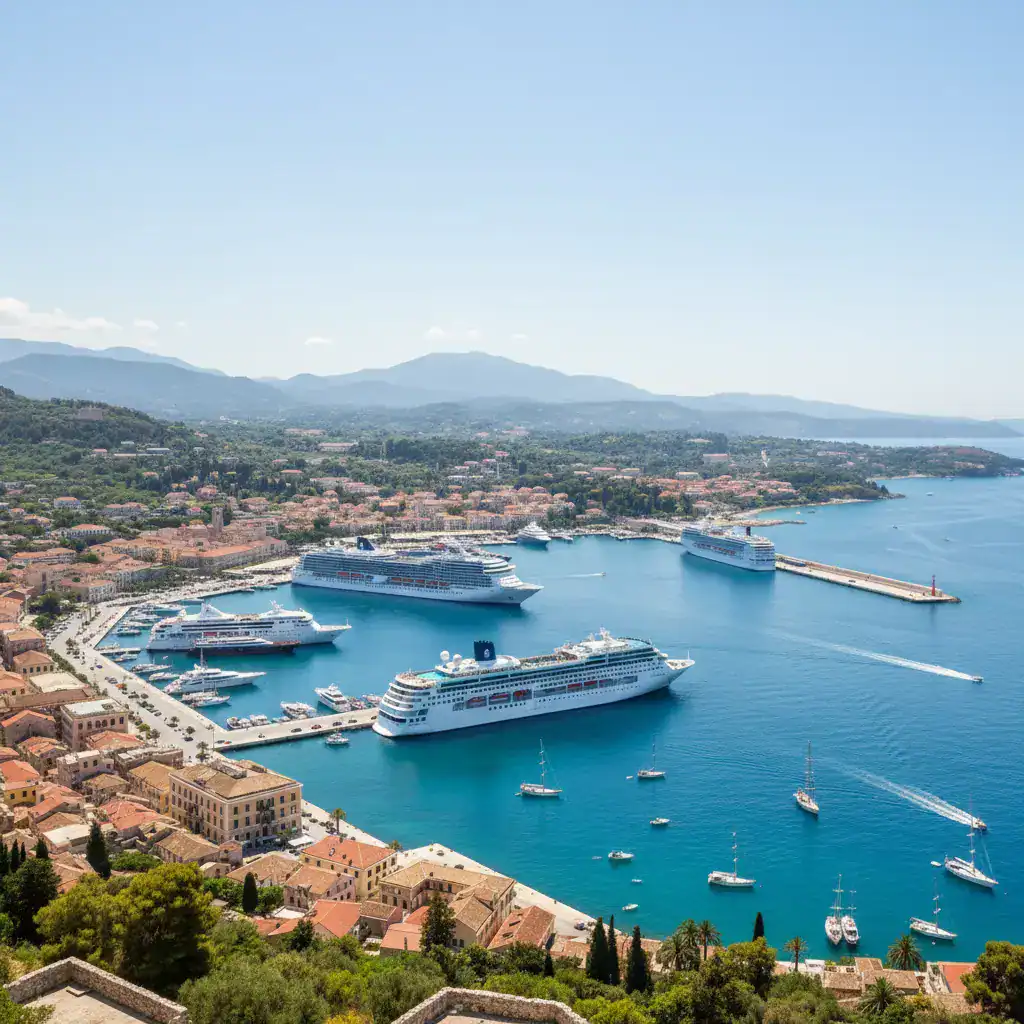
According to Dimitris Apergis, CEO of the Corfu Port Authority (OLKE S.A.), the port’s current situation is very positive, marked by significant traffic and upcoming investments. Corfu Port is solidifying its position as a central hub in the Adriatic and a gateway from the Western Mediterranean to Greece. Notably, it is among 15 Greek ports designated as ‘ports of international interest’ (Category K1) and included in the Trans-European Transport Network for Greece, underscoring its strategic importance.
Currently, Corfu Port facilitates passenger connections with Central Greece via Igoumenitsa and non-Schengen connections with Albania. During the summer months, it also connects with Italy. Crucially, cruise operations now run all year, a significant achievement by OLKE that unlocks substantial development opportunities for the winter months. Several companies are already showing interest in operating during winter, creating prospects for year-round maritime tourism.
A recent study by Compare Market Australia ranked Corfu Port as the top quality cruise port in Greece, among the top 10 in Europe, and 19th globally. This assessment considered 101 cruise ports worldwide across seven key indicators, including visitor experience, available activities, and local weather conditions. Apergis emphasizes the qualitative significance of this distinction, noting that quantitatively, Corfu is the fourth-largest cruise port in Greece, after Piraeus, Mykonos, and Santorini, according to data from the Union of Greek Ports.
But is this growth sustainable? And does it truly address the challenges of managing such an expansive network of ports?
The Social Dimension of Growth
Mr. Apergis points out a critical issue: OLKE manages a total of 37 ports across the region with a severely limited staff of just 14-15 people, despite an organizational chart calling for 37 for the central port alone. “Our staff is very limited. Normally, it wouldn’t even be enough for the central port. Yet, we operate 37 ports with just 14-15 people, and the staff does an excellent job,” he explains. They are administratively and technically responsible for all aspects, including lighting, water, electricity, dredging, maintenance, and expansions, operating with absolute consistency.
The economic contribution from the port’s operations and cruise activity for 2023-2024 amounted to 193 million euros. According to a study by the Democritus University of Thrace, the total economic footprint of cruise passengers on the local economy for 2023-2024 reached 180.8 million euros, while homeporting passengers spent a total of 48.7 million euros. This confirms the strategic importance of homeporting in maximizing economic contribution to the region.
However, the constraints imposed by austerity measures delay staff recruitment, particularly for engineers essential for maintaining older infrastructure. “We requested recruitments from the central government and received two out of the four we asked for in previous years,” Apergis notes.
This situation raises questions about the long-term sustainability of such operations. Can quality be maintained with such limited human resources? And what impact does this have on the well-being of the dedicated staff?
Is the Port Ready for Change?
A crucial question is whether Corfu Port’s infrastructure is sufficiently developed to handle the increased traffic and future expansion plans. Apergis confirms that two studies have been conducted: one on the cruise industry’s contribution to the island, presented last year, and another on visitor perceptions of the port, to be presented this year. The results indicate 100% visitor satisfaction with the port compared to others, suggesting robust infrastructure. However, the port is not just about endurance; it’s about enabling visitors to navigate the city and its monuments seamlessly.
Corfu’s high ranking is also attributed to its Old Town, a UNESCO World Heritage Site, which greatly interests visitors. The port acts as a gateway, guiding visitors on how best to experience the city and its heritage. Apergis notes that most visitors are interested in the city’s experience, not just the port itself, but the port remains critical as an entry point.
Professor Anna Kowalska, an expert in public finance from SGH, has doubts: