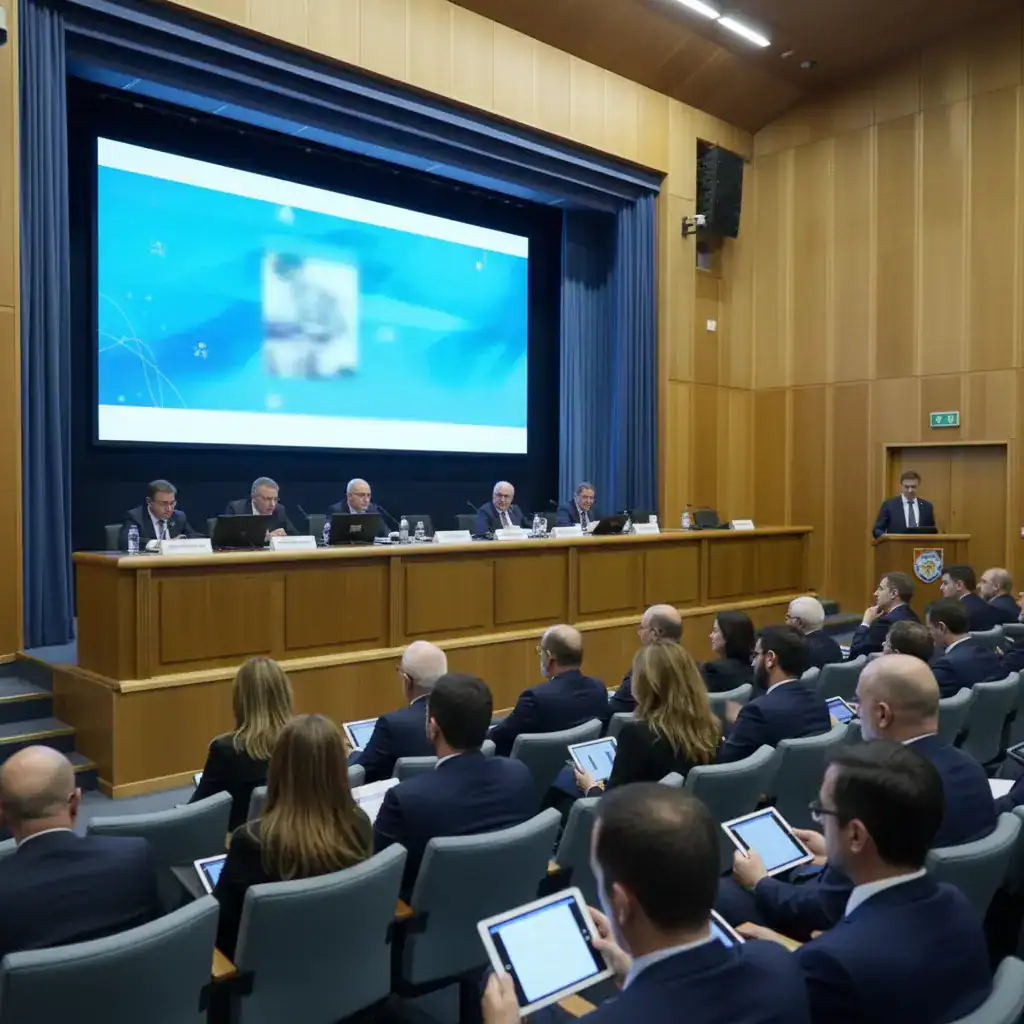
Athens, Greece – A high-level meeting on the implementation of the European Maritime Industry Strategy and the European Ports Strategy successfully concluded yesterday, May 5, at the Eugenides Foundation in Athens. The event, organized by the Waterborne Technology Platform in collaboration with the Eugenides Foundation and under the auspices of the Ministry of Maritime Affairs and Insular Policy, gathered top representatives of the European maritime ecosystem.
Athens at the Forefront of European Maritime Policy
The choice of the Eugenides Foundation as the host venue is particularly significant, as it coincides with its 70th anniversary of contributing to education, training, and skills development. At a critical juncture for the transformation of shipping, the Foundation is emerging as a hub of knowledge and dialogue for the skills and technologies that will define the future of the sector.
Apostolos Tzitzikostas, European Commissioner for Sustainable Transport and Tourism, set the tone for a new era, emphasizing that decarbonization is now a matter of strategic autonomy and competitiveness for Europe. Referring to the new European Industrial Maritime Strategy and the Ports Strategy, he stressed: “Our goal is clear: ports that are not only efficient, competitive, and sustainable, but also safe, resilient, and fully aligned with Europe’s strategic interests. The success of these strategies will be judged by their implementation. Zero-emission maritime transport partnerships align policy objectives with industrial realities, accelerating progress. In today’s geopolitical environment, Europe cannot afford to lag – it must lead.” He also underscored the importance of international coordination: “We must first create common ground within the European Union and then with our international partners. If we want a competitive future, a global agreement at the IMO is essential to ensure a level playing field.”
Greece’s Strategic Role in European Maritime Affairs
Vassilis Kikilias, Minister of Maritime Affairs and Insular Policy, highlighted the strategic importance of the event for Greece, emphasizing the country’s role as a key shaper of European developments. “We sought, in cooperation with European partners, to enhance upskilling, reskilling, and the improvement of technical tools to empower shipping – the country’s heavy industry. This effort is bearing fruit. However, consistency and realism are required. The initial plan was mathematically unfeasible and unsustainable, as the sector cannot bear such a burden to achieve zero-emission targets.”
Leonidas Dimitriades-Eugenides, President of the Eugenides Foundation, highlighted the need to connect the European maritime strategy with global realities and the experience of countries with strong shipping, such as Greece. “Shipping is now at the center of strategic decisions. The challenge is for the European transition – through initiatives like Waterborne – to remain globally coordinated and not create fragmentation.” He stressed the role of the International Maritime Organization as a framework for cohesion, while also pointing out the importance of Greek shipping as a factor of realism in the discussion. “Decarbonization must be globally coordinated, realistic, and, above all, safe.” He also emphasized the importance of education and skills for the successful implementation of the transition.
Waterborne Technology Platform’s Vision for the Future
In his opening speech, Jaap Gebraad, Secretary General of the Waterborne Technology Platform, emphasized the significance of the nine Technology Roadmaps, covering critical areas such as short-sea shipping, port ecosystems, and the blue economy. It was noted that Europe possesses 35% of the world’s fleet and 50% of maritime equipment, making it a global power that must be strengthened through coordinated investments. He stressed that the achievements of the Waterborne Partnership with the European Commission for Zero-Emission Shipping are tangible, and its renewal will be key to a competitive, resilient, and sustainable maritime sector, through the aggregation of public and private investments.
Eliza Vozemberg, Chair of the European Parliament’s Committee on Transport and Tourism, stressed that “shipping has always been a key pillar of European development and is more critical today than ever. As most of the EU’s external trade is carried by sea, the sector acts as an economic and strategic lever in an unstable international environment. Geopolitical tensions, increasing competition, supply chain pressures, and the climate crisis require innovative, sustainable solutions. Therefore, strengthening European shipping is a top priority, with new strategies for the maritime industry and ports shaping the future of the sector at a critical juncture.”
Key Issues and Panel Discussions
The thematic panels highlighted crucial issues:
Short-Sea Shipping, Coastal Navigation, and Insularity
The discussion among Manolis Koutoulakis, Secretary General for the Aegean and Insular Policy, George Alexandratos, President of the Hellenic Chamber of Shipping, Efstratios Apergis, Vice President of the Association of Passenger Shipping Companies (SEEN), and Elpi Petraki, Secretary General of the Hellenic Shortsea Shipowners Association and representative of the European Shortsea Network, moderated by Jaap Gebraad, highlighted the critical role of coastal shipping in connecting islands and the territorial cohesion of the EU. Emphasis was placed on the challenges of insularity and the need for sustainable, resilient maritime transport. Short-sea shipping was recognized as a key pillar of European transport policy, contributing to congestion reduction and the green transition. A central theme was the connection of innovation, infrastructure, and human capital as a prerequisite for the transformation of the sector. Special reference was made to the Zero-Emission Shipping Partnership, which acts as an investment lever, with significant private capital leverage. At the same time, it was noted that the cost of building new ships has more than doubled in recent years, making the transition particularly demanding for the sector. The need for a portion of the revenues from the EU ETS to be specifically returned to the maritime sector to support the financing of the green transition was emphasized. Finally, it was noted that the meeting prepares the ground for the upcoming public consultation (May-June 2026) on the Technology Roadmaps, which will determine the future course of the sector.
Strengthening Europe’s Shipbuilding Capacity and Technological Leadership
In the discussion between journalist Michalis Psilos, Director of Naftemporiki.gr, and Panos Xenokostas, President and CEO of ONEX Shipyards & Technologies Group, Mr. Xenokostas stated that “the European Union seems to be activating with two parallel dynamics: on the one hand, the maritime defense industry, which is already attracting significant capital, and on the other hand, commercial shipping, where progress remains mainly at the planning level. Greece is the southern pillar of European shipping and a key maritime hub. The challenge is to transform from consumers to producers and exporters of maritime technology,” adding that “a comprehensive ecosystem is required to ensure that investments remain within Europe, with an emphasis on access to finance, export promotion, and the integration of social and and energy criteria. We need a real ‘alliance of the sea’ at a European level.”
Maritime Technology
Moderated by Pieter Huyskens, Group Director of RD&I at Damen Shipyards Holding, the panel highlighted that maritime technology is at a critical juncture, with innovation, green transition, and Europe’s strategic autonomy at the forefront. A common ground was the need for closer cooperation between the public and private sectors and strengthening industrial partnership. Eleni Polychronopoulou, President of HEMEXPO, underlined the importance of testing and evaluating technologies, as well as the need for automation and upskilling of crews. Maja Novakovic, President of the Waterborne Technology Platform, focused on the importance of understanding market needs and cooperating with the European Commission as a basis for innovation. Vassilis Korkidis, President of the Piraeus Chamber of Commerce and Industry, highlighted structural problems, such as the lack of new fuels and restrictions for SMEs, emphasizing the need to strengthen clusters and European self-sufficiency. At the same time, it was noted that the development of innovative solutions requires significant maturation time, making it necessary to bridge the gap between research and the market, integrate smaller projects into larger initiatives, and avoid fragmentation of the regulatory framework at an international level. Overall, it was emphasized that a more targeted strategy and investments are needed to ensure competitiveness.
Port Ecosystems
The panel, moderated by Professor Sotirios Theofanis, Executive Director of Marlogmind PC, highlighted the transformation of ports from simple transport infrastructures into complex, multifunctional ecosystems with a pivotal role in connectivity, energy transition, and regional development. Apostolos Papapostolou, President of the Ports Regulatory Authority, highlighted the role of ports in stability and navigation, emphasizing the need for digitization of operations and a clear regulatory framework, particularly in environmental issues and data management obligations. He referred to the different concession models, with the landlord model being dominant but also hybrid approaches, and proposed the creation of a national register of port facilities to enhance transparency. Elena Athousaki, Chief Sustainability Officer, Motor Oil Group, stressed that LNG acts as a key transitional fuel, although its maturation has been time-consuming, and emphasized the need for a stable European framework for guiding investments, as well as strengthening security in small port infrastructures. Nikos Mertzianidis, Manager, European Government Affairs, CLIA, argued that ports are evolving into energy hubs and that LNG must be fully recognized as a transitional fuel, expressing optimism for European funding. Minas Papadakis, Managing Director of the Heraklion Port Authority, stressed that small and medium-sized ports are critical for cohesion, pointing out that the main deficit is not in strategy but in implementation. Finally, it was noted that the transition of ports clashes with a structural lack of coordination between the maritime sector, infrastructure, and the regulatory framework, making it necessary to accelerate investments, simplify financing mechanisms, and formulate clear rules for the effective implementation of projects.
Skills, Education, and Quality Jobs
The panel highlighted the critical role of human resources in the sustainable and technological transition of shipping. The Administrator of the Eugenides Foundation, Professor Ioannis Golias, emphasized that, beyond technical training, decision-making skills in complex environments are crucial, with adapted judgment combining situational awareness in complex systems, critical thinking under pressure, and confidence for actions in uncertain environments. These are abilities acquired through experiential learning and real experiences that lead to resilience for actions under unexpected conditions. Konstantinos Saviolidis, Director of Maritime Education at the Ministry of Maritime Affairs and Insular Policy, focused on the need to modernize maritime education and strengthen its connection with the labor market. Elpi Petraki, President of WISTA International, highlighted the global imbalance of supply and demand for seafarers and the importance of developing multidimensional skills, with an emphasis on soft skills and lifelong learning. Under the moderation of Professor Maria Boile, Coordinator of the Waterborne TP, the common conclusion was that investment in skills, education, and experience is a prerequisite for quality jobs and strengthening the competitiveness of the sector.
About the Waterborne Technology Platform
The Waterborne Technology Platform (TP) brings together stakeholders from across the maritime transport value chain, including shipowners, shipyards, equipment manufacturers, ports, energy providers, infrastructure and services, classification societies, universities, and research institutions. Its goal is to ensure that priorities in research, development, and innovation (RD&I), as well as the implementation of innovations, respond to both the needs of the industry and the objectives of broader European policy planning. In addition, since 2021, Waterborne TP has been coordinating the private side of the Zero-Emission Shipping Partnership in cooperation with the European Commission. Today, Waterborne TP has 130 members from 19 EU member states and 4 European countries associated with the Horizon Europe program.
70 Years of the Eugenides Foundation
The Eugenides Foundation has been a member of Waterborne since 2024 and is an institutional partner of the Ministry of Maritime Affairs and Insular Policy for the blue economy, with an emphasis on the skills required for sea-related professions. 2026 marks a milestone for the Eugenides Foundation, as it completes 70 years of continuous and multifaceted contribution to education, knowledge, and skills development for the youth of Greece. This 70-year journey is the result of a collective effort – a journey made with thousands of people: students, teachers, families, scientists, technicians, and professionals. The Eugenides Foundation has extensive experience in naval and vocational education, in the publication of educational textbooks – with more than 48 million books – as well as in the implementation of digital transformation actions and a rich work of Donations and Scholarships. Combined with its infrastructure, which includes one of the largest Science and Technology Exhibitions in Europe and one of the most modern digital Planetariums, state-of-the-art educational laboratories, a Library, a Conference Center, and the new Institute for Training and Skills Development, it has the organizational and technical basis for transferring knowledge to the general public in technical education.