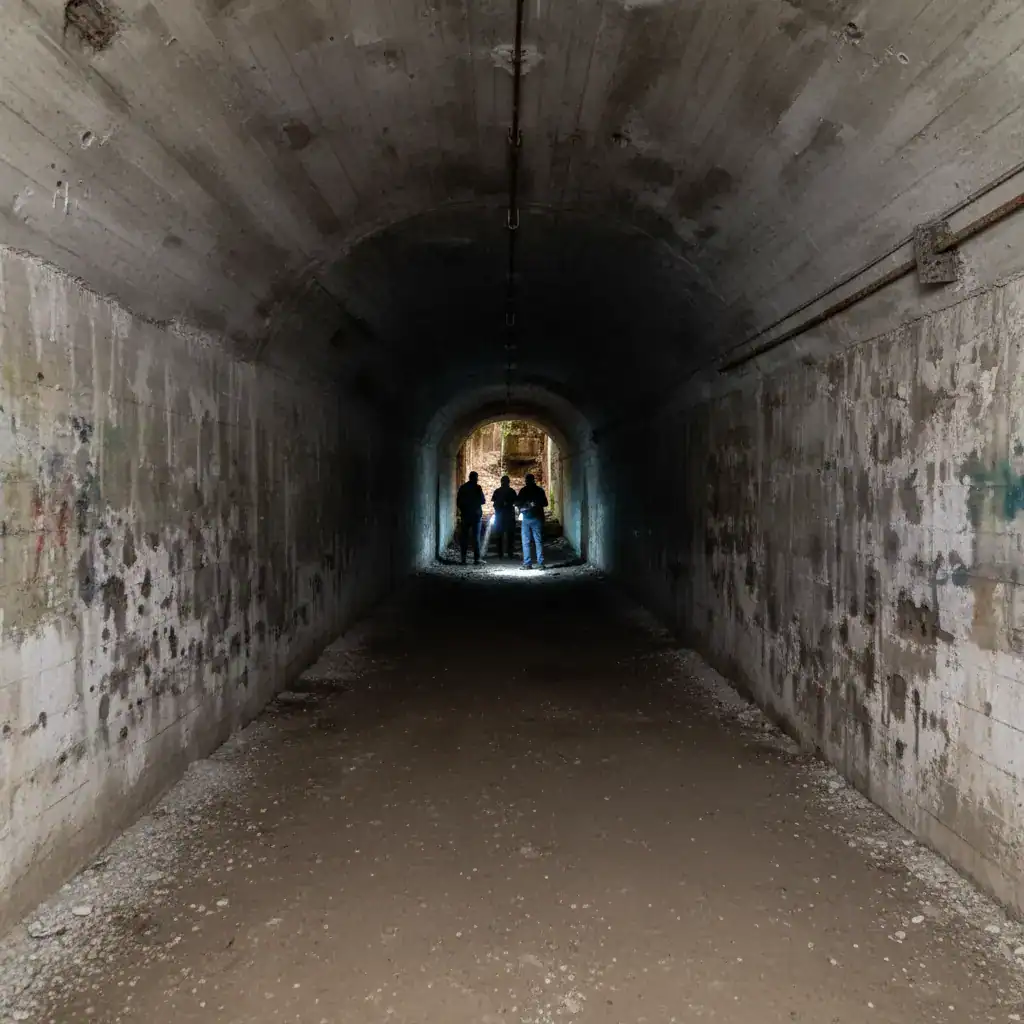
Hidden beneath apartment buildings, public structures, and industrial foundations, or sealed behind rusted doors, Athens’ air-raid shelters form an unseen network balancing between history and abandonment. Despite being created in times of tension and fear, today they remain largely unknown to most citizens – almost fantastical.
Athens’ Hidden Network: A Glimpse into the Past
In a city that has experienced wars, intense political upheaval, and natural disasters, the question persists: is there a real provision for the protection of the civilian population, or is it a forgotten infrastructure with no role in the present? Author and researcher Konstantinos Kyrimis has dedicated several years of his life to documenting and studying these spaces. Through his research and visits to approximately 150 small and large shelters, he highlights, speaking to Newsbeast, not only their historical significance but also the gaps in a modern reality where the concept of civil protection remains vague for the average citizen.
The overwhelming majority of shelters, as he tells us, were created between 1936, when the Ioannis Metaxas regime mandated their compulsory construction in every newly built building, and the repeal of the relevant law in 1956. Thanks to this provision, tens of thousands of such spaces were created. In Attica alone, it is estimated that approximately 15,000 shelters were built – a number that reveals the scale of the preparation at the time.
At that time, there was an organized passive air defense system that combined infrastructure, training, and social discipline. Because, as he points out, shelters were never just concrete structures. They formed half of the equation. The other 50% concerned citizen training: from school lessons and mandatory seminars for civil servants to readiness exercises and institutions such as the ‘house warden,’ responsible for the operation of each shelter in crisis conditions. An entire ‘culture of defense’ that allowed the population to react in an organized way and without panic, even under the threat of bombing.
Modern Warfare vs. Outdated Infrastructure
In modern times, however, conditions have changed radically. The technology of ‘smart’ weapons has reduced the need for massive shelters, while the emphasis is now shifting to active defense and prevention of strikes. At the same time, the lack of training and familiarity of the population with such situations creates a critical gap: even if the infrastructure exists, society is not prepared to utilize it.
In this context, the question is not only how many shelters we have or in what condition they are, but to what extent they could actually function in an emergency and, above all, how citizens themselves would react. The image of overcrowding every morning in a space like the metro, as he characteristically describes, serves more as a warning than a scenario. Perhaps that is why his answer to the hypothetical possibility of a hostile air attack sounds as simple as it is revealing: “If something happened, I would stay home,” he states emphatically. A phrase that summarizes not only his personal attitude but also the limits of an entire era that, despite its technological progress, seems less prepared than ever for the unpredictable. At the same time, however, according to the author and researcher, the state is rightly investing in prevention. In the procurement of defense systems and the creation of a ‘protective umbrella’ over the territory, in order to prevent the possibility of a missile or an unmanned aerial vehicle (drone) falling to the ground and even more so within the urban fabric.
The Researcher’s Journey: Uncovering Hidden Histories
The conversation with Mr. Kyrimis is revealing, and from the outset, we agreed to use the informal ‘you’ to convey with greater immediacy and naturalness a discussion that revolved not only around historical research but also around very contemporary questions about how ready we truly are for a crisis.
“How did you get involved with shelters?”
“Professionally, I have no connection to this subject; I am an IT analyst at an insurance company. However, from a young age, I loved history, especially World War II. At the same time, I was fascinated by everything unseen and underground – caves, tunnels, etc. In shelters, I managed to combine both interests.”
“When I learned about the existence of a shelter in Piraeus, I was impressed and sought it out purely out of curiosity. I located it and entered it in a somewhat unorthodox way. It was very close to the port, in the wider area near the Piraeus Port Authority. The space made a huge impression on me, and I started wondering: who built these shelters, how many are there, where are they, what characteristics did they have? I started researching them, and along the way, I discovered that most of them had been built during the Metaxas dictatorship and had played a very important role then.”
“How did you locate them? From testimonies or archives?”
“Initially, the first information came from people who had visited some shelters, not in an organized way or as part of research, but more out of curiosity, looking for the so-called ‘Underground Attica.’ So, I started with online searches and then began asking acquaintances, people with similar interests, etc.”
“When did this research begin?”
“My research began in 2012. Since then, I started talking to people, gradually gaining access to archives, and researching in libraries. In general, the process was quite difficult. Both the research and, even more so, the licensing. There were shelters that I ‘chased’ with papers, phone calls, and emails for six months to secure access.”
“Who grants permission?”
“There is no single body. Administratively, the shelters belong to the Ministry of Citizen Protection, but in practice, permission is given on a case-by-case basis by the competent authority. For example, in an apartment building, you have to find the manager; in an institution, the administration; in a factory, the management; and in a municipal area, the municipal services. Each time it is a completely different process, a small adventure as to whom to approach and how. Often, ‘social engineering’ is also needed to achieve your goal.”
“Are all these shelters from the Metaxas period or World War II?”
“All date between 1936 and 1956. In 1936, Ioannis Metaxas enacted a Compulsory Law for the construction of shelters in every newly built building, which remained in force until the end of 1956. So, in December 1956, we have the last ‘pure’ shelters. Anything built after that is not essentially a shelter but an underground space simply designated as such.”
The Evolving Role of Shelters: From Mass Protection to Psychological Comfort
“Could these shelters be used today in an emergency?”
“First of all, we must understand that the importance of shelters has significantly decreased. They were of enormous importance in World War II when bombings were carried out massively with unguided bombs (‘carpet bombing’). That is, aircraft would pass and drop bombs that simply fell by gravity, resulting in widespread destruction. If they aimed, for example, to hit Parliament, dozens of aircraft would pass, dropping hundreds of bombs, everything from Monastiraki to Evangelismos would be destroyed, and within that section, Parliament would also be destroyed.”
“Now there is no such need. Today, bombings are carried out with ‘smart’ weapons, launched from long distances (e.g., 200 km away) and hitting targets with great accuracy. If someone wants to hit a specific building, they can even choose the floor the bomb will hit, with a deviation of a few meters. This means that casualties are much fewer. So, if we had a large budget for defense, I would say it is preferable to invest in active air defense, i.e., in interception systems, rather than in how to defend against the strike. It is better to shoot down the carrier aircraft or destroy the weapon than to protect yourself from incoming strikes.”
“So, practically, we don’t have shelters?”
“Shelters exist, in the sense that the infrastructure that existed then is maintained. However, I would say that they function more for psychological reasons or as a last resort. That is, if someone told me they lived next to a factory or the port, which are priority targets, then probably more for psychological reasons, I would tell them to take refuge there. But I, if something happened, would stay home! Shelters, something many do not understand, are not just the construction part. That is, some think that if we have the shelter, we will go in and be saved.”
“The Metaxas regime, when it set up the Passive Air Defense and shelters in 1936, had well understood that 50% of the protection is the construction, but the other 50% is training. That is, going into a shelter has specific ways you must behave, what to do, what not to do, not to panic – to have had the cold shower of being, say, in the dark with 300 others. In the tours I do with a travel agency, we go to some shelters and give a historical overview. In every tour, someone comes at the end and tells me, ‘in the first shelter we went to, I was very stressed and scared, in the second so-so, in the third it was like I was drinking coffee, I got used to it.’ That is, it is a shock to enter these spaces under difficult conditions, and it is good to have done it in peacetime.”
“Should Civil Protection be responsible for this?”
“Exactly. Back when the system worked, under Metaxas, imagine that students had mandatory air defense lessons, the state sent children to summer camps specializing in passive air defense, and they constantly did very realistic and intense exercises in the city. And civil servants from 1938 onwards had to attend mandatory passive air defense seminars. In all police stations, the so-called ‘schools of popular enlightenment’ operated, where in the afternoons the police stations would announce that, for example, today we will have passive air defense lessons, and the whole neighborhood would go to attend.”
“The same happened in universities where military personnel went and taught passive air defense. Nowadays, if a military person tries to enter a university, they might even be lynched. The ‘culture of defense’ that existed at that time has been lost. So, the question is not how to build thousands of shelters worth billions of euros, but how to first develop a culture of defense, to utilize what we have here and to the extent we can utilize it, and then we will see about the rest of the construction part.”
The Metro Dilemma and Urban Myths
“Can one take refuge in the metro in an emergency?”
“I hear this about the metro very often, but it would be the last place I would go. I use the metro every day. If you go to Syntagma at 9 in the morning, everyone is ready to trample you. We don’t even have the simple culture that when the train doors open, those inside the carriage exit first, and then new passengers enter. They push and swear. So imagine this happening in wartime with sirens, alarms, and bombers coming, and 5,000 people wanting to enter the metro… 200 will die from trampling, and 2 from the missile. That’s why I say that education is important.”
“Consider that in 1940, when the war started, due to intensive training, people had managed to do the following: In each shelter, there was a shelter manager, the so-called ‘House Warden,’ who underwent special training to have this status, and among his responsibilities was to be at the entrance and when the shelter was full (i.e., reached its specified capacity), he would not let others in. And people were trained and had understood that they should calmly go elsewhere, to another shelter. Imagine today a similar ‘House Warden’ saying that ‘we are full, go elsewhere.’ They would be attacked and everyone would enter the shelter, one on top of the other. So, that’s why I insist that it’s not only the shelter that should exist but also the ‘culture of the shelter and protection.'”
“Could the state today restore such a culture of Civil Protection, since we don’t have shelters? Practically, from what I understand, we don’t; what exists is a museum piece.”
“Even for psychological reasons, the shelters we have could be used in wartime. Rather than a person being in the street screaming in shock, let them enjoy the illusion that they are absolutely safe in the shelter. Of course, they are not absolutely safe, but certainly more so than being in the street. In addition, the maintenance of shelters also has a high operating cost. You don’t just build it and leave it there; there must also be maintenance. In the Metaxas era, for example, the person in charge of each shelter was obliged to keep it in perfect condition. And each ‘House Warden’ had to attend an Air Defense School lasting from one week to one month, depending on the size of the shelter.”
“Are there urban myths you encountered about ‘underground Athens’ that were debunked by your research?”
“Of course. As I explored the shelters, I read many monstrous stories, for example, that someone entered a shelter and ended up in Penteli, on Lycabettus, in Parliament, walked for kilometers, everything is connected, etc. Tremendous speculation. I can tell you with certainty, having entered approximately 150 shelters, that no shelter is connected to another, nor are there supernatural phenomena. Shelters cost a lot of money to build, so it was not appropriate to build kilometers of tunnels. The goal was to create a space for protection and to have one or two tunnels to safely exit to a nearby point if the main entrance was blocked. For example, in an apartment building shelter, a tunnel was built to exit to the opposite sidewalk, a distance of a few meters.”
“Are all these shelters that existed then closed now, or are they accessible?”
“No, unfortunately, they are not accessible to the public. The philosophy in the 1940s was that before the war broke out, we should know which shelters exist and what specific characteristics each one has. For example, near your home, you knew which were the closest shelters. Similarly, if you were at work, which were the nearest. So, people were familiar and knew where the shelters close to the places they frequented were. Now the philosophy is that ‘if the war starts, we will tell you then.’ To be honest, this practice doesn’t seem very functional to me.”
“What is the strangest object you have found inside a shelter?”
“First of all, it is very difficult to find period items, because no matter how much we have the illusion and want to believe that we were the first to enter, always, even 20, 30, or 40 years ago, someone has entered and seen something and taken it. It is very rare to find authentic objects. I remember finding a poster with the original air defense instructions of that era. What to do or not to do inside the shelter.”
“In another shelter, I found a discarded can from the 1950s, from UNRA (UNRRA was the United Nations Relief and Rehabilitation Administration, established to provide aid to the population after the end of World War II). Of course, they are also a bit… time capsules, I would say. I remember in another shelter I went to, I found a box from an ice cream I ate in the 1980s as a kid. Obviously, these have no historical value, but truly, due to the fact that people have not visited these specific spots for a long time, you can find various forgotten things there.”
“Last November, Deputy Minister of Citizen Protection Ioannis Lampropoulos, in response to a question addressed to him in Parliament by the president of the Hellenic Solution Kyriakos Velopoulos, stated that currently nationwide 2,892 spaces have been designated as shelters, with a total capacity of 1,981,514 people. Are there really so many?”
“I know for sure that in 1940, when the war started, we had 12,000 shelters in Attica. We also know that until 1956, when the Metaxas law for the creation of shelters in apartment buildings was repealed, there were approximately 3,000 other buildings with these provisions, so a total of about 15,000 were certainly built. So half a century later, such a number does not surprise me; it seems realistic. I just don’t know what condition they are in. I have seen everything from dilapidated spaces where you say ‘there’s no way I’m getting out of here intact’ to shelters that are spotless and well-maintained. Now, for the capacity of 2 million, I have considerable reservations. It comes out to about 650-700 people per shelter, which doesn’t seem realistic to me.”
Konstantinos Kyrimis’s self-published three-volume work on the air-raid shelters of Attica is available by contacting him at: [email protected]. His two-volume work “The Shelters of Attica 1936-56” is available by contacting the Army History Directorate. Organized visits to selected shelters are carried out by the travel agency Kedros Travel, with the participation of the author. The next tour will take place on Saturday, April 25th. Information at email: [email protected].