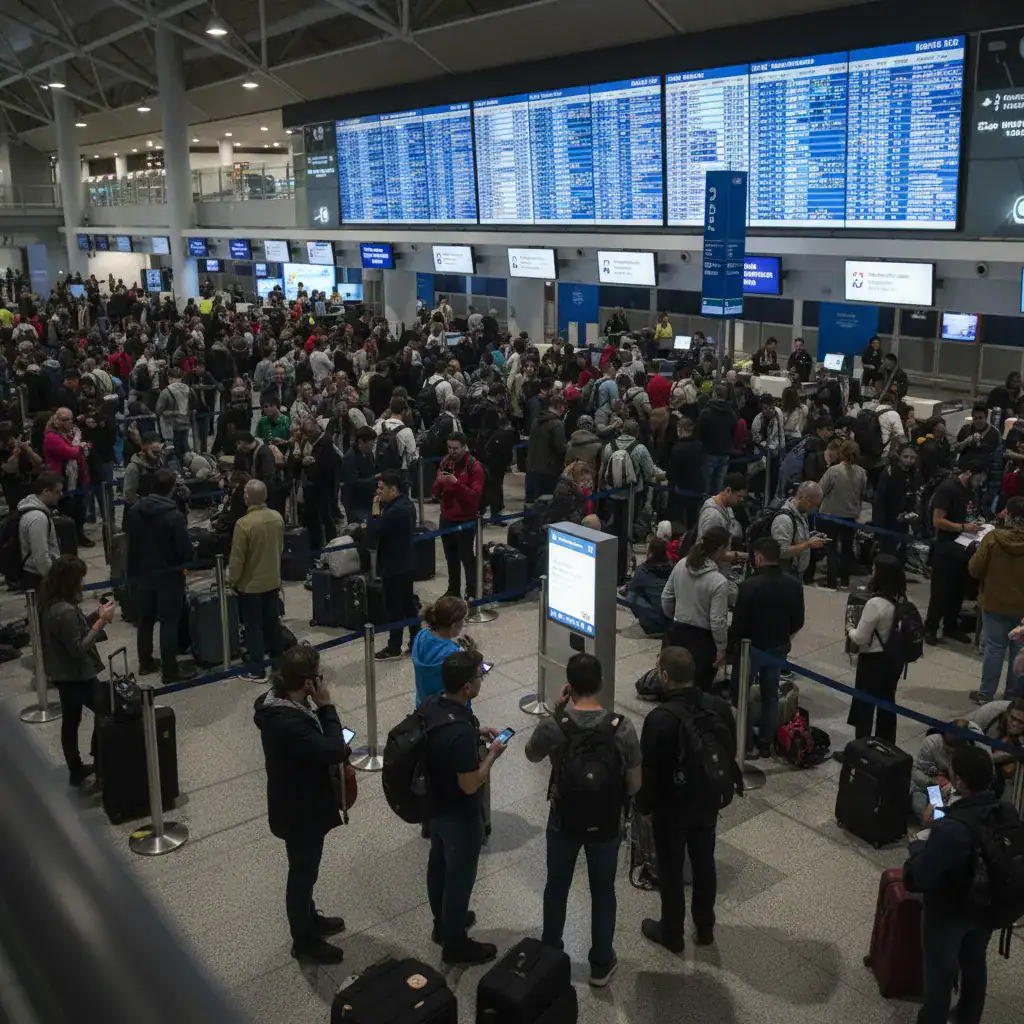
Athens, Greece – A widespread technical issue affecting nearly all radio frequencies within the Athens Flight Information Region (FIR) on Sunday, January 4, 2026, led to considerable disruptions in air traffic across Greece. Despite the extensive nature of the blackout, Chrysanthos Chrysanthou, President of the Mediterranean Flight Safety Foundation (FSF-MED), confirmed on Monday that no flight safety problems arose during the incident.
Technical Glitch Disrupts Greek Airspace
The technical malfunction, which appears to be linked to the central radio frequency systems of the Athens and Macedonia Area Control Centers, began around 07:00 GMT on Sunday. This unprecedented outage resulted in the grounding or delaying of numerous flights at Athens International Airport and other regional airports. For approximately two hours, no aircraft could land or depart from Greek airports, and for up to three hours, most flights destined for Greece were redirected, primarily to Turkey. [ekathimerini.com](https://www.ekathimerini.com/news/1291513/flights-disrupted-by-technical-issue-at-athens-fir)
Chrysanthou stated that information suggests the problem was related to equipment upgrades. However, he also noted that current information regarding the precise cause of the problem remains insufficient. He highlighted that discussions with individuals in the field indicate that the issue might stem from unmodernized systems. “As far as we know, there were no problems with flight safety, either in the Greek or in Cypriot airspace,” Chrysanthou affirmed.
Cyprus Manages Rerouted Flights
During the disruption, the number of flights passing through Cypriot airspace significantly increased. Aircraft from other airspaces, including those from Turkey and the south, rerouted via Cyprus to avoid the affected Greek airspace where communication with pilots was compromised. Cypriot authorities effectively managed these rerouted flights without encountering any issues. [ekathimerini.com](https://www.ekathimerini.com/news/1291523/domestic-flight-service-slowly-resumes-authorities-investigating-fir-technical-failure/)
A critical aspect of air traffic management, the transfer of data between airspaces, also faced challenges. When an aircraft transitions from one country’s airspace to another, the receiving country is typically informed in advance by the control center of the originating country, which transfers the necessary flight data. This process ensures that air traffic controllers in the new airspace have all relevant information. The Athens FIR blackout affected this data transfer, adding to the operational complexities.
Investigation and Future Implications
The Hellenic Civil Aviation Authority (HCAA), in coordination with external agencies, is currently investigating the incident. Preliminary reports suggest a circuit failure, but the exact cause or origin has yet to be determined. There is no clear indication of when normal operations will be fully restored. As a precautionary measure, the affected sector has been temporarily closed, with only overflights (aircraft passing through Greek airspace without landing) permitted to continue operations while restoration efforts are underway. [france24.com](https://www.france24.com/en/live-news/20260104-flights-grounded-in-greece-after-radio-frequency-loss)
Panagiotis Psarros, head of Greece’s air traffic controller union, described the incident as “very serious” and attributed it to “obsolete” airport equipment. Chrysanthou echoed concerns regarding systems that may not have been modernized, suggesting that such issues should have been promptly addressed by political leaders and civil aviation authorities.
When questioned about the possibility of external interference, Chrysanthou clarified that interference from another country had not been confirmed. He explained that interference typically affects specific frequencies, making it difficult to disrupt all frequencies simultaneously. The prevailing information points towards equipment upgrades as the underlying cause. Domestic flight services have slowly begun to resume, with up to 35 departures and arrivals being handled at Greek airports, prioritizing safety. [ekathimerini.com](https://www.ekathimerini.com/news/1291523/domestic-flight-service-slowly-resumes-authorities-investigating-fir-technical-failure/)
Passengers at Athens airport experienced long waits and overcrowded departure areas, highlighting the significant impact of the technical failure on travel plans. The incident underscores the critical importance of modern and reliable air traffic control infrastructure for ensuring both operational efficiency and flight safety.
Source: [stockwatch.com.cy](https://www.stockwatch.com.cy/en/news/chrysanthou-no-problem-for-flight-safety-due-to-athens-fir-blackout), [ekathimerini.com](https://www.ekathimerini.com/news/1291513/flights-disrupted-by-technical-issue-at-athens-fir), [ekathimerini.com](https://www.ekathimerini.com/news/1291523/domestic-flight-service-slowly-resumes-authorities-investigating-fir-technical-failure/), [france24.com](https://www.france24.com/en/live-news/20260104-flights-grounded-in-greece-after-radio-frequency-loss)