Athens Drowning in Overtourism: The Nine Saturated Neighborhoods and the ‘Number One’ District
Athens is rapidly transforming into a city grappling with overtourism, particularly in its most saturated neighborhoods, where the viability of the urban fabric, housing, and the quality of life for permanent residents are increasingly at risk. This phenomenon, highlighted by recent studies, points to a city under immense pressure from accelerating tourist development, raising critical questions about its future as a liveable urban center.
The significant and accelerating tourist development in Athens is meticulously documented by both the Sustainable Tourism Observatory, developed by the Municipality of Athens, and a Capacity Study on the city’s tourism. These tools are designed to collect, analyze, and utilize real-time data to prevent the adverse effects of overtourism.
The Unstoppable Rise of Short-Term Rentals
Despite a temporary halt during the 2021 pandemic, which saw a 16% reduction in short-term rental beds compared to 2018, the period between 2021 and 2025 marks a dramatic recovery. According to E. Marinakis, president of the Athens Development and Tourist Promotion Company (EATA) of the Municipality of Athens, “This period signifies an impressive rebound, surpassing pre-pandemic levels.”
Data reveals that by 2025, short-term rental accommodations reached 18,769 units, a 59.5% increase from 2021, setting new historical highs. Over the eight-year span from 2018 to 2025, the total number of Tourist Accommodation Units (comprising Hotels and Short-Term Rentals) surged by 33.5%, with total beds increasing by 24.3%. Hotel establishments alone saw a 29.1% rise.
Intensifying Tourist Pressure
The evolution of tourism intensity indicators is particularly revealing. The “Overnight Stays per Resident” index for the Municipality’s average nearly tripled, from 3.67 in 2018 to 10.41 in 2025, marking a staggering 183.7% increase. Concurrently, the “Tourists per Resident” index rose by 142.2%. Marinakis notes, “These figures reflect how tourist pressure in the Municipality is rapidly intensifying, much faster than a simple increase in accommodation numbers would suggest.”
Regarding the degree of complex tourist specialization, 11 neighborhoods in the Municipality of Athens were categorized as having “Very High” specialization in 2018, a number that remained largely stable in 2025 with nine neighborhoods. Marinakis clarifies, “This slight decrease does not reflect an improvement in the situation, but rather the fact that tourist development is now spreading to more neighborhoods, raising the average and leveling the differences between them.”
The Nine Areas of Tourist Saturation
The neighborhoods maintaining “Very High” complex tourist specialization in both 2018 and 2025, forming the core of the Municipality’s tourist saturation, include:
- Commercial Center
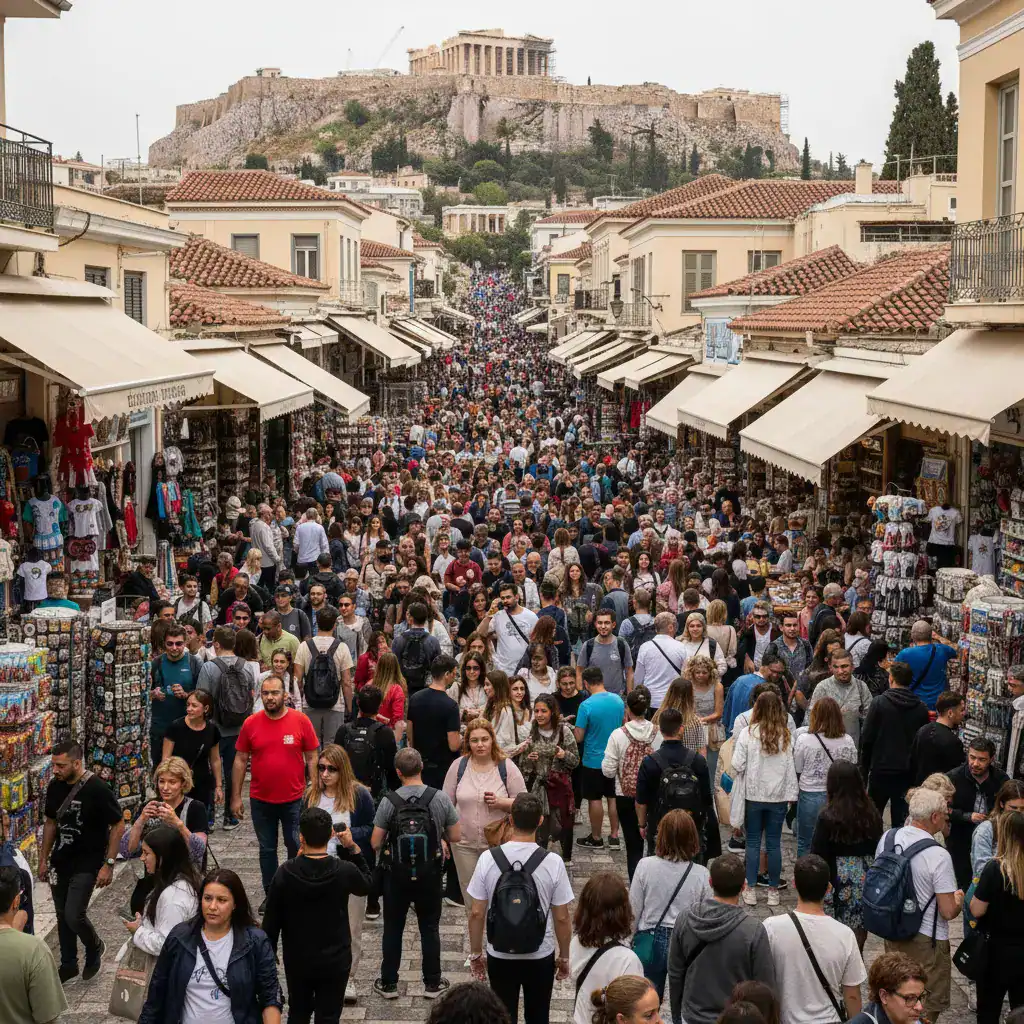
- Monastiraki and Plaka
- Psyrri and Koumoundourou
- Makrygianni
- Ag. Konstantinos and Vathi Square
- Thissio
- Kallirrois
- Dourgouti I (part of the Neos Kosmos district, above Syngrou Avenue)
- Plastira Square in Pagrati
The 1st Municipal Community of Athens (Center, Plaka, Kolonaki, Exarchia) alone accounts for nearly 60% of the Municipality’s total beds. The significant gap between this and the other six Municipal Communities indicates that tourist infrastructure remains deeply geographically concentrated, despite a gradual dispersion in recent years.
The ‘Number One’ Tourist Neighborhood: Commercial Center
Among the prominent neighborhoods, the Commercial Center stands out as the area with the fastest tourist expansion. From 504 short-term rental homes and 24 hotels in 2018, it escalated to 1,465 Airbnb-type homes and 49 hotels in 2025, representing increases of 190.7% and 104.2% respectively. Notably, the Commercial Center surpassed Monastiraki and Plaka in the number of short-term rental homes as early as 2023, recording approximately 35% more units by 2025. The “Tourists per sq.km” index surged from 148,721 to 588,087 (a 295.4% increase), while the “Overnight Stays per Resident” index reached 503.32, the highest in the Municipality of Athens. The Tourism Specialization Index relative to the Municipality reached 12.78 in 2025, the highest among all neighborhoods.
The areas of Psyrri and Koumoundourou also demonstrate strong dynamics. Short-term rental apartments nearly doubled (from 453 to 868, a 91.6% increase), and the “Tourists per sq.km” index rose by 154.1% (350,686 to 891,082), ranking the area second in 2025. The “Overnight Stays per Resident” index (185.98 in 2025) reflects extremely high tourist pressure relative to the permanent population.
The Makrygianni area boasts the highest “Tourists per sq.km” index in the Municipality in 2025 (1,003,565). This exceptionally high value reflects its relatively small territorial extent combined with dense tourist activity. Short-term rental accommodations increased by 28.5% over the eight-year period, with a temporary reduction during the pandemic.
Monastiraki and Plaka, despite a more moderate tourist expansion compared to the above neighborhoods (a 30.4% increase in short-term rental accommodations), remain among the most tourist-laden neighborhoods in the Municipality. The “Tourists per Resident” index reaches 198.43, indicating a resident population experiencing some of the most intense tourist pressures in Athens’ broader urban fabric.
Emerging Areas and Policy Responses
The phenomenon of tourist expansion is not confined to already saturated neighborhoods. Areas such as Koukaki (from 311 to 465 short-term rental accommodations, a 49.5% increase) and Exarchia (from 351 to 499 short-term rental accommodations) show an upward trend, indicating a diffusion of tourist development from the central core to broader neighborhoods. Marinakis warns, “If this trend continues, it may alter the character of neighborhoods that until now remained outside the zone of tourist saturation.”
In response to this escalating situation, the suspension of new short-term rental licenses in the 1st (Center, Plaka, Kolonaki, Exarchia), 2nd (Pagrati, Neos Kosmos, Mets, Stadium), and 3rd Municipal Communities (Votanikos, Metaxourgeio, Petralona, Thissio) has shown a clear outcome: the increase in Airbnb-type accommodations, which ranged from 18-20% during 2023-2024, drastically narrowed to 1.7-5.4% for the 2024-2025 period. However, as Marinakis explains, “The suspension acts as a brake, not a reversal. The existing stock of these accommodations remains active in its entirety, meaning that tourist pressure on residential areas freezes at current levels without receding.”
A Question of Sustainability
Overall, the data paints a picture of a Municipality on a trajectory of rapid touristification, with geographically concentrated yet constantly diffusing tourist activity. The indicators of tourist intensity, especially in saturated neighborhoods, raise serious concerns about the viability of the urban fabric, housing, and the quality of life for permanent residents. The balance between economic gain from tourism and the well-being of its citizens is becoming increasingly precarious, demanding urgent and effective policy interventions to safeguard Athens’ unique character and ensure a sustainable future for all its inhabitants.