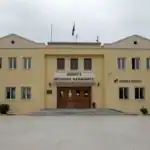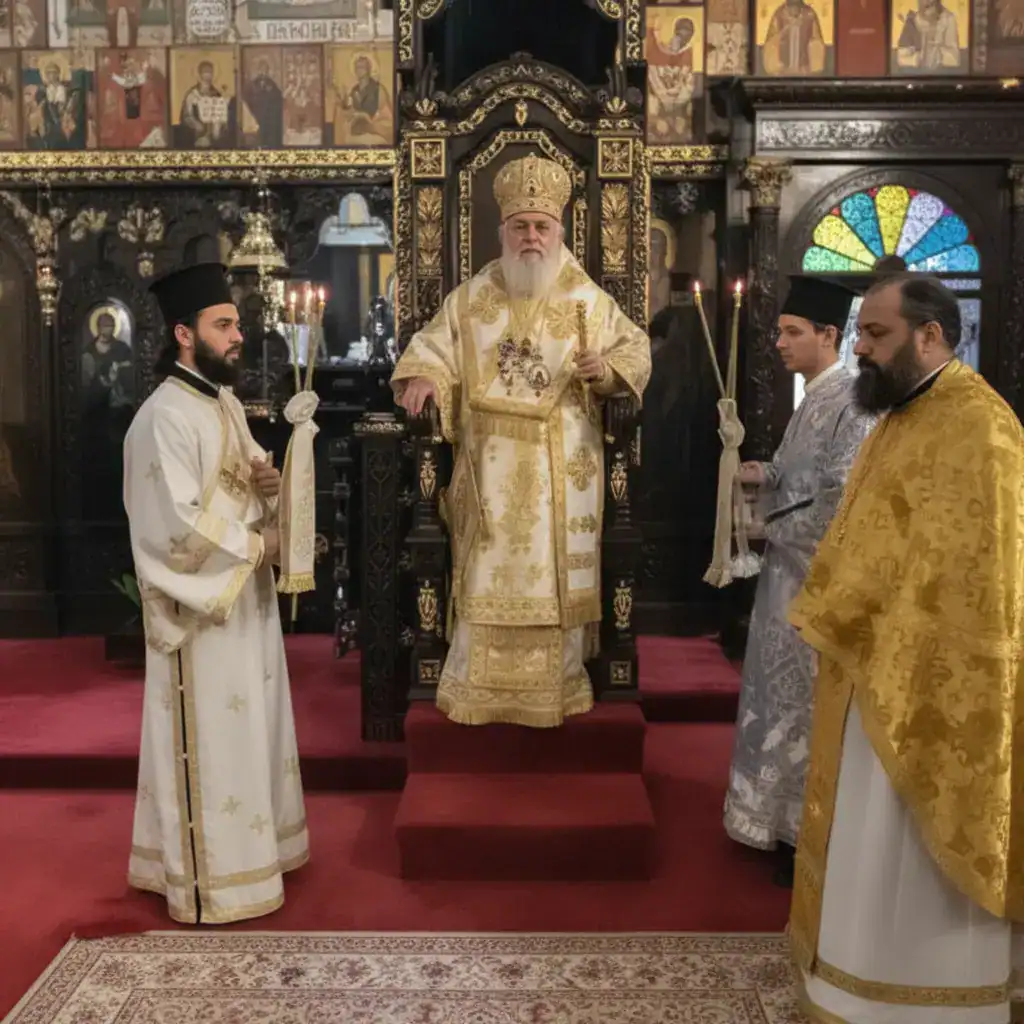
On Sunday, December 14, 2025, the Sunday of the Holy Forefathers (11th Sunday of Luke), His Eminence, Archbishop Nektarios of Corfu, Paxoi, and the Diapontia Islands, officiated and delivered a sermon at the historic Holy Church of Panagia Faneromeni, also known as “Panagia ton Xenon” (Our Lady of Foreigners), located in the heart of Corfu Town.
Archbishop Nektarios Joined by Venerable Clergy
During the Divine Liturgy, His Eminence was joined by the parish priest, Protopresbyter Spyridon Mandilas, and his Deacon, Fr. Eusebius Pandis. Also present in prayer was His Eminence, Elder Metropolitan Demetrius of Prinikonnisos, from the Ecumenical Patriarchate. Metropolitan Demetrius was visiting Corfu at the invitation of the local Archbishop, having presided over the festive celebrations commemorating the memory of Saint and Wonderworker Spyridon, the patron saint of the island.
A Byzantine choir, under the direction of Mr. Nikolaos Makropoulos, Director of the School of Byzantine Music of the Holy Metropolis of Corfu, served at the chanter’s stand, rendering the hymns with ecclesiastical reverence and musical excellence.
Sermon on the Holy Forefathers
In his sermon, addressed to the large congregation, His Eminence drew inspiration from the Sunday of the Forefathers, who possessed a deep thirst and faith for the coming of the Messiah, the Redeemer. They lived in spiritual darkness, yet all spoke of His arrival. All the Holy Forefathers, along with the Prophets and the Righteous, had an intense desire for God and a sense of His presence, so that He might lift the curse inherited by humanity from the disobedience of the First-Created. These were individuals who lived persecuted, wandered, and suffered martyrdom for their faith in the expectation of the Messiah. They renounced much of the established order of their time and, for this reason, came into opposition and conflict with the prevailing system.
The Tree of the Righteous and the Incarnation
All these Holy Forefathers formed a tree with many branches of the Righteous of the era before the incarnate economy. Of course, to this tree is added the branch of our Most Holy Lady Theotokos and Ever-Virgin Mary, from whom our Lord Jesus Christ proceeded according to His human nature. Thus, the Word of God, who created the created universe, was to take human form, to be made like us in every respect, as the Apostle Paul tells us: “Therefore, in all things He had to be made like His brethren, that He might be a merciful and faithful High Priest in things pertaining to God, to make propitiation for the sins of the people” (Heb. 2:17).
This mystery is described in detail by the great dogmatic father of our Church, Saint John of Damascus, as the union of the created with the uncreated occurred unconfusedly, unchangeably, indivisibly, inseparably. Our Lord Jesus Christ was made like us in all things, and this was done so that we too might understand Him, that is, for the creative Word of God to become comprehensible, even if we, after so many centuries, have not received Him into our lives. For this, the Evangelist John tells us: “He came to His own, and His own did not receive Him” (John 1:11). The doors of our soul and heart remained hermetically sealed, and the current state of humanity deeply testifies to this when there is a deviation from the natural state in which the true God created and fashioned us, instead of us, the created, living in communion with the Creator Himself through His uncreated divine energies.
A Call to Re-evaluate Faith in Modern Times
The Holy Forefathers thirsted for this true communion and union with God. Many of them did not live to know our Redeemer Jesus, while we, after so many centuries, living in the age of God’s grace, in the age of enlightenment, willfully persist in our spiritual alienation. Have people today sought the Redeemer? One wonders how Western atheistic humanism was born when the Christian West benefited from the incarnate Son and Word of God, not only through the offering of the entire “being” of people but also through the formation of its culture, because the culture of the West was largely based on Christian education. Unfortunately, instead of becoming continuators of the God-inspired Byzantine Christian culture of the great Holy Fathers of our Church, we chose today to copy this distorted imitation of the apostasy of the West.
In conclusion, the Archbishop once again thanked His Eminence, Elder Metropolitan Demetrius of Prinikonnisos, for his edifying presence during the three-day festive events of Saint Spyridon. He also wished the numerous congregation many happy returns and urged everyone to move away from the delusion of the Western system, which discards the experience of God’s presence in the life of modern man, and to strive to understand, in essence, the world-saving meaning of Christmas.
Source: https://www.ekklisiaonline.gr/nea/i-kyriaki-ton-agion-propatoron-stin-kerkyra/