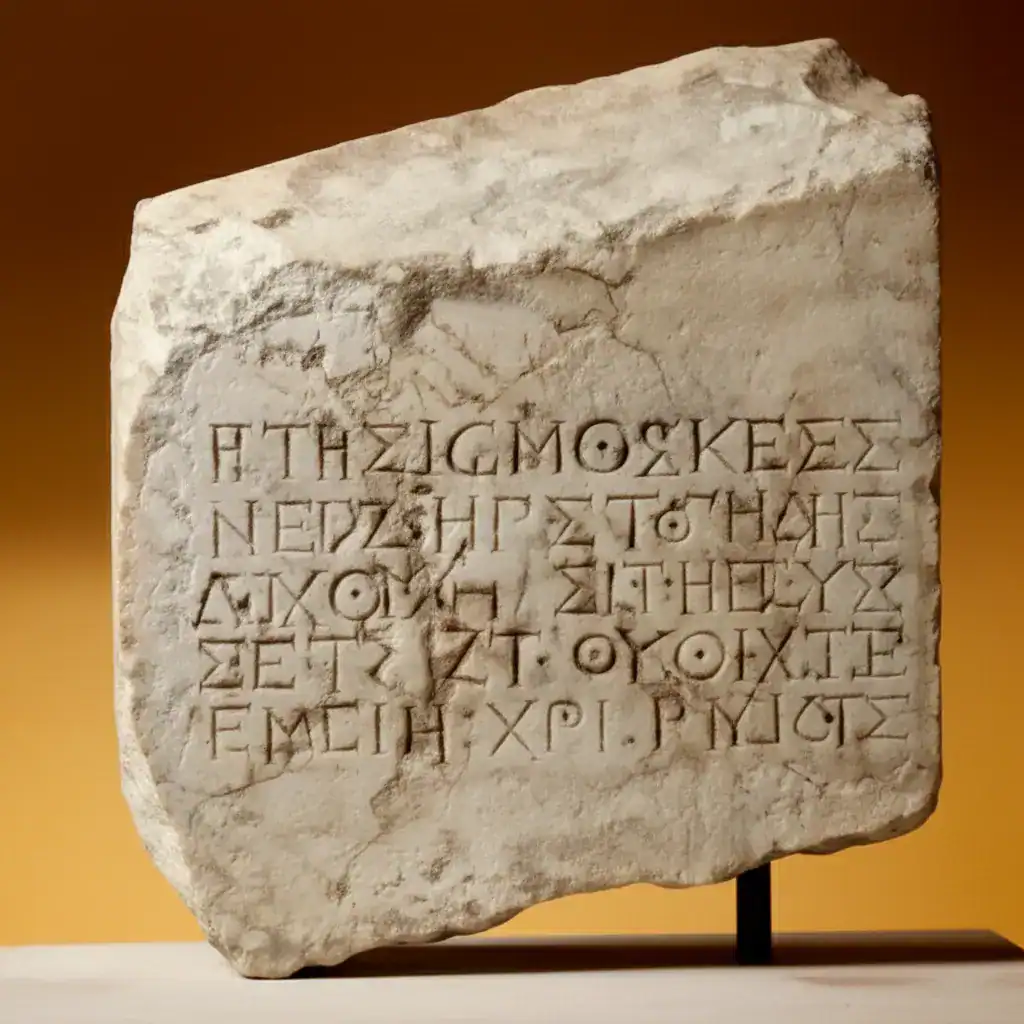
Athens, March 22, 2026 – The Library of Pantainos, a prominent cultural and educational institution in Roman Athens, has revealed what may be the earliest known inscription in the world detailing rules for its visitors. The marble inscription, which is now housed in the Epigraphic Museum of Athens, clearly states: “No book is to be taken out. Open from the first hour until the sixth.” This suggests the library functioned primarily as a reference facility rather than a lending institution.
The Pantainos Inscription: A Glimpse into Ancient Library Practices
The inscription provides valuable insight into the operational procedures of ancient libraries. The directive “No book is to be taken out” highlights a system designed to keep valuable scrolls and texts within the library’s premises, ensuring their preservation and availability for all scholars and readers. The operating hours, “Open from the first hour until the sixth,” refer to the Roman timekeeping system, where the first hour began at sunrise (approximately 6:00 AM) and the sixth hour marked midday (around 12:00 PM). This schedule indicates a focused period for study and intellectual activity during the brightest part of the day.
Location and Preservation of the Inscription
The inscription is currently preserved in the Epigraphic Museum of Athens, which is situated near the National Archaeological Museum. This museum is renowned for housing one of the world’s most extensive collections of ancient Greek inscriptions, making it an ideal location for such a significant artifact. Its presence there allows for scholarly study and public appreciation of this unique historical document.
The Library of Pantainos: A Center for Learning in Roman Athens
Constructed in the late 1st or early 2nd century AD during the Roman period, the Library of Pantainos was a generous donation to the city by Titus Flavius Pantainos, a philosopher and benefactor, and his family. This institution was an integral part of a larger complex that also featured lecture halls and a courtyard, establishing it as a vibrant hub for learning and intellectual discourse in Athens.
Strategically located near the Roman Agora in Athens, along the Panathenaic Way, the library primarily housed scrolls. Its construction during Emperor Trajan’s reign underscores the Roman Empire’s patronage of Greek culture. Romans held Greek philosophy, literature, and science in high esteem, and institutions like the Library of Pantainos were crucial in maintaining Athens’ esteemed status as an intellectual center.
A Second Inscription and Dedication
Another significant inscription discovered at the site further illuminates the library’s origins and dedication. This inscription reads: “To Athena Polias and to the Emperor Caesar Augustus Nerva Traianus Germanicus as well as to the city of Athens, the priest of the Muses of philosophers, T. Flavius Pantainos, son of the Flavius Menander the Successor, dedicated at his own expense the outer galleries, the peristyle, the library with the books and all the ornaments contained therein, with his children Flavius Menander and Flavia Secundilla.” This dedication highlights the philanthropic spirit of Pantainos and his family, connecting the library’s establishment with both divine and imperial blessings.
Architectural Features and Historical Context
The core structure of the Library of Pantainos consisted of two main areas. One was a spacious open courtyard, measuring 20 x 13.5 meters, with a floor paved with small, irregular marble tiles set in mortar. The other was a large, square room, open to the east, whose floor was laid with marble slabs. A peristyle was later added to the courtyard, with its central section also paved with marble slabs. These architectural details suggest a well-designed and aesthetically pleasing environment conducive to study and reflection.
The Library of Pantainos was one of several notable libraries in ancient Athens, though it was later overshadowed by the Library of Hadrian, which was built slightly later and on a grander scale. Unfortunately, the Library of Pantainos is believed to have been destroyed by the Heruli, a Germanic tribe, during their invasion of Athens in 267 AD, an event that also led to the destruction of many other structures in the city. Unlike the larger Library of Hadrian, which was eventually restored, the Pantainos Library was never rebuilt and gradually faded from historical records, making the surviving inscription an even more precious link to its past.
Source: https://greekreporter.com/2026/03/22/library-rules-inscription-pantainos-ancient-athens/