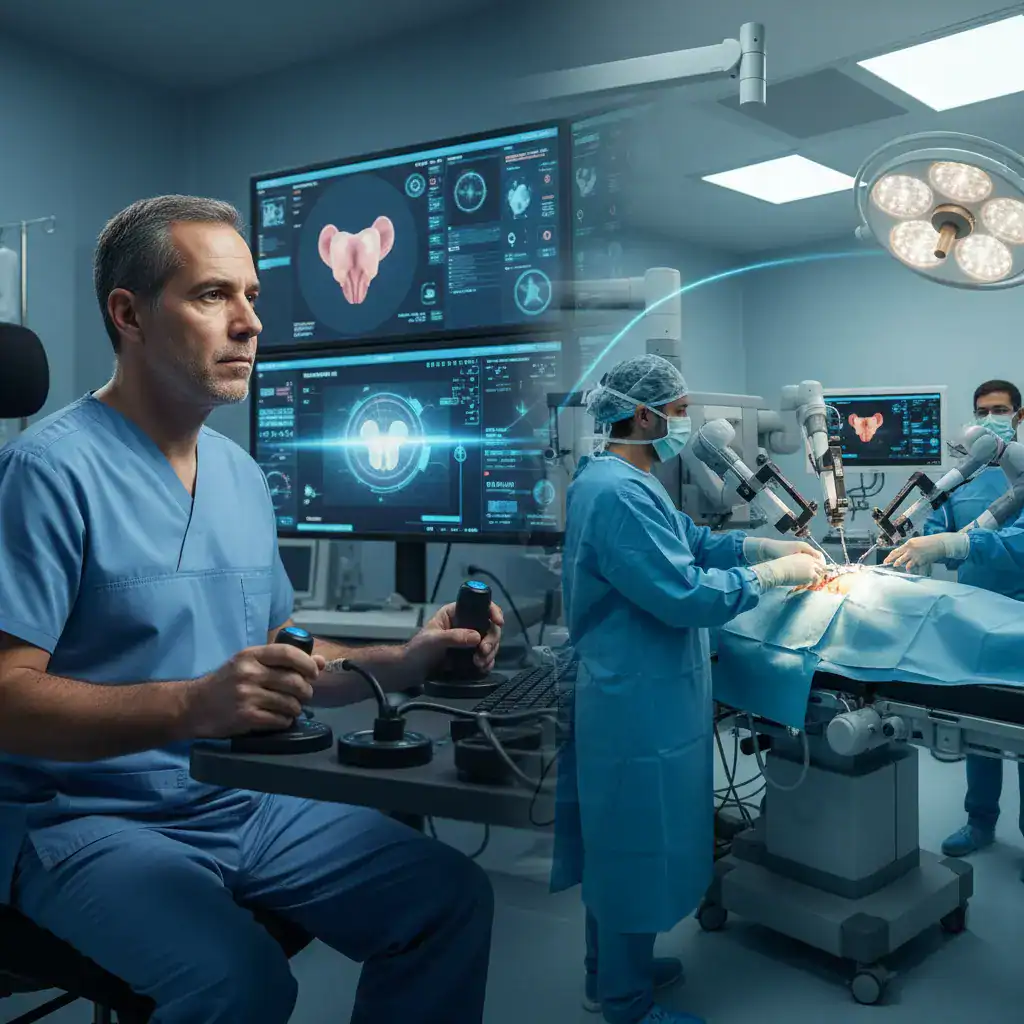
Groundbreaking Remote Robotic Surgery Links Athens and China
Athens, June 26 – A significant medical milestone has been achieved in Greece, as a patient in Athens successfully underwent a prostate cancer operation performed by a surgeon located 8,000 kilometers away in Wuhan, China. This pioneering procedure, a robotic-assisted radical prostatectomy, was carried out by Professor Evangelos Liatsikos, Director of the Urology Clinic at the University Hospital of Patras, utilizing advanced robotic technology and telemedicine.
Speaking to the Greek public broadcaster ERT, Professor Liatsikos, who was also scheduled to perform another remote operation from Patras on a patient in Athens using the same technology, hailed the achievement as a major technological advance. “To be somewhere so far away, standing in a room wearing your tie and operating on a person, is an extraordinary technological development,” he stated.
Seamless Connection and Prepared Medical Team
Professor Liatsikos emphasized the critical role of a fully prepared medical team present in Athens to manage any unforeseen circumstances. “There was a team in Athens that could immediately take over the patient if something unexpected occurred, such as an earthquake like the one recently experienced in Venezuela,” he explained.
A remarkable aspect of the procedure, according to Professor Liatsikos, was the complete absence of any noticeable delay in the remote connection. “The most astonishing thing was that there was no delay at all. It felt as though I was standing right beside the patient. This connection is made possible through dedicated network lines. The Chinese have secured the route from China to Frankfurt, and from there we connect directly to Athens,” he detailed.
Evolution of Telemedicine and Robotic Technology
The professor highlighted that satellite technology has largely been supplanted by robust fiber-optic networks, enabling such complex remote operations. “The robotic technology already existed, but now the networks are capable of supporting it,” he noted, indicating the crucial role of infrastructure development in advancing telemedicine.
Professor Liatsikos believes that what was once confined to science fiction is rapidly becoming a reality in the medical field. “The concept of telemedicine with robotic systems is to enable surgeons to be trained without travelling and to perform operations remotely. And this is only the beginning,” he remarked, foreseeing a future where remote robotic surgery becomes increasingly common.
Patient Informed and Future Implications
The patient, diagnosed with prostate cancer, was fully informed about the innovative nature of the procedure and enthusiastically embraced the opportunity to be a pioneer in this medical advancement. “He was fully aware and very excited to be a pioneer,” Professor Liatsikos confirmed.
The professor anticipates a rapid increase in remote robotic surgery in the near future. “This process has been developing gradually over the past year, but in the future you will see it happening much more frequently. Until now telemedicine has mainly been diagnostic; now it is becoming therapeutic,” he explained, underscoring the shift towards therapeutic applications of telemedicine.
He also recalled that robotic surgical systems were initially developed by the United States military to allow surgeons to operate on wounded soldiers from a distance on the battlefield, but network connectivity limitations hindered their widespread use. “Now we have reached an entirely extraordinary stage,” he concluded.
Professor Liatsikos stressed that while advanced technology is essential, the success of remote surgery ultimately relies on medical expertise. “These procedures require medical knowledge, and Greece has doctors of the highest calibre. Technology has no borders – whatever exists overseas also exists in our country,” he affirmed, highlighting the global accessibility of medical technology and the importance of skilled practitioners.