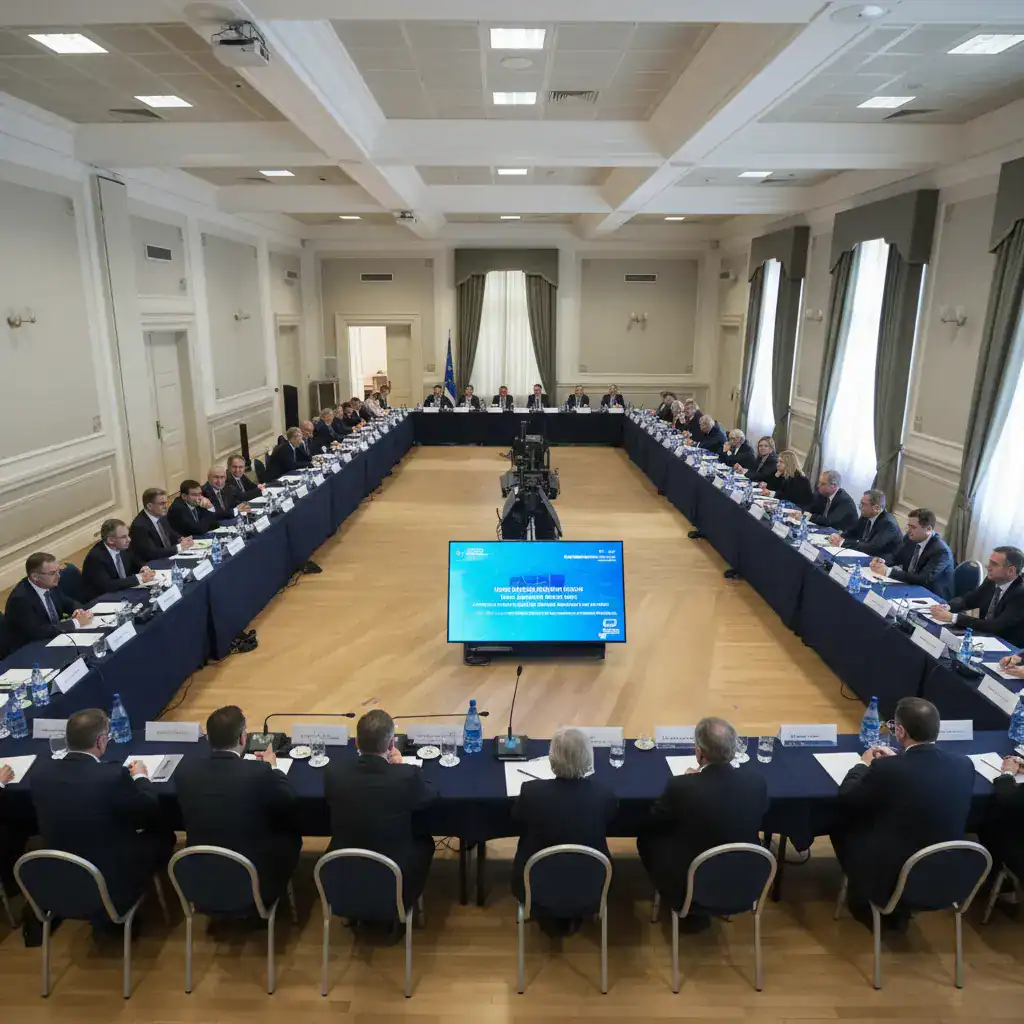
Athens Electricity Forum: Pushing for EU Electricity Market Integration Amid Geopolitical Instability
Athens, June 4, 2026 – Decision-makers, regulators, system operators, market participants, and representatives from European institutions convened at the Athens Electricity Forum yesterday, addressing the critical need for integrating the European Union’s eastern and southeastern neighbors into the single electricity market. This initiative gains particular urgency in light of ongoing geopolitical instability, making it a paramount pre-accession energy priority for the region, as highlighted by Artur Lorkowski, Director of the Energy Community Secretariat.
Energy ministers from the organization’s contracting parties affirmed their commitment to investments, reforms, and alignment with the European Union’s electricity market. However, they also voiced concerns regarding the uncertainties presented by the current form of the Carbon Border Adjustment Mechanism (CBAM).
Legal and Operational Frameworks Taking Shape
The Energy Community Secretariat confirmed that the legal and practical building blocks for electricity market integration with the EU are progressively falling into place. The Electricity Integration Package (EIP) serves as the legislative cornerstone of this process. Once fully transposed and implemented, it will enable contracting parties to initiate market coupling with the EU. Serbia, Moldova, and Montenegro are currently advancing through the legislation verification process, overseen by the Energy Community Secretariat and the European Commission, with several other nations nearing full transposition.
Concurrently, the operational framework is also progressing. Nominated electricity market operators (NEMOs) from the EU have drafted the Market Coupling Operator Integration Plan, a central framework for connecting contracting parties, which is soon to be submitted to the European Union Agency for the Cooperation of Energy Regulators (ACER).
CBAM Concerns and the Need for Flexibility
Despite these integration efforts, the forum emphasized that regulatory frameworks must evolve to unlock the flexibility essential for a renewables-based power system. Contracting parties are encouraged to assess future flexibility needs, enhance cooperation among system operators, regulators, and market participants, and advance cross-border infrastructure opportunities through the timely transposition and implementation of the TEN-E Regulation for Trans-European Networks for Energy.
A significant point of contention raised was the Carbon Border Adjustment Mechanism (CBAM). Participants reiterated that, in its current form, CBAM risks fragmenting markets. In the first quarter of the year, CBAM-related costs and regulatory uncertainty contributed to weaker price correlation, wider price spreads, and reduced cross-border electricity flows between the Western Balkans and the EU, disproportionately affecting renewable electricity exports. Concerns were raised that this mechanism is already weakening incentives for renewable energy projects.
Montenegro’s Historic Breakthrough and North Macedonia’s Reforms
Admir Šahmanović, Montenegro’s Minister of Energy and Mining, highlighted his country’s commitment to robust investments in renewable energy sources, transmission infrastructure, regional interconnections, and market digitalization. He stated, “The progress we have made in transposing the acquis from the Energy Integration Package represents a genuine breakthrough for Montenegro’s energy system – one that can rightly be described as historic.” Šahmanović emphasized that this process is not merely about legislative alignment but about fundamentally modernizing the energy sector to build a more stable, transparent, competitive, and resilient system.
Sanja Božinovska, Minister of Energy, Mining and Mineral Resources of North Macedonia, underscored that her country’s new Law on Energy is fully harmonized with EU regulations and obligations within the Energy Community. She noted, “This is not merely a formal transposition, but a substantive reform process that is already delivering tangible improvements in the functioning of the electricity market.” Božinovska added that these reforms signal to investors that North Macedonia is fostering a transparent, modern, and predictable market framework capable of supporting investments in non-fossil flexibility solutions, including energy storage, smart grid technologies, and demand-side response.
Serbia’s Decarbonization Challenges and EU Support
Dubravka Đedović Handanović, Minister of Mining and Energy of Serbia, addressed the challenges posed by CBAM to Serbia’s market coupling with the EU, especially since its full implementation at the beginning of the year. Given Serbia’s high reliance on coal for electricity generation, the country faces difficulties in meeting the exemption requirements until 2030.
Đedović Handanović stated, “Serbia’s commitment to ensuring energy security, investing in clean energy sources, and strengthening the energy grid demonstrates that we are ready to be a reliable partner in achieving shared European climate objectives and decarbonisation in a fair and sustainable manner.” She also emphasized Serbia’s need for support on this path, noting that as an EU candidate country and a leader in reforms among Energy Community contracting parties, Serbia has requested the European Parliament to consider expanding enhanced financial support for the region’s decarbonization efforts.
The forum concluded with a shared understanding of the complexities and opportunities involved in integrating the Energy Community into the EU’s electricity market, with a strong emphasis on fostering renewable energy and ensuring long-term energy security across the region.
Source: https://balkangreenenergynews.com/athens-electricity-forum-brings-energy-community-closer-to-eu-electricity-market-renewables-integration/