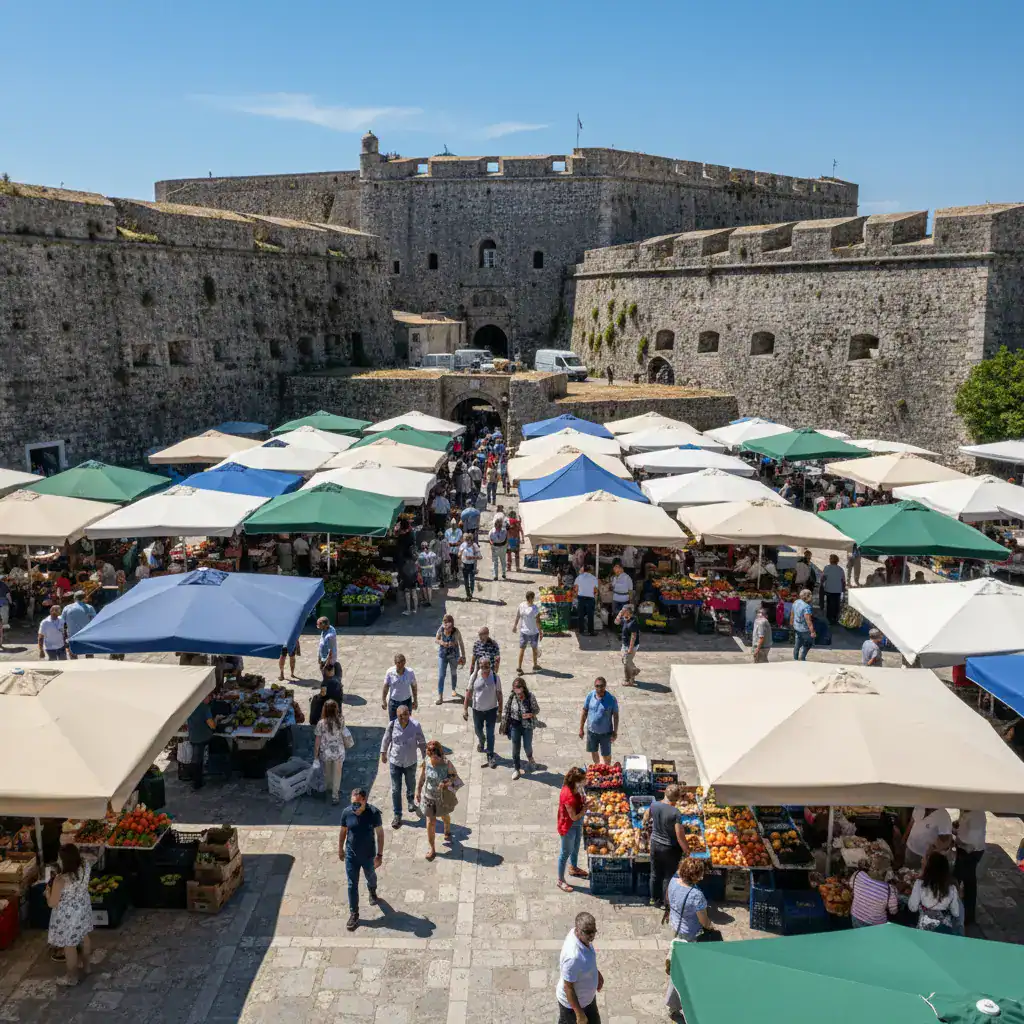
Corfu: MP Dimitris Biagkis Calls for Relocation of Open-Air Market from Historic New Fortress
Corfu, May 23, 2026 – Dimitris Biagkis, Secretary of the PASOK – KINAL Parliamentary Group and Member of Parliament for Corfu, has formally addressed the Minister of Culture regarding the urgent need to restore and promote the historic ‘Sarantaris’ bastion and the main trench of the western land front of the New Fortress. A key element of his proposal is the immediate removal of the open-air market from this monumental area and its relocation to a more appropriate site.
The Historical Significance of the New Fortress
The New Fortress of Corfu, constructed in the late 16th century by the Venetians, represents a monumental achievement in urban fortification. By the first half of the 18th century, a new defensive line had been established, effectively isolating the city of Corfu from the countryside and the sea. Situated near the commercial port, the New Fortress remains one of Greece’s most significant and well-preserved examples of 16th-19th century military architecture.
The western front features the two bastions of ‘Six and Seven Winds,’ connected by a curtain wall. The barracks were built at the highest level of the fortress in 1843.
Restoration Efforts and Ongoing Challenges
A restoration project for the southern wall of the ‘Seven Winds’ bastion, with a total budget exceeding 2.5 million euros, commenced in May 2023 and was expected to conclude by the end of 2025. This project aimed to document the existing condition, record pathologies and damages, and propose necessary interventions to preserve this crucial landmark of Corfu’s Old Town.
However, despite the elapsed timeframe, significant work, particularly regarding the backfilling of the bastion, appears to remain incomplete. Five months past its scheduled completion, the project’s status-whether it has been finalized, if a completion certificate has been issued, or when it will be definitively handed over to the local community-remains unclear. The local community has received no official updates on the matter.
Furthermore, the Ephorate of Antiquities had previously announced plans to extend the ongoing restoration work to the recently damaged ‘Six Winds’ bastion, which suffered a partial collapse. While temporary stabilization measures were taken, the substantive restoration of this bastion is still pending, awaiting further study, funding, and a clear timeline for implementation.
Current State of Degradation and Proposed Solutions
The area between the southern horn of Scarpone and the ‘Sarantaris’ bastion currently presents a disheartening and degraded scene. It has become an abandoned construction site, a dumping ground for waste, and a place of uncontrolled vegetation growth, severely undermining the aesthetic and functional value of this historic location. A structure within the main trench of the western fortifications, lacking any functional compatibility with the monumental site, further exacerbates the situation.
This site is not merely an old military work but a place of immense historical significance, marking the most critical moments of the Ottoman siege of Corfu in 1716. Here, the city’s defenders held their ground against the Ottoman army, preventing them from descending from Scarpone and encircling the defenders on the outer lines. This victory, written in blood, had profound implications not only for local history but for the balance of power across Europe.
Instead of comprehensive and rational interventions for the overall restoration of the main trench’s counterscarp (the only surviving part of the western fortifications after British redesigns), the local municipality is undertaking piecemeal repairs, such as installing new railings. These efforts are meant to address decades of neglect, as the area remains covered with makeshift construction fences from the period of the open-air market’s construction, accumulating waste and uncontrolled vegetation due to lack of access.
Any restoration efforts must respect the historical character of the monument, enhancing its image by completing missing stone elements, reinstating curved terracotta bricks in line with British parapet construction practices, and ensuring that new railings are morphologically compatible with the site, avoiding modern solutions that alter its character.
Long-Term Vision for the Site
The ultimate goal for the state should not be the perpetual presence of waste disposal areas, shacks, makeshift structures, and parking lots in this historically charged space. Instead, it should be the substantive promotion of this significant area. This cannot be achieved without relocating the open-air market from the monumental environment to a more suitable location, thereby allowing the historic monument to be returned to citizens and visitors as an organized pedestrian zone, featuring discreet paving, highlighting the fortification’s morphology, clear signage, and the creation of a commemorative monument or obelisk in honor of the defenders who fell protecting Corfu and European values. The praiseworthy donation from the Corfu Heritage Foundation for the historical event of the 1716 siege has yet to be utilized.
The protection and promotion of national monuments, alongside measures to safeguard cultural heritage and integrate urban monuments into the broader region’s attractions, are paramount. Corfu, as one of Greece’s most popular tourist destinations, with its Old Town recognized as a UNESCO World Heritage site, demands such dedicated efforts. The city’s monuments should be revitalized and integrated into the daily lives of both residents and visitors.
Ministerial Inquiry
MP Biagkis’s inquiry to the Minister of Culture includes the following specific questions:
- Has the contractual scope of the project “Stabilization and restoration of the ‘Seven Winds’ Bastion in the New Fortress of Corfu” been completed? Have the foreseen works been finalized, has the relevant completion certificate been issued, and has the project been handed over, or are works still pending (e.g., backfilling) despite the expiration of the completion deadline?
- What is the Ministry’s plan for the ‘Six Winds’ bastion, as it has not been fully restored after its partial collapse, and the definitive restoration of the monument remains pending despite temporary stabilization?
- Is the Ministry, in cooperation with local authorities, planning to initiate expropriation procedures and remove the building located within the main trench of the western fortifications, which severely degrades this historic site?
- Does the Ministry intend, in cooperation with local authorities, to undertake a comprehensive and correct intervention for the restoration of the main trench’s counterscarp of the New Fortress, as it constitutes the only surviving part of the western fortifications?
- Is it the Ministry’s intention, in cooperation with local authorities, to substantially promote this historically significant area by relocating the open-air market outside the monumental environment, thereby returning the historic monument to citizens and visitors as an organized pedestrian zone with discreet paving, highlighting the fortification’s morphology, and clear signage?
- Is it the Ministry’s intention, in cooperation with local authorities, to create a commemorative monument or obelisk in honor of the defenders who fell protecting Corfu and European values, utilizing the commendable donation from the Corfu Heritage Foundation?
Source: Corfu TV News