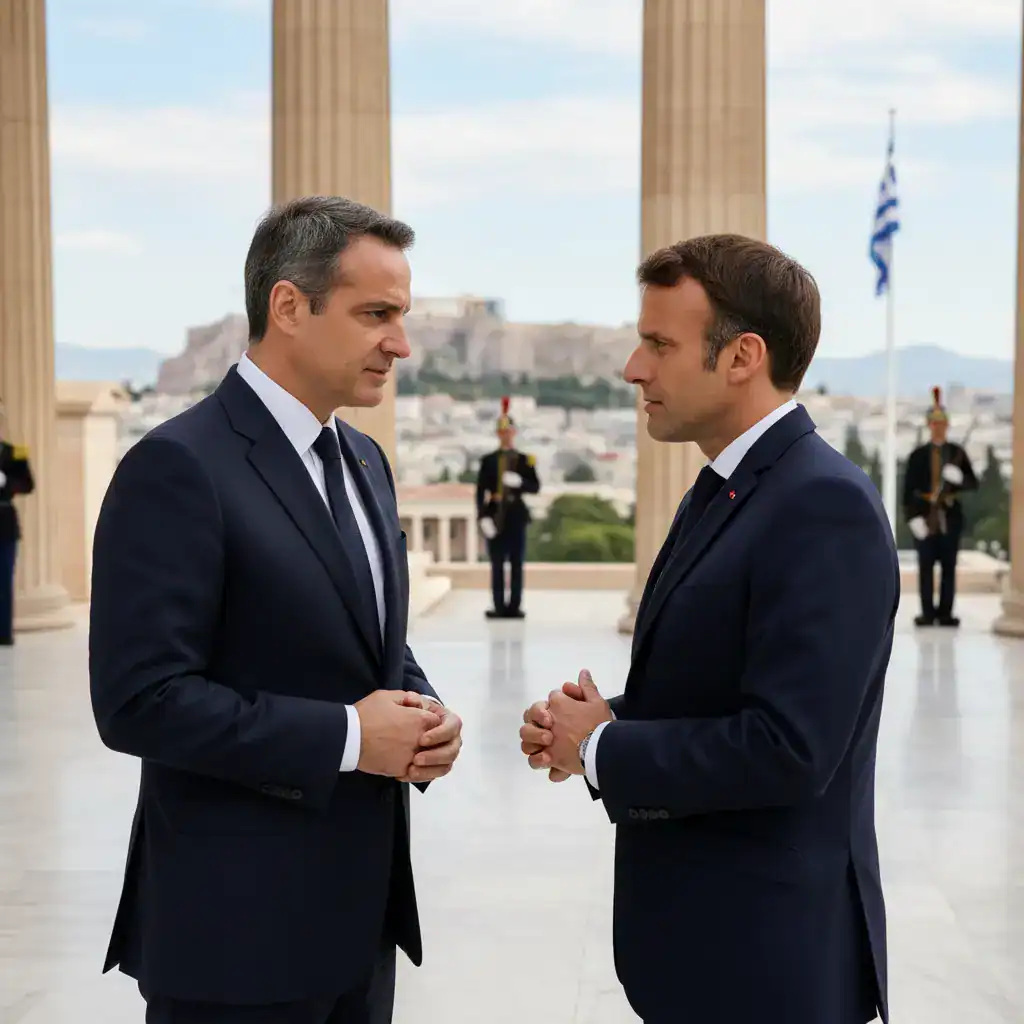
French President Emmanuel Macron’s anticipated visit to Athens, scheduled to follow the Cyprus Summit (April 23-24), signifies a crucial juncture in European defense and regional diplomacy. This high-profile meeting is poised to solidify the strategic alignment between Athens and Paris, particularly in the volatile Eastern Mediterranean, an area increasingly susceptible to the ripple effects of Middle Eastern conflicts.
A Shifting Geopolitical Landscape: The Need for European Autonomy
The backdrop to this intensified cooperation is a global political climate characterized by what analysts describe as the “unreliability and turmoil” of US foreign policy under “Trump 2.0.” This perception has fueled a growing imperative for European defense autonomy, pushing member states to explore more agile and flexible groupings, often termed “coalitions of the willing.”
Dr. Eleftheria Papadopoulou, a political scientist specializing in European security at the University of Athens, notes, “The current geopolitical fluidity, coupled with the slow pace of implementing a comprehensive European defense strategy among the 27 member states, naturally directs attention towards bilateral and multilateral frameworks of cooperation. Greece and France, with their shared strategic interests, are at the forefront of this evolution.”
Greece and France: A Reliable Partnership in a Volatile Region
Within the Greek government, there is a clear consensus that France stands as Greece’s most dependable partner. This conviction was forged during critical moments, such as the tense summer of 2020, when Greece and Turkey neared military confrontation near Kastellorizo, and more recently, with the deployment of the French aircraft carrier Charles de Gaulle off Cyprus amidst Iranian threats.
The upcoming visit is expected to culminate in the renewal of a bilateral defense agreement, incorporating an enhanced mutual assistance clause. This provision would obligate either party to provide support if the other’s territory comes under attack, underscoring the depth of their commitment to mutual security.
“This clause is more than symbolic; it’s a concrete manifestation of a shared understanding of regional threats and a proactive approach to collective defense,” states Professor Konstantinos Karamanlis, an expert in international relations from the Hellenic National Defence College.
Addressing Regional Challenges and Shaping European Defense Architecture
Beyond bilateral defense, Athens and Paris share a convergent vision on addressing broader EU challenges, including migration, energy independence, and regional crises in Lebanon, Syria, and Libya. Their shared strategic outlook is expected to be prominently featured in public statements following the Mitsotakis-Macron meeting.
A significant aspect of their discussions will revolve around the security of maritime navigation in the Strait of Hormuz. With the UK and France taking a leading role in exploring the formation of a capable naval force for this critical waterway, Greece’s potential participation has been a key point of discussion. While Athens has set the full cessation of hostilities involving Iran as an essential condition, diplomatic sources indicate that discussions are in their early stages, with a preference for a mission under the auspices of the EU or UN.
The failure to secure a UN Security Council mandate for the Hormuz initiative, due to objections from Russia and China, highlights the complexities of international cooperation and the increasing reliance on European-led solutions, exemplified by Operation ASPIDES, in which a Greek frigate is already participating.
The Cyprus Summit: Testing the Limits of European Solidarity
The forthcoming EU-27 summit in Ayia Napa, Cyprus, just kilometers from occupied Famagusta, will further test the boundaries of European solidarity. The territory of the Republic of Cyprus has recently served as a staging ground for a “coalition of the willing” model, involving Greek, French, Italian, Dutch, UK, and German contingents. This informal summit will focus on shaping a political framework based on the April 2024 conclusions, with Cyprus advocating for explicit references to EU energy security, particularly in light of Turkish intervention in the Greece-Cyprus electricity interconnection project.
According to Cypriot President Nikos Christodoulides, Athens and Nicosia effectively activated-at least partially-Article 42(7) of the EU Treaty on mutual defense assistance during these exercises. This raises the critical question of whether such flexible formations represent the future of European defense.
A seasoned diplomatic source, outlining Athens’ position, suggests, “By necessity, collective defense among the 27 and more flexible coalitions of willing states-those whose interests are directly affected in each case-will coexist, without undermining the general obligation of European solidarity.” This nuanced perspective acknowledges the practical realities of current European defense capabilities and the pressing need for immediate, adaptable responses to emerging threats.
A Forward-Looking Alliance
President Macron’s visit to Athens is more than a diplomatic formality; it is a strategic maneuver to bolster European defense capabilities and project stability in a region fraught with challenges. The deepening alignment between Greece and France underscores a growing European resolve to act decisively in safeguarding their interests and contributing to global security, even as traditional alliances face unprecedented strains.
The outcomes of these discussions, particularly concerning defense agreements and regional security initiatives, will undoubtedly resonate across Europe and beyond, signaling a new chapter in the continent’s pursuit of strategic autonomy and a more robust role on the international stage.
Source: https://www.tovima.com/politics/macrons-agenda-in-athens/