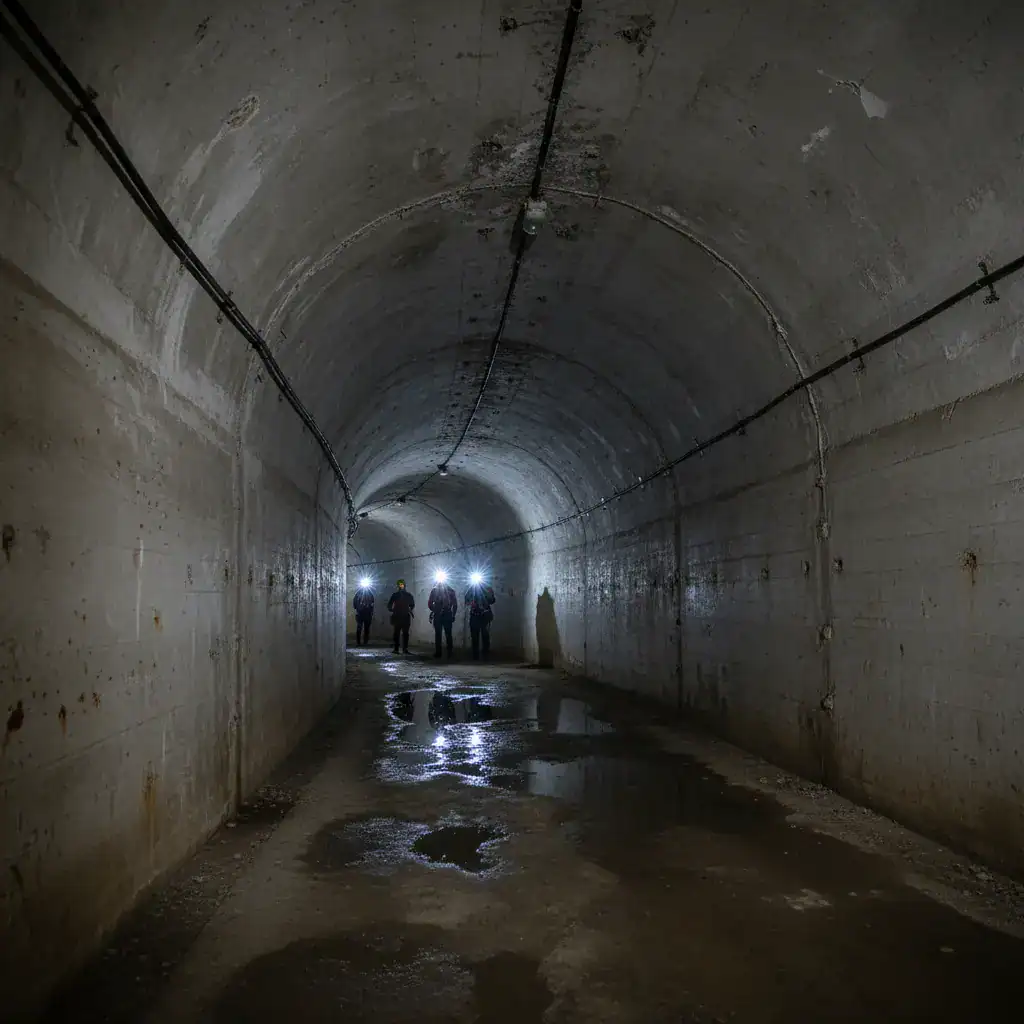
Underground Athens: Decades after they were built, many of Athens’ WWII-era air-raid shelters remain in place: silent, fragmented and largely forgotten.
Hidden beneath the now ubiquitous Athenian apartment blocks, sealed behind heavy doors or incorporated into public buildings, the Greek capital’s WWII-era air-raid shelters form a vast underground network that remains largely unknown to the public. Born out of the urgency of a pending war, this subterranean infrastructure is now something between historical relic and forgotten utility.
As researcher and author Konstantinos Kyrimis describes the structures, the shelters amount to “a city beneath the city… and we often walk above it without knowing.”
An Urgently Built Underground Network
The shelters were built in the lead-up to World War II as part of Greece’s civil defense preparations. By 1940, the greater Athens-Piraeus area reportedly had around 12,000 shelters, ranging from purpose-built bunkers to adapted spaces such as basements, caves and older structures. This extensive system reflected a highly organized approach to wartime preparedness at the time, integrating civilian protection into broader defensive planning.
Hundreds Remain
Today, the picture is far less clear. Estimates suggest only 2,000 to 3,000 shelters may still exist, though no comprehensive registry has ever been completed. “There are shelters that don’t appear in any records,” Kyrimis said, underscoring the lack of systematic documentation and oversight.
Many structures have been demolished, repurposed, or absorbed into modern buildings, leaving their original function effectively erased from public awareness. In fact, most surviving shelters no longer serve their intended purpose. Instead, they have been converted into storage rooms, archives or even wine cellars. Others have been abandoned entirely, their existence barely perceptible amid the fabric of everyday urban life.
“In many cases they’ve completely changed character,” he said, describing how war-time infrastructure has been quietly repurposed over eight decades of urban development.
Notable Surviving Sites
Despite widespread neglect, some shelters remain striking in scale and significance. One of the most notable is the large shelter at Ardittos Hill, next to the Panathinaiko stadium, capable of holding roughly 1,300 people and partially carved into rock.
Another key site is on higher Lycabettus Hill, which played an important role as an observation post in the city’s wartime defense system, effectively serving as the Greek capital’s “eyes and ears” during air raids.
Myths vs. Reality
Urban legends have long surrounded the shelters, particularly claims that they are interconnected through hidden subterranean tunnels. Kyrimis dismisses these “theories”: “I have visited many shelters, and none are connected to each other. That is more fiction than fact.”
Safety Concerns and Sealing Off Access
At the same time, conditions vary widely across the network. Some shelters remain structurally sound, while others are deteriorated or difficult to access. Due to safety risks and incidents of vandalism or misuse-including theft, the dumping of waste, or unauthorized habitation-many sites have been sealed off.
Beyond physical decay, Kyrimis highlights a deeper issue, as he opines: the absence of a modern civil protection culture. “A shelter is only 50% of preparedness,” he said. “The other 50% is training and awareness …During the war, residents knew exactly where to go and how to respond. Today, that knowledge has largely faded, leaving uncertainty about how such infrastructure would function in a real emergency.”
Beyond their defensive purpose, shelters once played a social role, bringing neighbors together under extreme situations. “They were places where people learned to cooperate and form a kind of community,” Kyrimis added.
Source: https://www.tovima.com/society/underground-athens-hidden-network-of-wartime-shelters-vid/