The aroma of aged stone, the whisper of centuries-old prayers, and the faint echo of Byzantine chants blend seamlessly with the vibrant life of Corfu’s Old Town. Designated a UNESCO World Heritage site, this labyrinthine city is a tapestry woven with architectural masterpieces and humble neighborhoods, grand monuments and narrow ‘kantounia’ (alleys), sprawling squares and winding staircases. Here, the azure of the Ionian Sea meets the pastel and reddish hues of ancient buildings, creating a unique atmosphere that captivates every visitor.
This distinctive blend is a testament to the profound influence of diverse European cultures that have shaped the island’s history. Nowhere is this more evident than in the multitude of churches that dot the cityscape, each a silent guardian of time, reflecting Corfu’s unique religious and artistic heritage. Unlike many other parts of Greece, Corfu never fell under Ottoman rule, remaining a free Christian land where religious expression flourished without oppression. This freedom is palpable in the sheer number of churches, seamlessly blending Byzantine and Catholic elements in their design and decor.
Beyond the well-trodden paths leading to the iconic Saint Spyridon Church, with its distinctive bell tower, the 17th-century Catholic Duomo in Town Hall Square, the terracotta-hued Metropolis or Spilaiotissa, and the former Anglican Church of Saint George within the Old Fortress, lie hidden treasures. These smaller, less-known churches offer a deeper dive into the island’s soul, each contributing its unique charm to the mosaic of Corfu’s Old Town.
Panagia Antivouniotissa: A Glimpse into 15th-Century Devotion
Following the coastal road in the ‘Mouragia’ area, with its breathtaking views of Vido island, a wide staircase leads to the summit of the outwardly simple Church of Panagia Antivouniotissa. This is the only surviving single-aisled basilica from the late 15th century, believed to have been completed around that time. Its most distinctive feature, typical of Corfiot churches of the era, is the exonarthex that encircles three sides, forming a serene and simple atrium where the bell tower is also attached.
During the Venetian rule, it was common for wealthy families to be benefactors, supporters, and even owners of churches. A 16th-century contract confirms this was the case for Antivouniotissa. The church also served as a burial ground, and today, one can still find large, carved tombstones on the floor of both the exonarthex and the main nave. Some bear embossed noble emblems, silently narrating how the church’s history is inextricably linked to the island’s own past.
In stark contrast to its austere exterior, the church’s interior boasts all the intricate elements that characterized Ionian churches of that period. High stalls, frescoes, and wood carvings create a captivating atmosphere, forming an impressive backdrop for the iconography, precious heirlooms, and portable icons displayed in the Byzantine Museum housed within the church. This museum offers a remarkable journey through five centuries of religious artistic expression, showcasing significant artworks and demonstrating how, despite the promotion of Catholic dogma, the Byzantine tradition remained vibrant in Venetian-ruled Corfu.
Saint Nicholas of the Elders: A Cradle of History and Resistance
Known as the church where Ioannis Kapodistrias was baptized in 1776, Saint Nicholas of the Elders served as the cathedral of the Great Protopapades until 1712. Its name is attributed either to its status as the oldest Saint Nicholas church in the district or because the Gerontia (Council of Elders) convened there. Its rich history continued into modern times, serving as the metropolis for Serbs who sought refuge in Corfu during World War I. During the German occupation in World War II, it became a clandestine meeting place for resistance members.
Today, the church’s interior preserves one of the oldest carved stone iconostases and hagiographies by Emmanouil Bounialis Tzannes and Michael Damaskinos. Among these, the icons of Saint Corfu, Saint Theodora, and Saint Metaleipsis stand out, offering a profound spiritual experience.
Pantocrator: A Testament to Enduring Faith
Consulting the map outside Saint Nicholas of the Elders, one can ascend towards Taxiarches Square, in the Kampielo district. Here, aristocratic families like Theotokis, Kapodistrias, and Kokkinis, established in the area since the 14th century, adorned the neighborhood with beautiful mansions and a church. Sadly, the original Church of Taxiarches Michael, a representative example of an Orthodox church from the Venetian period, suffered a devastating fire in 1545 and was completely destroyed during World War II.
Adjacent to the site of that lost church now stands the Holy Church of Pantocrator, built in a typical Ionian style. A 1.25-meter-high embossed angel at its apex, crafted by the Italian sculptor Toretti in the 18th century, is one of its distinguishing features, a tribute to the Archangel Michael. Here too, one can admire the exquisite work of Emmanouil Tzannes, who decorated the iconostasis with a depiction of the Pantocrator. For those visiting Corfu during Easter, note that the church’s Epitaphios procession begins at 2 PM on Good Friday.
Panagia Faneromeni or of the Foreigners: A Baroque Jewel in the City’s Heart
In a more central part of the Old Town, in the beloved ‘Plakada tou Agiou’ square, stands another church with a captivating history. Its soft yellow facade, the unique terracotta baroque bell tower, and its corner location opposite the Numismatic Museum make it instantly recognizable. It has stood there since the 17th century, built in 1690 by Epirots who fled to Corfu during the Ottoman rule. Dedicated to Panagia Faneromeni, it became known as Panagia ton Xenon (Our Lady of the Foreigners). A marble plaque above the church’s gate informs us that its construction was funded by contributions from Steriotes, Ioannites, Paramythians, and Dervinites.
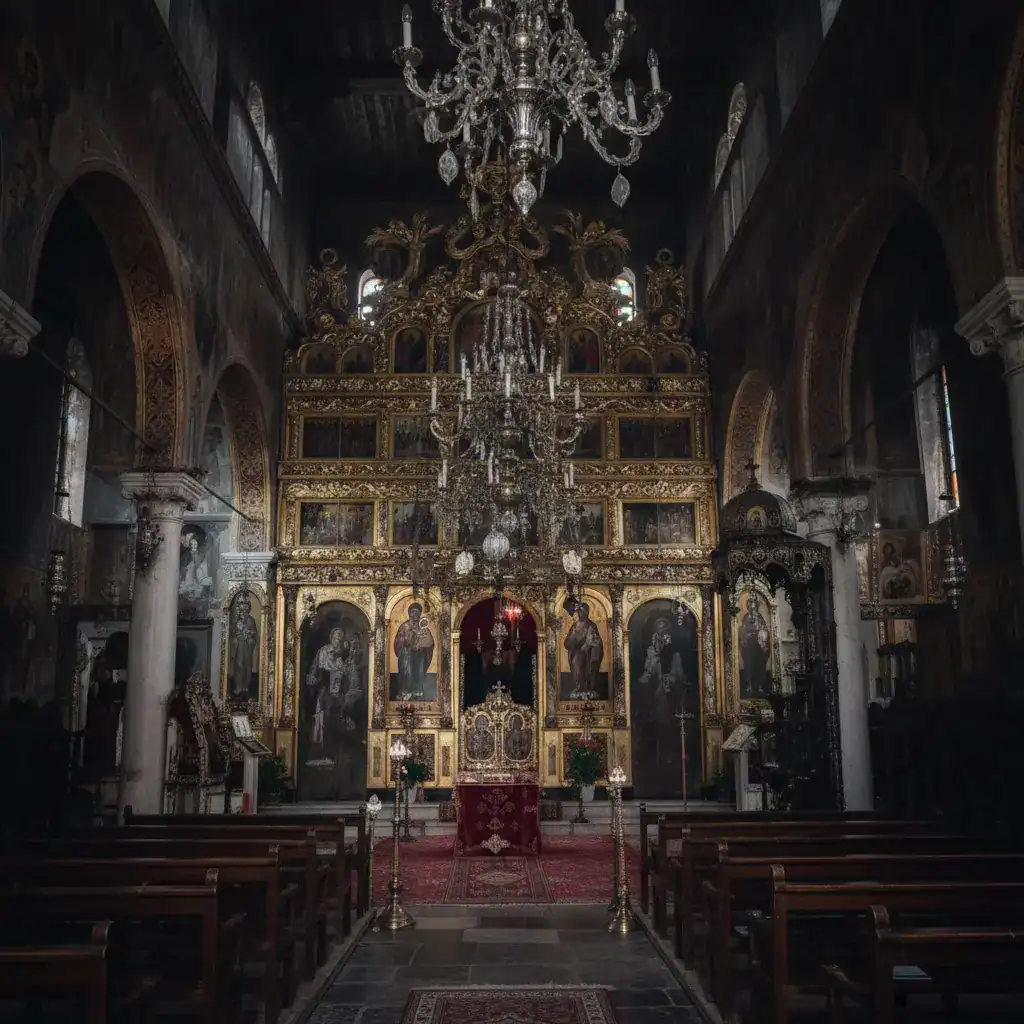
The interior of the three-aisled basilica is truly impressive, thanks to its exceptionally tall, gilded wooden iconostasis, also in baroque style, widely considered the most beautiful and ornate on the entire island. Its brilliance illuminates the entire interior, creating a magnificent contrast with the intensely blue ‘ourania’ (ceiling), which in turn is adorned with frescoes in golden frames. Do not miss the icon of Panagia Faneromeni, that of Prophet Elias, a work by the Corfiot painter Spyridon Prosalentis, and that of Saint George Foustanelas, a neo-martyr from Ioannina who refused to convert and was hanged by order of Kadi Pasha, a martyrdom depicted in his icon.
Saint John the Baptist: A Sanctuary of Noble Lineages
Directly opposite Panagia ton Xenon, lies another church rich in history and religious relics, and even older, having been built in 1480 by noble families of the island. Passing into the northern narthex, one can still see surviving, albeit incomplete, frescoes from the 15th-16th centuries. Looking down at the floor of this peculiar quadrilateral basilica, numerous funerary monuments from the Venetian era are easily discernible.
In the same area, the showcases of a small museum display priestly vestments, as well as the cross of the prominent Corfiot scholar Nikephoros Theotokis, who performed his priestly duties here. Other significant figures were also associated with the Church of Saint John, including Ioannis Kapodistrias, Dionysios Solomos, and Iakovos Polyilas, who worshipped here. As for the interior decoration, it is equally impressive, with an elegant iconostasis entirely crafted from marble, adorned with works by hagiographers from the Corfiot and Cretan schools.
These churches are but a glimpse into the splendid religious monuments that await visitors in Corfu’s Old Town. Explore also Panagia del Carmine, built in 1633 near the old Jewish quarter by Franciscan monks; Saint Eleftherios from 1700 in the ‘kantouni’ of Agios; the 18th-century Panagia Mandrakina with its vibrant colors and spectacular location; and the 8-century-old Saint Francis of Assisi, where the keys to the city were handed over to the Venetians. By visiting these sites, you will have touched a significant part of the rich culture and history of this unique place.
Source: Original reportage, interviews with residents of Corfu Old Town, archival materials from the Municipality of Corfu.