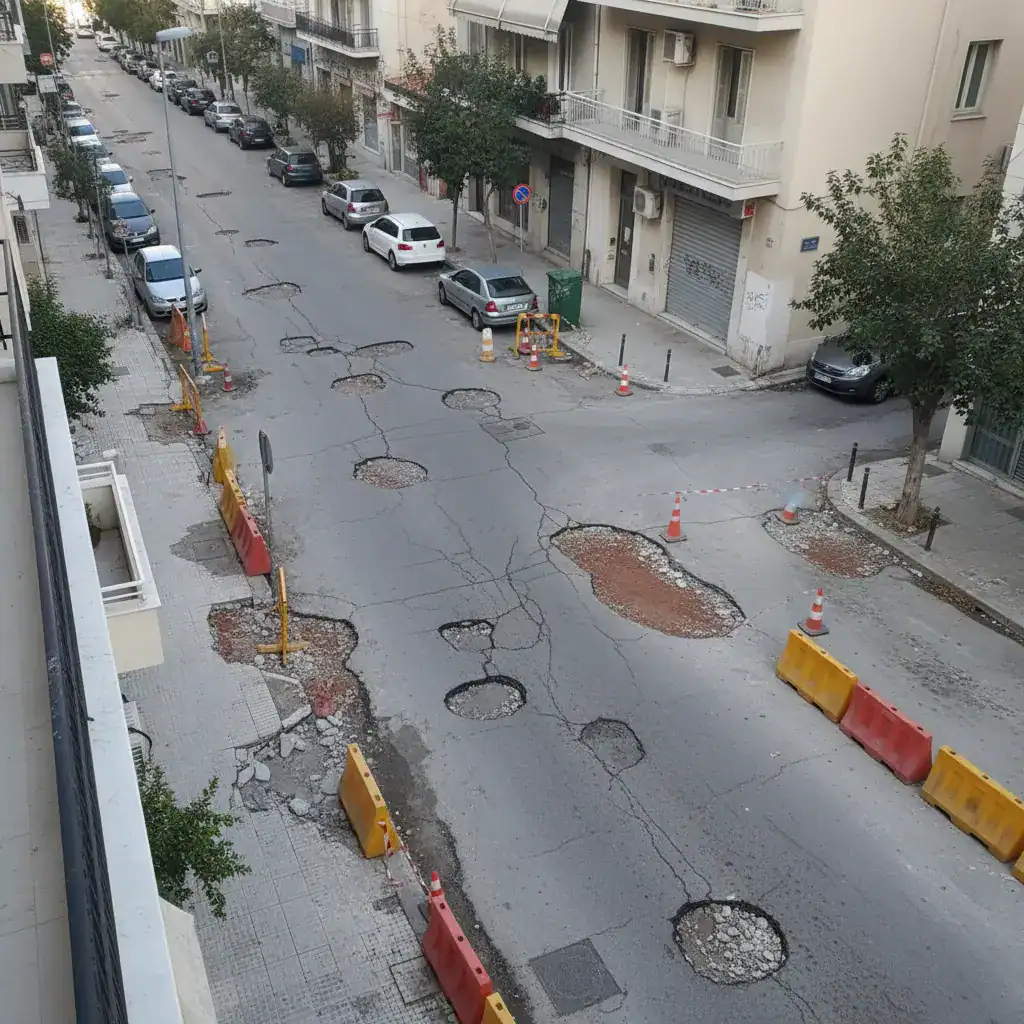
Athens, Greece – Residents across Greater Athens are increasingly frustrated by the proliferation of potholes and damaged sidewalks, a direct consequence of utility companies failing to properly restore roads after excavation work. Digital platforms and municipal offices are inundated with complaints as the city grapples with deteriorating infrastructure.
Utility Work Leaves a Trail of Damage
Utility crews, responsible for installing or repairing essential networks such as electricity, natural gas, and optical fiber, routinely dig up city streets. However, once their work is completed, the subsequent road restoration is often described as hasty and inadequate. This frequently results in uneven patches, sinking ground, cracked pavement, and broken tiles, leaving municipalities to bear the burden of repairs.
A recent incident in Glyfada at the intersection of Agamemnonos and Poseidonos streets highlighted the issue. After DEDDIE, the power distribution network operator, dug up the road for a new apartment building, an optical fiber was inadvertently destroyed. While a crew repaired the fiber, the road was left unrestored, leaving a significant pothole.
Municipalities Caught in a Regulatory Bind
Municipalities are in a difficult position. While any such work requires a municipal permit, local authorities have limited power to refuse, fearing public backlash from residents demanding essential services. Efforts by some municipalities to impose stricter restoration rules have been undermined by decisions from the decentralized administration, which represents the central state.
Panagiotis Charlaftis, deputy mayor for technical services, municipal property, and digital governance in Athens, stated, “We constantly receive complaints from citizens. They are obliged to follow technical specifications but they don’t. Now we have decided to hand out fines in hopes they will come to their senses under the threat of having their tax identification number blocked.”
The problem is exacerbated by the ongoing construction boom in the city, with new buildings requiring utility connections that necessitate fresh excavations on nearly every block.
Fines and Resurfacing Plans as Solutions
In response to the escalating issue, many cities have begun imposing fines on companies that fail to fully restore roads and surrounding areas. However, compliance remains challenging, as the actual work is often carried out by contractors rather than the utility companies directly.
The severity of the problem was underscored after recent rainfall, which exposed shoddy work and led to the opening of a two-meter-deep crater beneath a lamppost in Pangrati.
Mayor Georgios Papanikolaou of Glyfada revealed that he has been waiting 18 months for work on 25 roads to conclude before initiating a comprehensive €3 million resurfacing plan, which aims to cover 20 kilometers of roads.
The ongoing struggle highlights a critical need for improved coordination and stricter enforcement of restoration standards between utility companies and municipal authorities to ensure the long-term integrity of Athens’ urban infrastructure and the satisfaction of its residents.