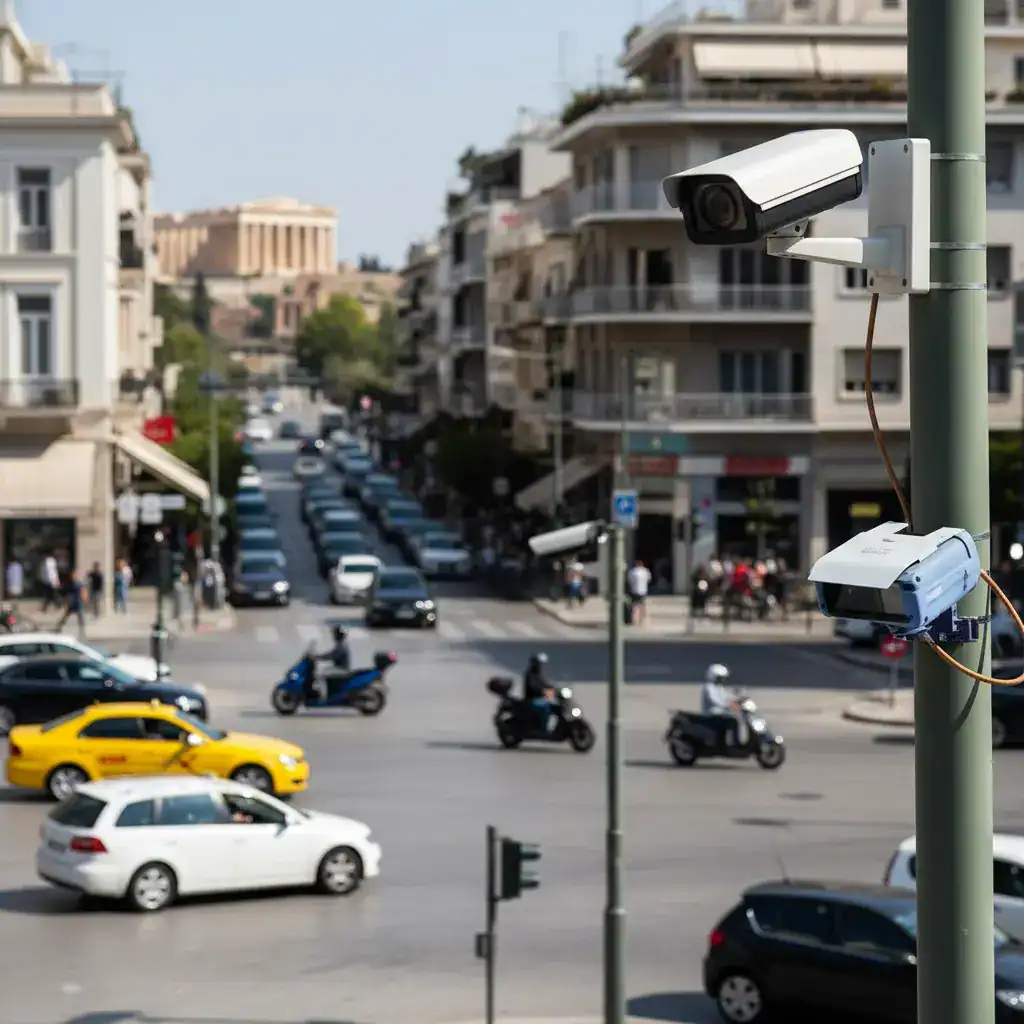
Several AI traffic cameras fitted on main routes in Athens have recorded thousands of traffic violations since their installation in December 2025. This advanced system aims to enhance road safety and enforce traffic laws more effectively across the city.
Thousands of Infringements Recorded in Early Weeks
Initial data reveals a significant number of violations. On Syngrou Avenue alone, between December 25 and January 28, over 10,000 infringements related to seatbelts and the use of mobile phones were documented. Additionally, more than 1,500 speeding violations were recorded on the same stretch of road.
In downtown Athens, the new cameras identified nearly 2,000 instances of running red lights within a mere three weeks. Furthermore, an alarming 32,000 violations were related to pedestrian crossings, highlighting a critical area for improvement in driver behavior.
Advanced Capabilities of AI Traffic Cameras
These “smart” cameras are designed to automatically detect a wide array of traffic violations. This includes, but is not limited to, running red lights, speeding, driving in bus-only lanes and emergency lanes, using a mobile phone while driving, and failing to wear a seat belt or helmet. They also monitor for illegal stopping and parking.
Unlike older CCTV systems that merely recorded footage, the new AI cameras analyze video in real-time using sophisticated deep learning algorithms. This allows the system to interpret what it sees by accurately identifying people, vehicles, and objects.
Automated Detection and Enforcement Process
The system leverages Automatic Number Plate Recognition (ANPR) to detect and log vehicle registration numbers. Trained algorithms then identify specific violations like speeding, running red lights, or mobile phone use. Once a violation is detected, the process becomes fully automated: the camera zooms in, captures photographic or video evidence, and digitally transmits the data for the issuance of a traffic ticket through the government’s gov.gr platform. In many locations, a dual-camera system with front and rear cameras ensures accurate driver identification.
Pilot Phase and Future Integration
The initial rollout involves a pilot phase, which is expected to continue at least until early March. During this period, the system is actively collecting data to improve its accuracy and refine its algorithms. Following the pilot, the cameras are slated to be connected to the new Unified Electronic System for Recording and Managing Traffic Violations, which is overseen by the Ministry of Digital Governance.
This integration will streamline the enforcement process significantly. Traffic fines will be served electronically, paid digitally, and automatically recorded in drivers’ penalty point records. Moreover, driving licenses will be suspended digitally without the physical seizure of vehicles, and unpaid fines after eight months will be forwarded to the tax authority for collection.
The regional governor of Attica conducted an on-site inspection of these newly installed ‘smart’ cameras on Poseidonos Avenue, underscoring the importance of this technological advancement in traffic management.