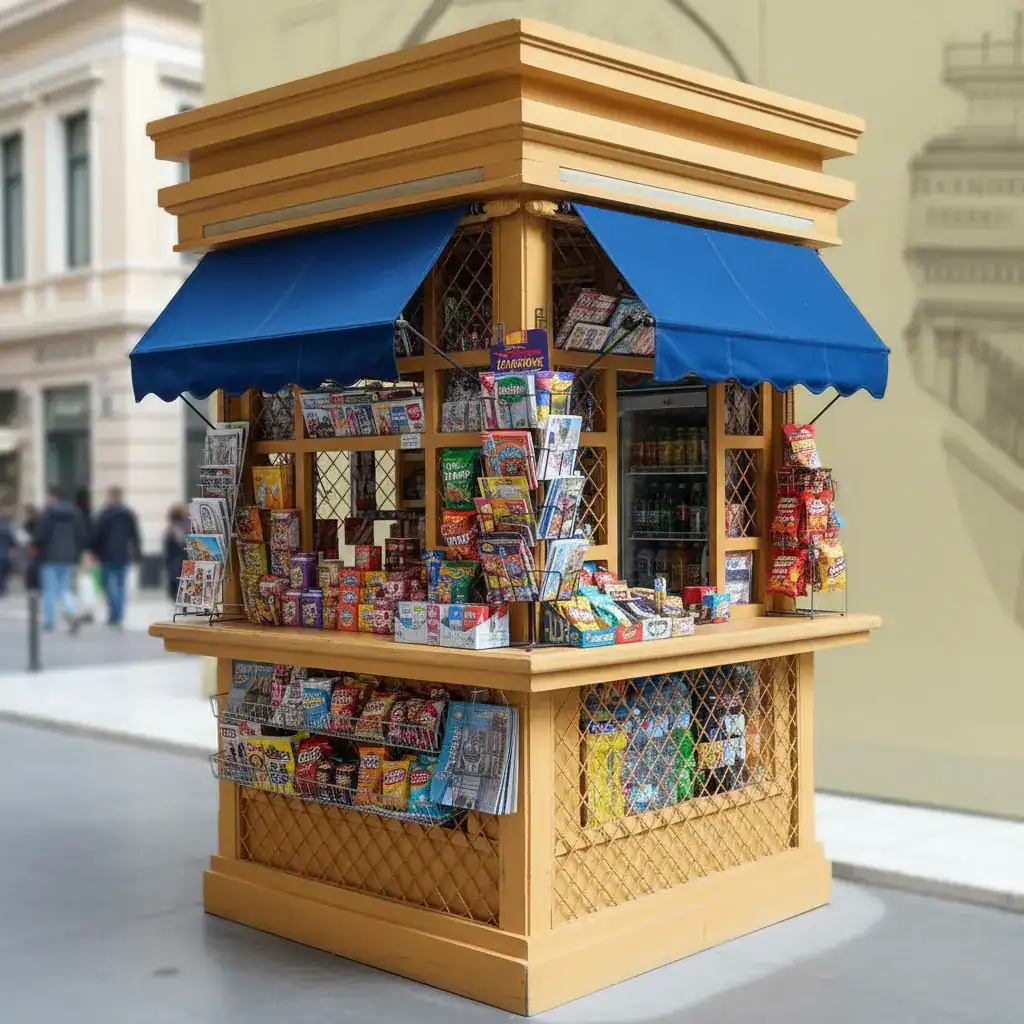
In the bustling heart of Athens, where ancient history intertwines with modern life, a quiet revolution of remembrance is unfolding. Visual artist Andreas Finch, with a meticulous eye for detail and a deep reverence for the city’s past, has embarked on a unique project: an exhibition that breathes new life into the humble, yet iconic, Athenian kiosk. These small structures, once ubiquitous symbols of daily life, now stand as poignant reminders of a bygone era, their stories brought to the forefront through Finch’s artistic lens.
The Genesis of an Icon: Kiosks in Athenian History
The first kiosks graced the streets of Athens in 1877, a mere few decades after Greece shed the Turkish yoke. The newly formed state, a vibrant mosaic of cultures and aspirations, was striving to forge its identity and gain international recognition. It was against this backdrop that Timoleon Filimon, then Mayor of Athens, introduced the first kiosk in Syntagma Square. A polygonal structure, imported from Switzerland and costing a hefty 15,000 drachmas, its purpose was primarily aesthetic – to “beautify” the city. Soon, others followed in Omonia, Vathis Square, and Varvakeios, weaving themselves into the very fabric of the Athenian landscape. From that moment on, kiosks became silent witnesses to the city’s tumultuous history, evolving alongside its people and bearing countless tales.
Andreas Finch: A Collector’s Passion Unveiled
Andreas Finch, a visual artist with a profound passion for collecting old Greek toys, realized a significant void in his extensive collection: the absence of a kiosk. This realization sparked a multi-year research endeavor, culminating in the current exhibition. “I relied on old photographs, postcards, and archival material that I had been collecting for many years, and this effort eventually led to the creation of the exhibition,” Finch explains. His work is a testament to the power of memory and the enduring allure of everyday objects. Through his art, he has transformed these forgotten structures into tangible links to the past, inviting viewers to reconnect with a shared heritage.
A “Game” of Memories: 20 Three-Dimensional Representations
The exhibition features 20 three-dimensional representations of actual Athenian kiosks, each meticulously crafted to a scale of 25 x 25 cm. Finch employs a diverse combination of materials, including plastic from a 3D printer, wood, balsa, and cement, to bring these miniature replicas to life. “This exhibition emerged after long-term research and presents the gradual course of Athenian kiosks from the beginning of the previous century to the present day, with emphasis on their historical, architectural, and folkloric evolution over time,” he tells TA NEA. Each model is a window into a specific moment in time, capturing the unique character and stories embedded within these seemingly ordinary structures.
Emblematic Kiosks and Their Untold Stories
Among the revived kiosks are legendary establishments such as the kiosk of the famous Koutalas on Vouliagmenis Avenue, where transactions were famously conducted using a long ladle. The small “Minion,” a precursor to the large department store on Patission Street, also finds its place in Finch’s collection. He also evokes the memory of the kiosk on Panepistimiou Street that tragically collapsed in 1997 during the construction of the metro. Finch also brings to light lesser-known gems, like “the blue kiosk on Karagiorgi Servias Street, which few remember today. It was built in 2000 and was blue with little stars on the roof,” he recounts. Perhaps one of the most intriguing stories is that of “The Muses” in Omonia Square. In 1934, when the Omonia electric railway station was moved underground, authorities decided to place kiosks at the base of eight ventilation shafts, adorning them with statues of the Muses on the roof. A humorous anecdote emerged from this architectural decision: with eight shafts and nine Muses, Calliope was left out, leading Athenians to jokingly associate her with the public toilets in the basement.
Kiosks as Mirrors of Society: Evolution and Identity
Andreas Finch emphasizes that “each kiosk is a different world. A kiosk in Perama sells completely different things and is set up in a completely different way from a kiosk in Kifissia. Kiosks reflect architectural evolution, social changes, and the needs of each era.” This observation underscores the profound connection between these structures and the communities they served. They were not merely points of sale but vital hubs of social interaction, reflecting the diverse needs and characteristics of different Athenian neighborhoods.
A Beacon of Greek Identity: The Enduring Legacy
Thanasīs Kappos, a journalist and author specializing in the history of Greek kiosks, aptly describes them as an “institution.” He asserts that despite challenges, they remain “a point of reference for Greece, ‘illuminating’ the streets of every city and village in every part of the country. A true beacon.” This sentiment echoes through historical accounts, such as an article by chronicler Sotiris Skipis in the SKRIP newspaper on October 20, 1919. Skipis lauded the Mayor’s decision to erect kiosks, envisioning them as an “ornament to the city,” a service to the public, and a source of livelihood for war-wounded veterans. Furthermore, he believed they would facilitate the spread of Greek printed matter – newspapers, magazines, and books – across the nation. Kappos notes that this historical perspective offers “a highly vivid depiction of the role of kiosks in Greece over the following 90 years.”
From Tobacco to Timeless Tales: The Evolution of Merchandise
Initially, kiosks functioned as small professional spaces with flexible hours, primarily selling tobacco products. However, they quickly expanded their offerings to include items of primary and secondary necessity. Newspapers, in particular, held immense importance in early 20th-century Greece. Published at least three times a day, they were a crucial source of information, often delivering “unpleasant” news that became an integral part of daily life, as reported by the newspaper EMPROS in 1956. That year, over 17,000 kiosks operated across Greece, with a significant concentration in Athens, Piraeus, and Thessaloniki, highlighting their widespread presence and essential role in society.
A Lifeline for Veterans: Kiosks and Social Welfare
A pivotal moment in the development of the Greek kiosk was the major military conflicts of the early 20th century. Following the Balkan Wars, a committee was established to support the families of fallen soldiers and war-wounded veterans. Special legislation was enacted, providing for the construction of kiosks in public and municipal squares, to be granted exclusively to these veterans. This initiative not only offered a means of livelihood but also integrated these individuals back into society. In September 1922, the Ministry of Welfare formalized this, stipulating that all existing and future kiosks would be granted for the exclusive use of the “Panhellenic Union of War Wounded 1912-1921.” Over the years, kiosks adopted a uniform appearance across Greece, featuring security shutters and refrigerators, solidifying their status as a basic necessity of Greek society.
The exhibition, organized with the support of OPANDA and curated by Art Place Kyriakos Petalidis, serves as a powerful reminder of the enduring legacy of these seemingly small structures. Through Andreas Finch’s art, the kiosks of Athens transcend their utilitarian origins, becoming vibrant storytellers of the city’s past, its people, and its evolving identity.
Source: https://www.tovima.com/society/kiosks-tell-the-story-of-athens/