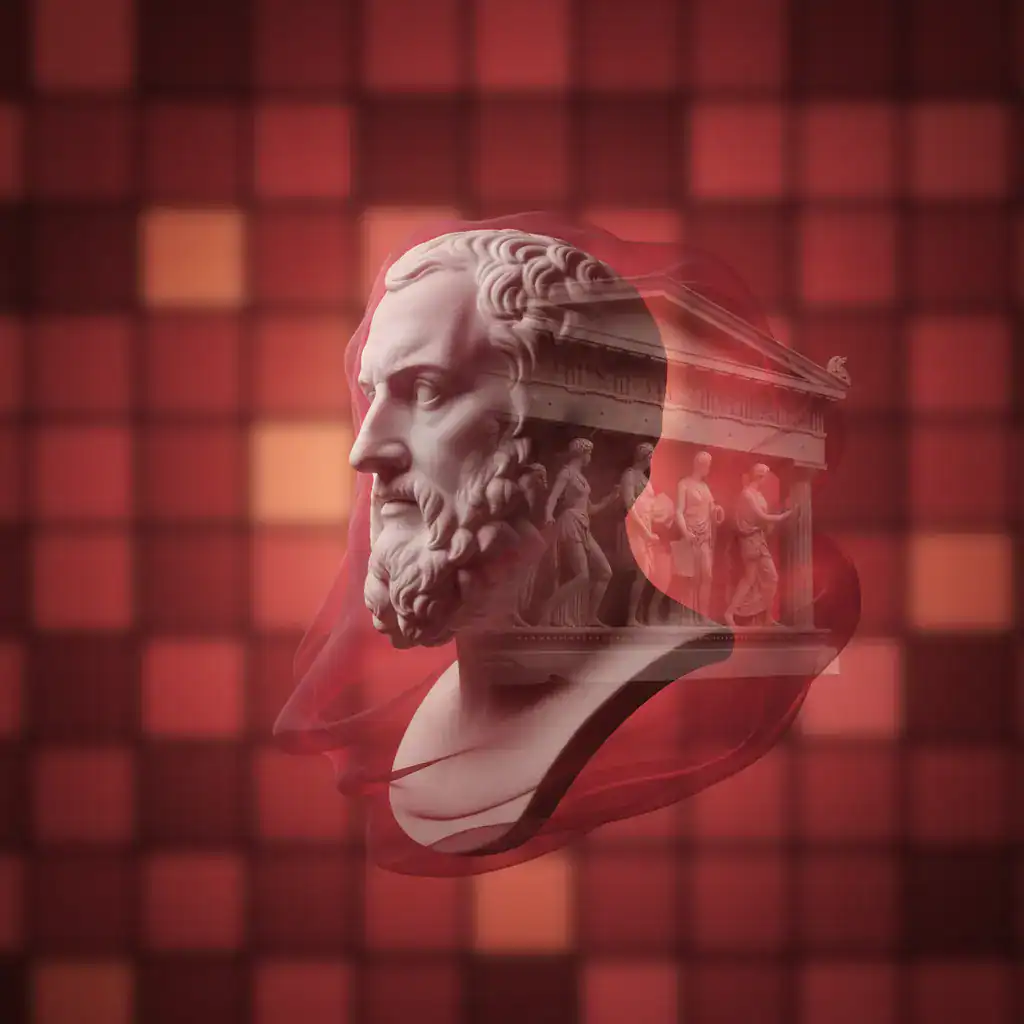
For Hegel, the reconciliation of nature and spirit is a fundamental characteristic of the Greek world. In his ‘Lectures on Aesthetics’, Hegel approaches art not as a mere aesthetic production, but as a historical form of the Spirit’s self-consciousness. Within this framework, Greek mythology, architecture, and sculpture constitute a unified spiritual reality, through which the Greek spirit becomes sensuously present even before philosophical conceptualization.
Greek Religion as ‘Religion in the Form of Art’
A central Hegelian tenet is that Greek religion is realized pre-eminently as Religion in der Form der Kunst (religion in the form of art). The Greeks approached the divine not primarily through abstract thought or dogmatic theology, but through sight and form. The divine became an object of experience through artistic embodiment. In contrast to Eastern religions, where the divine remains inaccessible, transcendental, and symbolically expressed through colossal or allegorical forms, the Greek religious experience is characterized by proximity, clarity, and human measure. The divine is not merely hinted at; it becomes present.
The Greek Temple: A Place of Divine Presence
According to the Hegelian interpretation, the Greek temple does not function as a symbol of the divine, but as a place of the actual presence of the god within the human world. The temple is the space where the spirit is objectified, acquires a concrete form, and becomes accessible to human experience, study, and understanding.
The architecture of the Greek temple is characterized by clarity of proportions, human scale, and harmonious integration into the natural environment. These elements express the reconciliation of nature and spirit, which for Hegel is a fundamental characteristic of the Greek world. The temple does not ‘show’ the god; it hosts him. It is the space where the divine becomes sensuously present without losing its spiritual dimension.
Interestingly, earlier scholarship on Greek temples often depicted them as brightly illuminated, rational, pristine spaces, a trope that largely reflects the ideals of the European Enlightenment rather than historical reality. However, recent studies, utilizing advanced 3D digital technologies and physically based lighting simulations, suggest that the interiors of temples like the Parthenon were generally quite dark and dim. This dimness, far from being a flaw, likely served to enhance the dramatic and mystical experience of encountering the chryselephantine statues within, with the occasional gleam of gold and ivory creating a profound sense of divine presence. The interior of the Parthenon, for example, was mostly dimly lit, with natural light accentuating outlines and spatial forms, making the golden deity emerge from the shrouding darkness. This nuanced understanding challenges long-standing beliefs and introduces a fresh perspective on Greek sacred structures, aligning them more with ‘mystical darkness’ seen in other ancient religious architectures. [cambridge.org](https://www.cambridge.org/core/journals/annual-of-the-british-school-at-athens/article/illuminating-the-parthenon/D0F077C96D199A00C5294CA6B41B42D1#article)
Greek Sculpture as the Culmination of Classical Art
Even more characteristic is the significance of Greek sculpture, which Hegel considers the culmination of classical art. In the statues of the gods, the divine appears in human form, not as a transcendental or terrifying power, but as a free, calm, and self-sufficient presence. The human form is not a mere representation, but the appropriate medium through which the spirit manifests sensuously. The tranquility, balance, and inner freedom exuded by classical statues express the reconciliation of spirit and nature. The divine is not presented as absolute transcendence, but as an ideal human form. Zeus is not depicted as an authoritarian despot, but as a majestic and calm presence; Apollo embodies measure, light, and clarity; Athena combines wisdom, strength, and political order.
The Parthenon Athena and Athenian Self-Consciousness
Of particular importance is the figure of the Parthenon Athena, which can be seen, from a Hegelian perspective, not merely as a mythological deity, but as an artistic embodiment of Athenian political and spiritual self-consciousness. In this case, art does not yet express abstract concepts, but makes the spirit visible through form. The city recognizes itself in the statue of its goddess.
Art and Philosophical Self-Consciousness
Consequently, for Hegel, Greek mythology is neither philosophy in the strict sense nor a simple fairy tale. It is artistically embodied in the Greek temple and in sculpture as a sensuous and objective form of the spirit. Before philosophical conceptualization, the Greek spirit knows itself through forms where the divine, the human, and the natural coexist in harmonious unity.
Greek art thus constitutes a necessary historical stage in the journey of the Spirit: the culmination of its sensuous embodiment and, at the same time, the limit beyond which the transition to philosophical self-consciousness becomes necessary.
Source: [athensvoice.gr](https://www.athensvoice.gr/politismos/more-in-culture/941045/hegel-kai-elliniki-istoria-arhitektonikis-kai-tehnis/amp/)