There are moments when current affairs, geography, and history align with such precision that an event acquires symbolism far greater than the sum of its parts. The recent recognition of Italian cuisine as Intangible Cultural Heritage of Humanity by UNESCO-the first time an entire national gastronomy has received this distinction-coincided with the arrival of Tuscany in Athens for a symposium dedicated precisely to what the international community has just affirmed: Taste as culture, memory, and identity.
A Symbiotic Relationship: Italian Cuisine as World Heritage
UNESCO’s decision to include Italian cuisine in the list of Intangible Cultural Heritage concerns something far broader than recipes. It encompasses the entire set of social practices, rituals, methods of transmitting knowledge, and bonds formed around the table. From family meals to local products and seasonal cuisines, Italian gastronomy is recognized as a living cultural ecosystem deeply connected to work, landscape, and daily life. This institutional protection against imitations also offers a powerful international footprint in gastronomic tourism, arriving at a moment when authenticity, locality, and sustainability are emerging as central values in global travel.
Tuscany’s Deliberate Choice: A Return to Shared Roots in Athens
Within this historic context, Tuscany’s choice of Athens gains special significance. Not only because Greece is considered the cradle of Western civilization, but because Tuscany’s identity itself has been built upon an ongoing dialogue with ancient Greek thought. From the Etruscans to the Renaissance, Tuscany has been a place of assimilation, interpretation, and creative continuity. The Symposium in Athens, organized by Toscana Promozione Turistica and Vetrina Toscana in collaboration with Greece Therapy and Electra Hotels Group, was designed as a cultural gesture: A return to shared roots, in a symbolic city, at the very moment Italian cuisine was receiving global institutional recognition.
A Four-Hands Symposium: Co-creation and Cultural Harmony
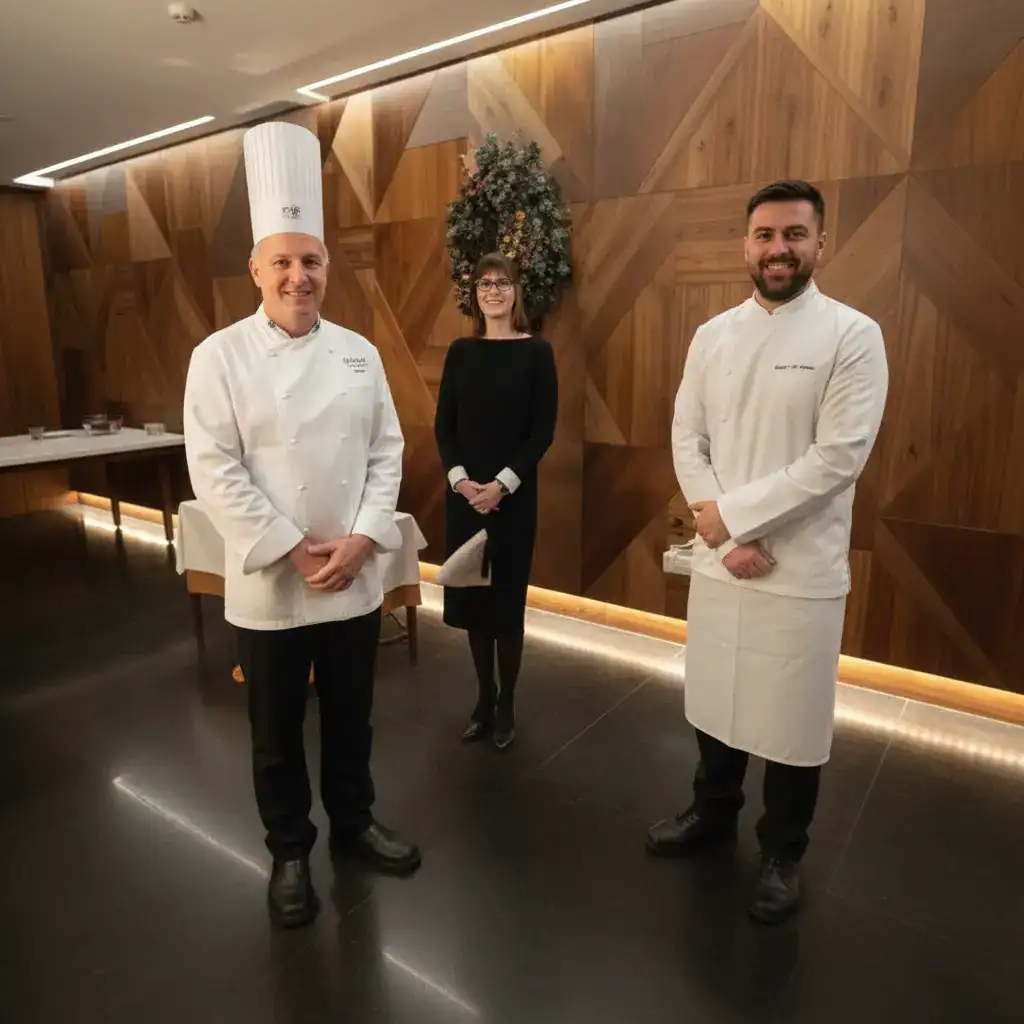
At the heart of the Tuscany Symposium in Athens was the idea of co-creation. Roberto Lodovichi, president of the Tuscan Chefs Association, and Greek chef Haris Zevgoulis did not present two separate cuisines placed side by side. Rather, they proposed a unified gastronomic dialogue where techniques, ingredients, and narratives were interwoven into an experiential menu built around the concept of harmony. Chef Lodovichi emphasized primordial ingredients, bringing the Etruscan world into the present with wheat as a central axis. Haris Zevgoulis approached Greek tradition with his characteristic creative lens, using both marine and land products of Greece as structural elements of a cuisine evolving without detaching from its roots.
A Taste Recital Under the Acropolis: A Culinary Journey
The first evening at Electra Metropolis Athens unfolded like a musical score. Chef Roberto Lodovichi opened with Garfagnana Protected Geographical Indication in cappuccino form, a statement dish connecting land, tradition, and contemporary presentation. Chef Haris Zevgoulis followed with handmade ravioli, Koilada prawns, wild fennel sauce, and Arta caviar, bringing the seas of the Ionian and Aegean to the table. The composition continued with chef Lodovichi’s handmade pasta from Mugello chestnut flour, filled with beef and served with a reduction of Vino Nobile di Montepulciano. Chef Haris Zevgoulis’ main course was slow-cooked lamb fricassee with wild greens, parsnip purée, and bulgur, where Greek cuisine spoke with confidence and clarity. The recital concluded with chef Zevgoulis’ desserts of caramelized apples, cinnamon, white chocolate, and green apple sorbet with cider, leaving a sense of balance and completion.
Francesco Tapinassi: Gastronomy as a Strategy of Identity
A central figure in Tuscany’s narrative is Francesco Tapinassi, director of Toscana Promozione Turistica. He views gastronomy not as an accompaniment to travel but as a core tool of international projection. As he stated at the Symposium, when Italians speak of Greece, they refer to the cradle of Western civilization. Tuscany, in turn, represents the Renaissance. These two worlds are not competitive but sequential and complementary. In recent years, Mr. Tapinassi has invested almost exclusively in gastronomy for Tuscany’s global promotion, not through tourist guides full of lists, but through experiences, actions, and networks. Abroad alone, Tuscany carries out around 15 targeted events, from Argentina and Canada to China and Japan, alongside numerous domestic initiatives within Italy.
Vetrina Toscana: Gastronomy as Cultural Policy and Soft Power
Vetrina Toscana is the institutional pillar upon which Tuscany builds its contemporary gastronomic identity. This regional program protects and highlights gastronomic heritage as a living part of local culture and the visitor experience. Approximately 2,200 businesses across the region participate in the Vetrina Toscana network, covering the entire gastronomic chain and adhering to a strict code of values prioritizing locality, seasonality, sustainability, and support for the local economy. The digital platform functions as a map of authentic experiences, enabling visitors to approach Tuscan cuisine not as a tourist product but as a cultural expression. Notably, only two restaurants worldwide currently operate exclusively with Vetrina Toscana products, with Athens already selected as the next international location. This strategy confirms that for Tuscany, gastronomy is not just part of its identity but a tool of soft power and international cultural presence.
When Taste Becomes Memory and Future
UNESCO’s decision to recognize Italian cuisine as intangible cultural heritage acknowledges a way of being-a culture that values seasonal rhythms, knowledge passed from hand to hand, and the importance of the table as a place of meeting, exchange, and memory. The Tuscany Symposium in Athens proved that this cultural heritage does not belong to the past. Under the Acropolis, gastronomy served as a shared code between two worlds historically in dialogue: Greece, the cradle, and Tuscany, the Renaissance. Not as nostalgia, but as a proposal for the future of travel, where authenticity outweighs speed and consumption becomes understanding. In an era where destinations seek ways to stand out without losing themselves, Tuscany invests in gastronomy to tell the world who it is. And it does so by choosing Athens-not accidentally, but consciously-as a place of return, symbolism, and continuity. This deeper meaning of UNESCO’s recognition highlights that cuisine, when faithful to its land, people, and time, requires no translation. It speaks for itself, becoming a living culture at the table, in experience, and in memory.
Source: https://tornosnews.gr/en/tourism-businesses/gastronomy/54743-tuscany-%E2%80%93-athens-a-cultural-symposium-coinciding-with-unesco%E2%80%99s-highest-recognition-of-italian-cuisine.html