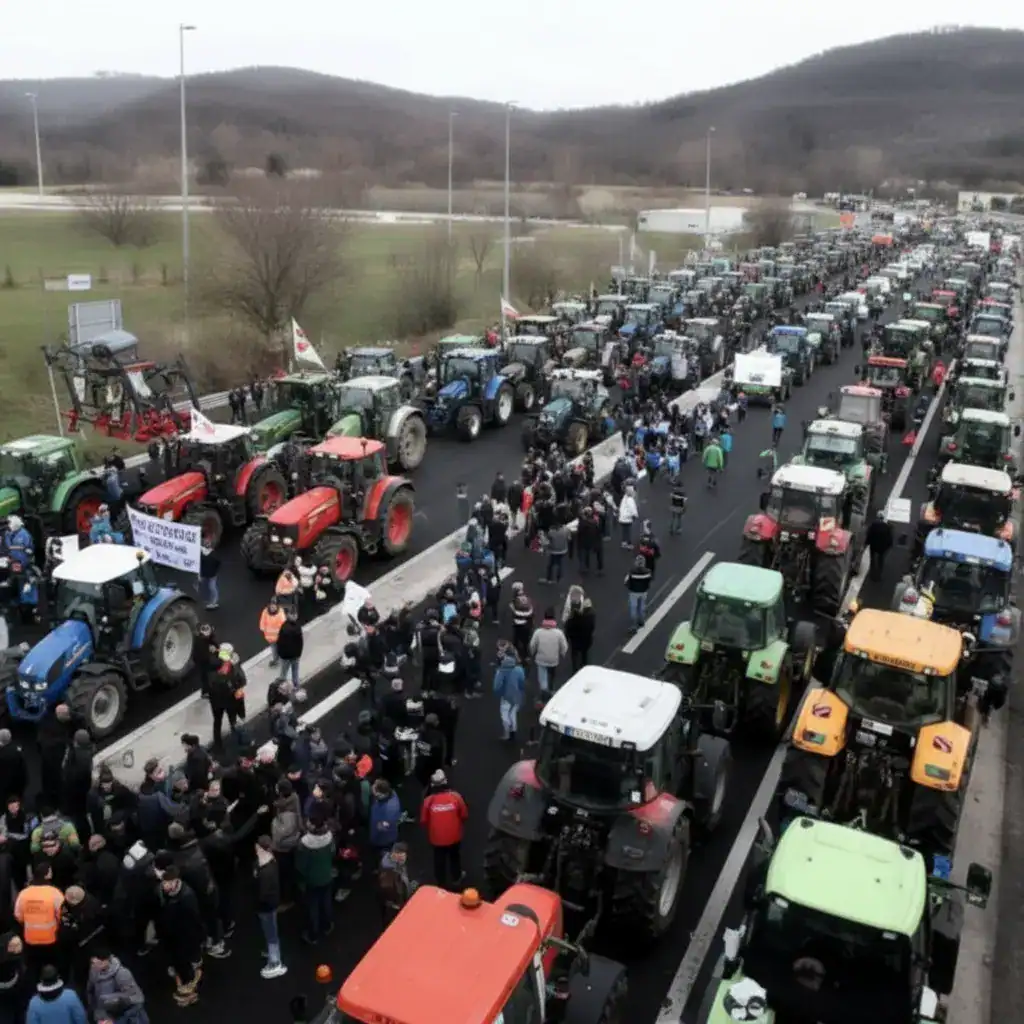
Farmers across Greece have significantly escalated their protest actions, leading to widespread disruption on the national highway network and at various customs posts. The latest wave of demonstrations, which began on Friday, December 5, 2025, has seen tractor convoys block crucial arteries from Western Macedonia in the north to Thessaly, Central Greece, the Peloponnese, and the islands to the south. Notably, an indefinite shutdown of Heraklion airport in Crete has been announced to commence from Monday.
Widespread Blockades Across the Nation
The impact of the farmers’ protests is being felt across nearly the entire country. At the Siatista tolls on the Egnatia Odos in Kozani, northern Greece, convoys of tractors originating from Kozani, Ptolemaida, Kastoria, and other parts of Western Macedonia have completely closed the highway to all vehicles. This has forced motorists to reroute onto older, parallel mountainous roads, causing significant delays and inconvenience.
Further west, blockades were established earlier on Saturday at the Angelokastro tolls in Aetoloakarnania and at Aktio. Farmers there negotiated passage with police as they advanced onto the national road network, signaling their determination to make their presence felt.
Thessaly has emerged as a major focal point of the protests, with more than 4,000 tractors gathering at the Nikaia junction on the E65 European route near Karditsa, and at the Longos tolls in Trikala. Organizers describe this as the country’s largest roadblock, underscoring the scale of the mobilization. These farmers are preparing for even tougher action from Monday, which is expected to include customs blockades and a significant effort to shut down the port of Volos. Final decisions regarding these actions are anticipated at a general assembly scheduled for Sunday.
On the Athens-Lamia highway, farmers managed to occupy the Mikrothives section in both directions, forming mile-long queues of tractors. This action followed their successful breach of a police cordon that had been put in place to prevent them from blocking traffic. The Bralos junction outside Lamia, north of Athens, is also under a farmers’ blockade, with over 100 tractors from Lamia, western and eastern Fthiotis, Amfikleia-Elateia, and Kamena Vourla converging on the route. In a symbolic act of protest, demonstrators burned straw and spilled milk at this location.
In Crete, the coordinating committee of farmers and livestock breeders has taken a drastic step, deciding to block Heraklion airport from Monday for an indefinite period. Producers from Lasithi are set to join this action, assembling in Pachia Ammos at 09:00 on Monday before proceeding in a convoy towards Heraklion. Despite adverse weather conditions, farmers in Achaia are maintaining three separate blockades, including one near Kato Achaia and a new one in Itea with more than 100 tractors. Protesters in these areas have repeatedly closed both the new Patras-Pyrgos highway and the old national road, while farmers from Aigialeia have taken to the streets at the Selinoundas bridge.
Pressure on Customs and Border Crossings
Customs posts are also experiencing significant pressure due to the protests. Blockades have been reported at key border crossings, including Kipoi, Exochi, Promachonas, Evzoni, Niki, and the Kalpakio junction, which leads to the Kakavia customs stations on Greece’s northern borders with Albania, North Macedonia, Bulgaria, and Turkey.
Despite the abolition of border controls with Bulgaria since its entry into the Schengen area at the beginning of 2025, disruption persists due to the farmers’ actions. At Promachonas, farmers have implemented a rolling blockade for five days, alternating between opening and closing the crossing for lorries. As a gesture of goodwill, they have allowed the gradual exit of over 170 trucks from Greece, but numerous others remain stranded on the Greek side of the border. While passenger cars and buses can generally pass through single lanes, and lorries carrying perishable goods are being permitted to cross, hundreds of other trucks remain immobilized near the Kipoi border and along the vertical axis of the Egnatia Odos highway in northern Greece.
Farmers’ Demands: Economic Survival at Stake
The core of these widespread protests lies in a set of economic demands that farmers’ unions assert are crucial for the survival of small and medium-sized agricultural holdings. Their key demands include:
- Immediate payment of delayed EU and national subsidies and compensation: Farmers are calling for the prompt disbursement of financial aid that they say is overdue.
- Lower production costs: They seek reductions in fuel, energy, and input prices to alleviate the financial burden of their operations.
- Targeted tax and social security relief: The sector is requesting specific measures to ease tax and social security contributions.
- Faster and fairer aid assessments: Farmers are demanding more efficient and equitable processes for evaluating and distributing aid.
- Reforms to the ELGA national insurance system: They aim for changes that would speed up payouts and provide better support, especially for livestock farmers affected by goat and sheep pox outbreaks and extreme weather events.
Government Response: Open to Dialogue, but with Conditions
Prime Minister Kyriakos Mitsotakis, speaking during a visit to Markopoulo in Attica, stated that the Greek government is open to discussions with the protesting farmers. He urged them to come to the negotiating table in an organized manner, with clear representatives and concrete demands. Mitsotakis emphasized that while the authorities would do their utmost to address the concerns, the protests should also consider the broader public interest.
Pavlos Marinakis, the Greek government’s spokesperson, highlighted that the administration has already put forward a plan for cheaper electricity for farmers over the next ten years. He also indicated that further reductions in power prices might be possible if a viable solution can be found. Marinakis underlined the government’s willingness to engage in discussions specifically with those who are facing the most severe problems within the agricultural sector.
The situation remains tense as farmers await a concrete response to their demands, with the threat of continued and intensified disruptions looming over the country.