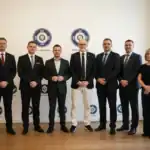
Athens, December 4 – The 2nd Athens Policy Dialogues, an influential conference examining the shifting dynamics in the Eastern Mediterranean, concluded on Friday after two days of intense discussions. Political leaders, diplomats, and security experts from Greece and abroad convened to address the region’s increasing volatility, a trend highlighted by events from the Arab Spring to the recent conflict in Gaza and the reverberations of Russia’s invasion of Ukraine.
Greece’s Geostrategic Role and Regional Volatility
The conference, themed ‘The East Mediterranean in Flux,’ was inaugurated on Thursday with an address by Greek President of the Republic Konstantinos Tassoulas. President Tassoulas emphasized Greece’s historical and cultural impact, alongside its critical geostrategic presence in the broader region. He highlighted Greece’s historical alliances in WWI and WWII, and its tragic role as the first battlefield of the Cold War (1946-49). Tassoulas also underscored the unresolved Cyprus problem as a dominant feature of Greece’s foreign policy interests.
The event was a collaborative effort, organized and hosted by the Delphi Economic Forum, The Council – Greece in Global Affairs, and the historic Athens weekly “To VIMA” (Το Βήμα). Prominent figures including Symeon Tsomokos, president and founder of the Delphi Economic Forum; Professor Athanasios Platias, president of The Council – Greece in Global Affairs; and Yiannis Pretenteris, publisher of “To VIMA,” welcomed attendees to a downtown Athens hotel.
Professor Platias characterized the Eastern Mediterranean as a ‘powder keg,’ drawing parallels with Southeast Asia and Ukraine. He stressed that the convergence of the Middle East, Africa, and Europe in this geographic region elevates the necessity for Athens to serve as a central hub for geopolitical dialogue.
Yiannis Pretenteris further elaborated on the complex ‘equation’ of the East Mediterranean, noting the competing claims over energy resources, ongoing energy exploration, maritime delineations, the significant presence of both super and regional powers, and the recent emergence of Chinese interests in the area. He stated that the two-day event aimed to comprehensively detail and explore the full spectrum of issues affecting the region.
Key Regional Developments and Greek Interests
The past 15 years have witnessed volatile and unpredictable developments across the Eastern Mediterranean rim. This period began with the Arab Spring in 2011, which led to the overthrow of Muammar Gaddafi in Libya and subsequent years of factional warfare. It also saw the rise and eventual replacement of a Muslim Brotherhood government in Egypt by current President Abdel El-Sisi. Syria endured nearly 14 years of devastating civil war, culminating in the abrupt collapse of the Assad regime and its replacement by a provisional government dominated by former Islamist rebels. More recently, the Gaza-Israel war erupted following Hamas’ surprise attacks in southern Israel on October 7, 2023.
For Greece, the Eastern Mediterranean has become a geostrategic field of immense importance. This is due to its significant potential for hydrocarbon exploitation, and its role as a crucial corridor for undersea power and data cables, pipelines, and maritime traffic. However, Greece’s interests often face strong opposition from official Turkey, particularly concerning the divided island of Cyprus. The stalemate since 1974 has resulted in an internationally recognized two-thirds of the island in the south, represented in the UN and EU, and a Turkish-occupied one-third in the north.
Greece also confronts Turkish intransigence in the delimitation of maritime zones. Turkey insists on a unilateral, often revisionist, interpretation of international law, while Athens maintains a steadfast position that any delimitation and interpretation must be based on the UN Convention on the Law of the Sea (UNCLOS).
Another crucial element in the current geopolitical ‘calculus’ is the strategic relationship that has developed between Greece and Israel, with the non-occupied two-thirds of Cyprus actively participating when invited.
The Athens Policy Dialogues served as a critical platform for addressing these complex issues, fostering dialogue, and seeking pathways toward stability in a region vital to global peace and security.
Source: https://www.tovima.com/politics/2nd-athens-policy-dialogues-focuses-on-the-eastern-mediterranean-in-flux/